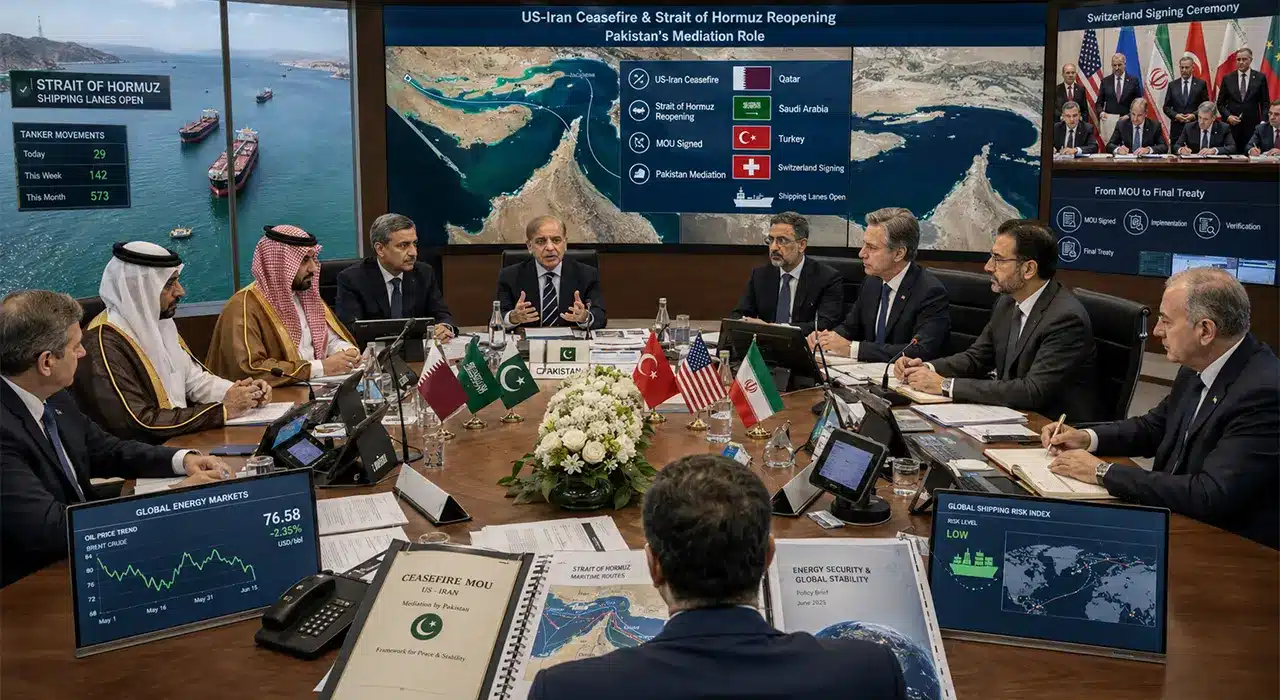



ISLAMABAD / VERSAILLES — In a historic diplomatic breakthrough, Prime Minister Shehbaz Sharif announced early Thursday that the United States and Iran have electronically signed the “Islamabad Memorandum of Understanding (MoU)”, bringing an immediate end to the military conflict that began in February 2026.
Under the direct mediation of Pakistan, the landmark interim framework was digitally executed by US President Donald Trump and Iranian President Masoud Pezeshkian, entering into force with immediate effect.
Just prior to this evenings dinner at Versailles in France, hosted by President @EmmanuelMacron—President @realDonaldTrump signed the Iran Memorandum of Understanding, once Secretary Rubio received it…
“A pretty key moment in history we are sharing together…” @SecRubio pic.twitter.com/sLYi6G9TM3
— Dan Scavino (@Scavino47) June 17, 2026
Key Terms of the Islamabad MoU
| Trigger Provision | Immediate Action |
| Strait of Hormuz | Iran will instantly reopen the crucial waterway to commercial shipping, allowing transit traffic to return to pre-war levels within 30 days. No transit fees will be charged for 60 days. |
| Naval Blockade | The United States will immediately lift its naval blockade of Iranian ports. |
| Economic Sanctions | Washington commits to immediately waiving oil, banking, and insurance sanctions, allowing Iran to resume unrestricted oil exports. |
| Nuclear Framework | Iran will maintain a freeze on its nuclear program and dilute its enriched uranium stocks via on-site down-blending under IAEA supervision. |
| Reconstruction Fund | Upon a final comprehensive agreement, a regional-backed $300 billion reconstruction fund will be facilitated alongside the release of frozen Iranian assets. |
The Diplomatic Execution
The remote digital signing bypasses the initially scheduled physical event in Switzerland. President Trump put his final signature on a physical copy of the text during a G7-related dinner at the Palace of Versailles alongside French President Emmanuel Macron.
“Just signed it,” Trump told reporters as he departed Versailles. He later noted that securing the reopening of the Strait of Hormuz was paramount: “If we didn’t do this deal… you would never have the Hormuz strait open.”
Meanwhile, Iranian Foreign Ministry Spokesman Esmaeil Baqaei confirmed the text was fully finalized with President Pezeshkian’s signature. While the formal Swiss signing ceremony is cancelled, technical-level stabilization talks will proceed at the Buergenstock resort in Switzerland to hash out a final treaty within a 60-day window.
✍️ Iranian President Masoud Pezeshkian signs memorandum of understanding between Tehran and Washington, with US President Donald Trump’s signature visible on document pic.twitter.com/E9EY8kz99O
— Anadolu English (@anadoluagency) June 18, 2026
High Praise for Pakistan’s Mediation
Prime Minister Shehbaz Sharif took to X to congratulate both leaderships, praising President Trump’s “steadfast commitment to diplomacy” and thanking Iran’s Supreme Leader Ayatollah Mojtaba Khamenei and President Pezeshkian for their statesmanship.
The premier gave special recognition to Pakistan’s Chief of Defence Forces (CDF) and Chief of Army Staff, Field Marshal Asim Munir, highlighting his “tireless efforts and instrumental role” in bridging the gap between Washington and Tehran. He also acknowledged the vital diplomatic support provided by Qatar, Saudi Arabia, Türkiye, and Egypt.
Separately, President Asif Ali Zardari warmly welcomed the agreement from the President’s Secretariat:
“The conflict inflicted immense suffering and severely disrupted global energy supplies and economic stability. Pakistan has played a principled, balanced, and constructive role throughout this crisis… War brings nothing but destruction and misery. Peace is the only path to progress.”
The agreement establishes a 60-day implementation period where both nations must maintain the military status quo, freeze new deployments, and refrain from hostile actions while negotiators finalize a comprehensive peace treaty.