



ISLAMABAD — Pakistan’s Commissioner for Indus Waters Syed Muhammad Mehar Ali Shah declared on Tuesday that adherence to the 1960 Indus Waters Treaty (IWT) is a core component of the state’s “survival architecture,” warning that unilateral attempts to alter the accord convert natural hydrological risks into manufactured security vulnerabilities.
Speaking at a high-level legal and political seminar in Islamabad, Shah stated that water stability directly dictates Pakistan’s economic survival. With the lives of more than 240 million people tied to the Indus basin, over 80 percent of the country’s arable land relying on these flows, and agriculture contributing nearly a quarter of national GDP, any disruption to the treaty constitutes an existential threat.
Indus Waters Commissioner Meher Ali Shah, speaking at the IWT 2026 Seminar, highlighted the Indus Waters Treaty as a key conflict-prevention mechanism sustained by the Permanent Indus Commission. He stressed its operational effectiveness over political debate, warning that… pic.twitter.com/WJLc1OKsbw
— Khawaja Yaseen Usmani (@YaseenUSM_Offl) June 30, 2026
The Geopolitical and Geographic Split
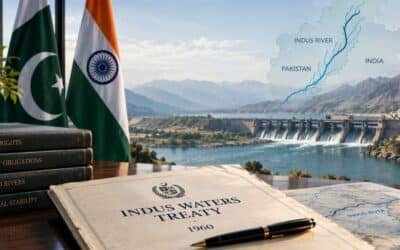
The 1960 treaty, brokered by the World Bank, established a strict legal framework that converted a disputed territorial waterway into a structured system of mutual rights and obligations.
Under the original bargain, the three Eastern Rivers were allocated to India, while the three Western Rivers were assigned to Pakistan, subject to strictly defined upstream exceptions. Pakistan rebuilt its entire agricultural and irrigation infrastructure around the permanent guarantee that these western flows would remain unhindered.
Key Legal and Operational Milestones
The current impasse stems from India’s decision last year to place its treaty obligations in “abeyance”—a move triggered by an attack on tourists in Pahalgam that New Delhi blamed on Islamabad without offering evidence.
The historical and legal timeline highlights how structural mechanisms are breaking down:
- Western River Disputes (Year 2000)
India begins physical work on a series of controversial run-of-the-river hydropower projects on the western river systems, sparking persistent bilateral discord. - Court of Arbitration Invoked (Year 2016)
Pakistan requests a comprehensive interpretation of the treaty provisions governing Indian infrastructure developments on the western systems. - Institutional Paralysis (May 2022)
The Permanent Indus Commission holds its last official meeting. No general or special tours of inspection have occurred since. - Abeyance & First Legal Award (Year 2025)
Following the Pahalgam incident, India declares the treaty in abeyance. Concurrently, the Court of Arbitration issues its first award regarding the treaty’s framework. - Second Binding Court Award (May 2026)
The Court of Arbitration issues a second major award, confirming that India’s non-appearance cannot paralyze proceedings, its abeyance stance does not clear it of liability, and the rulings remain final and binding. - Chenab River Fluctuations (June 2026)
Pakistan notes significant, unexplained water flow fluctuations in the Chenab River for the fourth time since last year. Technical requests sent to New Delhi receive no response.
Strategic Hazards and Data Failure
Commissioner Shah emphasized that data-sharing is not a diplomatic courtesy but an absolute operational necessity. Since August 2023, corresponding monthly hydrological data from India has remained outstanding.
Without this data, downstream engineers are forced to guess whether low flows or sudden surges are natural climate variations or upstream manipulations. This information vacuum shrinks flood forecasting windows and compromises the structural management of Pakistan’s major barrages and reservoirs.
“Pakistan’s restraint has been deliberate. But water, food, livelihood, and social stability are not negotiable abstractions; that is why Pakistan has publicly defined the strategic threshold for any attempt to stop and divert the treaty water belonging to Pakistan.”
— Indus Waters Commissioner Syed Muhammad Mehar Ali Shah
An Inalienable Right to the Indus
Information Minister Attaullah Tarar opened the seminar by reinforcing that the 240 million citizens of Pakistan possess an inalienable, historical right to the Indus River system, noting that the ancient Indus Valley civilization defines the very identity of the nation.
Tarar fiercely contested New Delhi’s “abeyance” posture, pointing out that an international treaty signed under the auspices of the World Bank cannot be amended, suspended, or revoked unilaterally. He stated that India’s attempts to weaponize water flow or alter established rules have resulted in international embarrassment at various legal forums, emphasizing that Pakistan remains resolved to protect its water rights through all international legal channels.