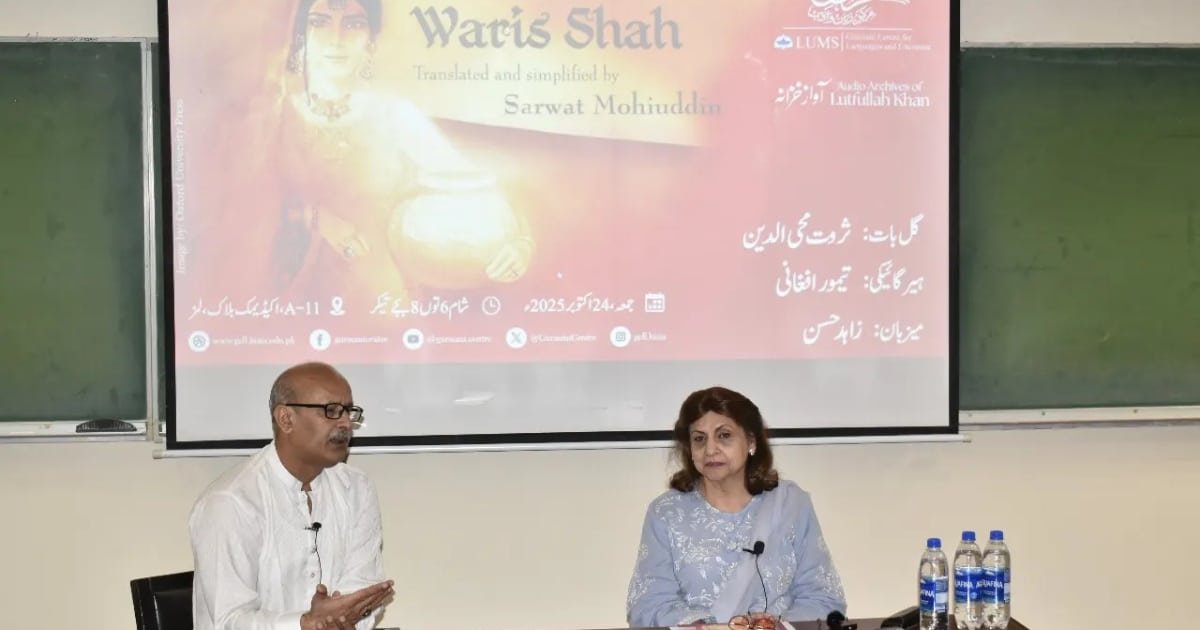





The story of Heer and Ranjha is not merely a tragedy of star-crossed lovers; it is an epic that chronicles the heart, history, and rebellion of Punjab. Recent high-profile literary events have affirmed its continued power, cementing Waris Shah’s masterpiece as a vital text for understanding contemporary South Asian identity and resistance.
This enduring relevance was highlighted at the 10th Adab Festival (AdabFest) 2025 in Karachi, and reinforced by a dedicated academic session at the Lahore University of Management Sciences (LUMS) in October 2025.
The New Reading: Heer, The Woman of Today
The Adab Festival brought the epic’s feminist core to the fore in the session “Heer: The Woman of Today. Celebrating Waris Shah’s Masterpiece.” Literary commentator Sarwat Mohiuddin and singer Usama Israr Ahmed emphasized Heer’s character as a figure of audacity and agency.
While the musical performance stirred the soul, the core message was clear: Heer’s willingness to defy customs, family, and fate makes her an archetype of modern resistance. She is revered not for her sorrow but for the unyielding dignity with which she fought for her choices, a theme that deeply resonates with women challenging patriarchal norms today.
View this post on Instagram
LUMS: Unpacking the Literary and Political Roots
The academic seriousness behind this cultural revival was best encapsulated by the session at the LUMS Gurmani Centre for Languages and Literature in October 2025. This event celebrated the launch of the English translation of Heer – Waris Shah by acclaimed poet Sarwat Mohiuddin.
This translation is the sixth volume in the Literary Heritage Series for Young Readers, an initiative dedicated to foregrounding Punjabi’s intellectual and aesthetic centrality by making foundational texts accessible to new audiences.
The session, moderated by Zahid Hassan, opened with a rare archival rendition of Heer on the sarangi by Ustad Nathoo Khan from the Lutfullah Archive, a premier repository of Pakistan’s aural heritage. This immersive experience rooted the poetry in the vibrant sonic universe from which it sprang.
A crucial part of the discussion focused on the systematic suppression of the Punjabi language under British colonial rule. They noted the deliberate destruction of Punjabi qaidas (primers), which constituted an act of epistemic violence, severing the language from its intellectual and pedagogical roots.
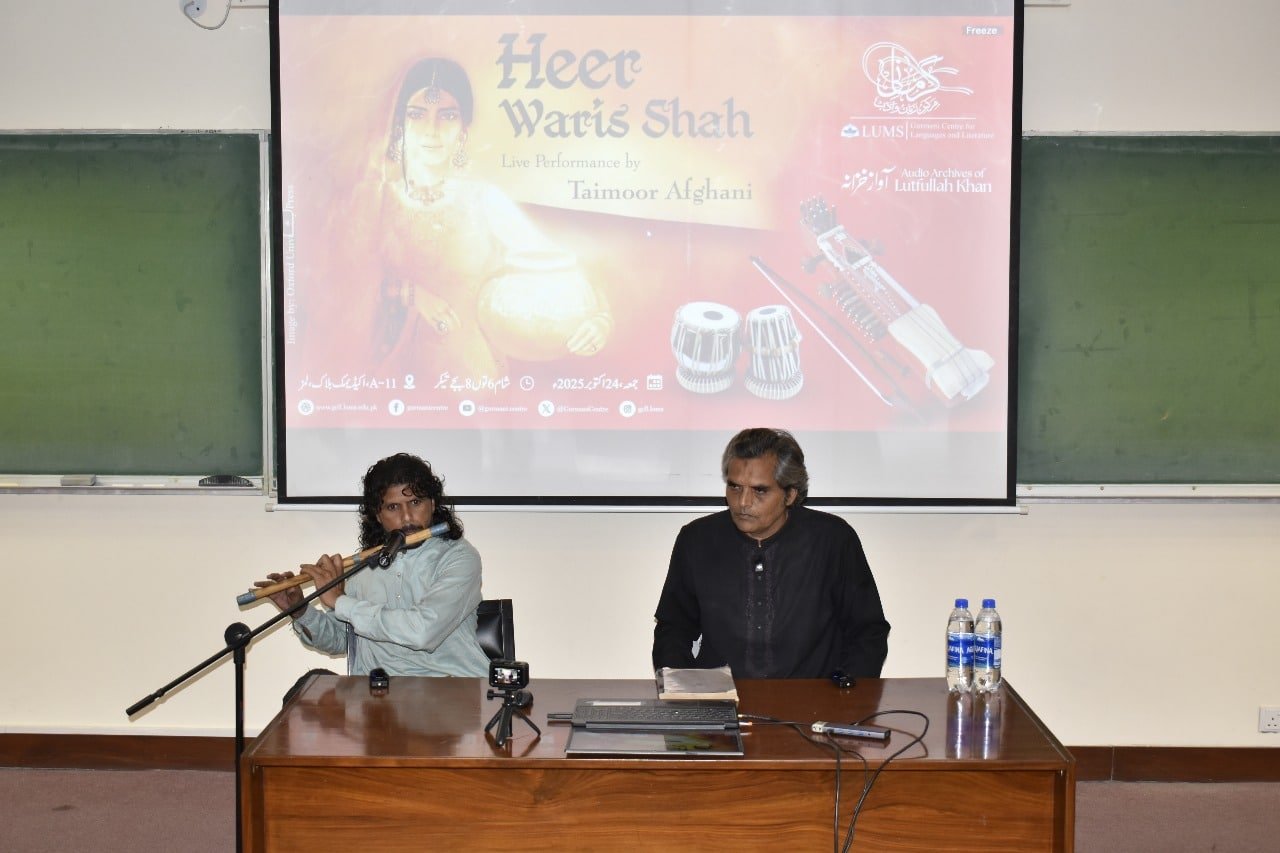
Taimoor Afghani and Aijaz Khan performing Heer on flute.
Source: LUMS
The Spiritual and Political Allegory
Sarwat Mohiuddin reflected on how Waris Shah reimagined Heer not merely as a forbidden romance but as a deeply metaphysical and socio-political narrative. Waris Shah wrote during a period of intense anxiety in 18th-century Punjab. His epic is shaped by the community’s negotiations with love, power, land, and cosmic justice. Mohiuddin argued that Waris Shah subtly critiques clerical power and mullah-cracy, positioning Heer as a metaphor for rebellion against both patriarchy and religious authoritarianism.
The tale, already established as part of the Qissa tradition (like Sohni Mahiwal), was transformed by Waris Shah into a spiritual allegory. Ranjha’s arduous journey as a Jogi (ascetic) symbolizes the human soul’s quest for union with the Divine Beloved.
The conclusion of the LUMS event, featuring a live Heer Khwānī performance by Taimoor Afghani and Aijaz Khan on flute, reaffirmed the core truth: Heer is not simply a literary text, but a living, breathing cultural memory, one that continues to shape linguistic identity, emotional imagination, and the politics of belonging across the region.
The Text of Today: Heer’s Unflinching Literary and Political Relevance
In the 21st century, Waris Shah’s Heer holds immense literary and political significance. Its enduring relevance is tied directly to the persistent societal issues it critiques: the conflict between individual passion and rigid institutions. Modern scholars and activists continue to turn to Heer to understand the roots of gender oppression and familial control over women’s choices in South Asia. The poem acts as a cultural critique tool, highlighting that the challenges faced by women today, from arranged marriages to honor killings, are extensions of the same patriarchal conflicts Heer defied centuries ago. Thus, the epic remains a source of both literary mastery and feminist inspiration, proving that its truth is tragically timeless.