What Happened?
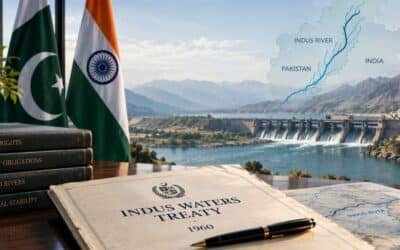
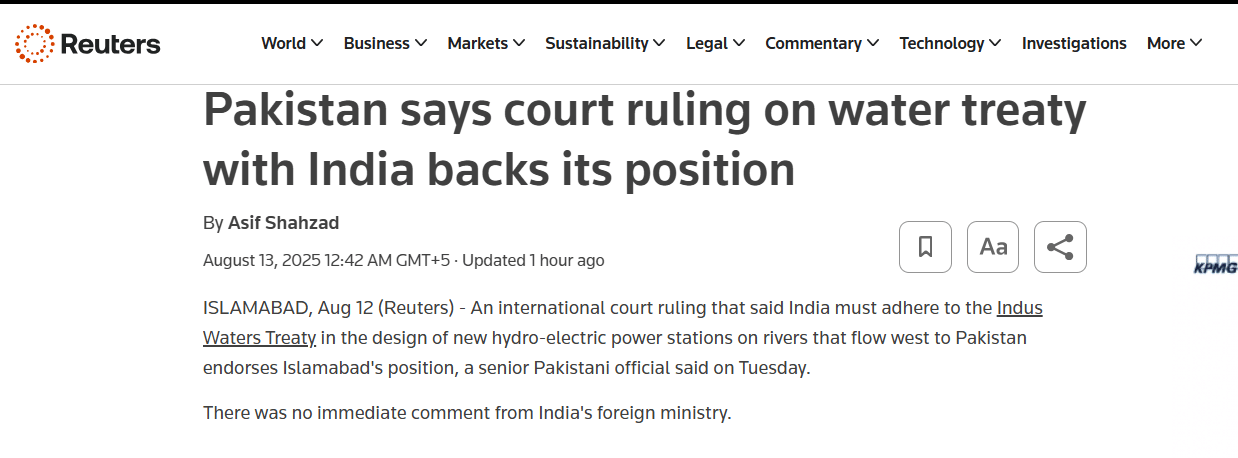
On August 8, 2025, the Permanent Court of Arbitration (PCA) delivered an important Award. The ruling affirmed that India must “let flow” the waters of the western rivers, Indus, Jhelum, and Chenab, for “Pakistan’s unrestricted use.” This ruling is a landmark moment for Pakistan’s water rights.
Source: Reuters
The Award also stated that when India constructs run-of-river hydro plants, the structures, such as outlets, spillways, turbine intakes, pondage, and freeboard, must strictly adhere to the Treaty’s rules, rather than India’s “ideal” engineering concepts. This limits India’s ability to build dams that harm downstream flows.
Source: Arab News
Why It Matters?
This Award confirms that the PCA has full authority even though India had suspended the treaty in April 2025. India’s suspension did not affect the Arbitration Court’s power to hear cases. That means Pakistan’s legal position is stronger than ever. Pakistan has long argued that the Indus Waters Treaty does not allow India to alter the natural flow of shared rivers beyond narrow, strictly defined exceptions. This Award supports that view, reinforcing the principle that water is a right, not a weapon.
What India Says?
India strongly rejected the court’s authority. The Ministry of External Affairs called the Arbitration process “illegal” and a “charade at Pakistan’s behest.” India said it does not recognize the Award.
Even though India objects, the Award remains final and binding. The Treaty wisely included legal processes to help resolve disputes peacefully—even when one party disagrees.
MEA reiterates: India rejects Court of Arbitration’s “award” under Indus Waters Treaty; cites Pakistan’s continued terror sponsorship.
Watch 📹 pic.twitter.com/WwP4LGFQ9v
— Mint (@livemint) August 14, 2025
Pakistan’s Response
Pakistan welcomed the Award as a validation of its long-held stance. The Foreign Office said the ruling matches Pakistan’s interpretation of key treaty terms. Pakistan also called on India to immediately resume normal treaty operations and faithfully implement the Award. Pakistan’s Attorney General noted that Pakistan’s position has been vindicated, especially on how India should design hydro plants. The Award clarified areas like pondage limits and plant safety measures to protect Pakistan’s water rights.
🚨BREAKING: Pakistan welcomes the Award rendered by the Court of Arbitration on the issues of General Interpretation of the Indus Waters Treaty. pic.twitter.com/KbFVfiRQy7
— The Daily CPEC (@TheDailyCPEC) August 12, 2025
What does it mean for Rivers and Farmers?
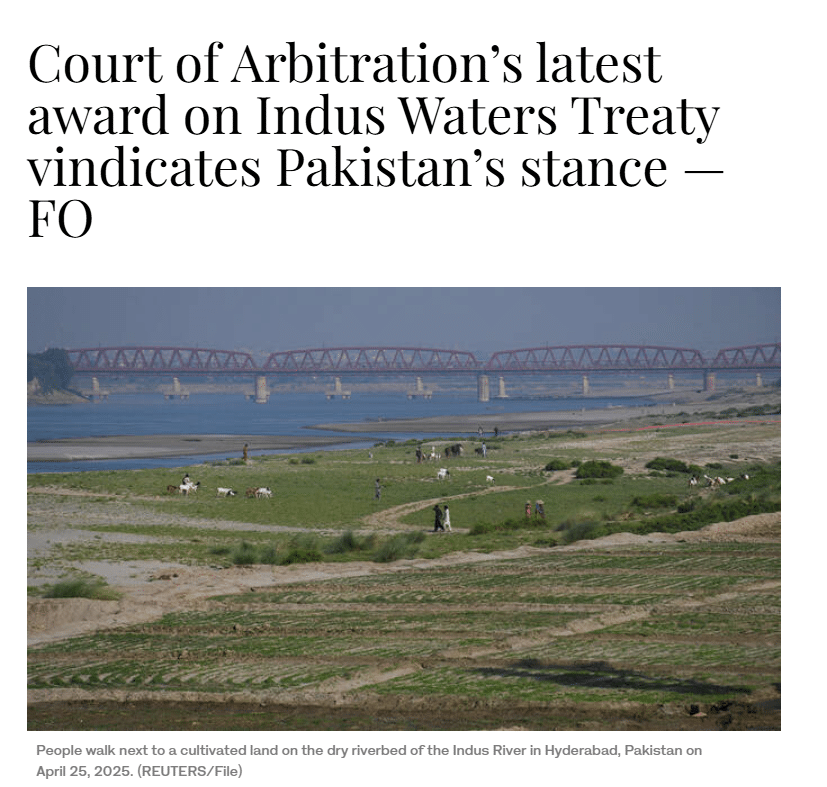
This legal win is not just about papers and courtrooms. It is about keeping Pakistan’s lifeline flowing. The Indus River system feeds the country’s farms, powers its turbines, and fills its cities’ taps. Without these waters, Pakistan’s economy and people would suffer deeply.
Pakistan relies on the Indus and its tributaries for nearly 80% of its agriculture and electricity production. In fertile regions like Punjab and Sindh, farmers plant wheat, rice, and cotton with water that starts as snow in the Himalayas. Hydroelectric plants along these rivers supply power to homes and factories.
The Court of Arbitration’s decision ensures that India cannot design or operate upstream dams in ways that reduce these flows unfairly. The ruling recognizes fair design limits under the Indus Waters Treaty, which means Pakistan’s downstream reservoirs will keep getting their share during key growing seasons.
For farmers, this means crops will not dry out in the middle of planting or harvesting. For towns and villages, it means taps will not run dry in summer. For industries, it promises steady power generation without costly blackouts.
Most importantly, it gives Pakistan leverage. It sets a legal precedent that strengthens the treaty and signals to India and the world that water rights are enforceable. This protection is vital in a time when climate change is shrinking glaciers and increasing drought risks.
In short, the ruling safeguards food security, stabilizes electricity rates, and gives peace of mind to millions who depend on the Indus every single day.
You May Like To Read:
- PAKISTAN KA MATLAB KYA – 78 Years of Independence
- Lieutenant General Nigar Johar: Woman of Steel
- The Indus Waters Treaty: A Lifeline for a Young Nation
Broader Significance for Peace
This Award shows that even amid political tension, Pakistan stands for rule-based solutions. The IWT remains a rare success in South Asia, a treaty that survived wars, disputes, and even suspension. The PCA ruling underscores that the treaty’s dispute mechanisms are still open and working.
Pakistan continues to push for a peaceful resolution, even as climate challenges pressure the rivers more. Letting law, not force, manage international water is how peace holds.
A Warning Against Water Weaponization
Earlier in 2025, India suspended the treaty, citing security. It then withheld water from the Chenab for a time, and carried out reservoir flushing, actions Pakistan warned could be viewed as criminal aggression. Pakistan’s officials called such actions “water terrorism.” The PCA Award now closes loopholes that enable such tactics.
Pakistan is also building a national water policy to protect itself, including new strategic storage and better water planning across provinces.
The Court of Arbitration’s August 2025 Award is a big victory for Pakistan and for diplomacy. Its key messages:
- India must continue to “let flow” the western rivers to Pakistan.
- All exceptions, like dam construction, must follow the Treaty’s limits.
- The treaty’s legal framework remains valid, even if one party tries to pause it.
- No matter how India responds, Pakistan’s rights under the treaty are now stronger than ever.
Water is life for millions of Pakistanis. This Award doesn’t just protect water, it protects their future. It shows that law, not force, should govern our rivers.
Pakistan honors its commitments while defending its rights. This is not just a legal win. It is a reaffirmation of how rivers connect us, not divide us.