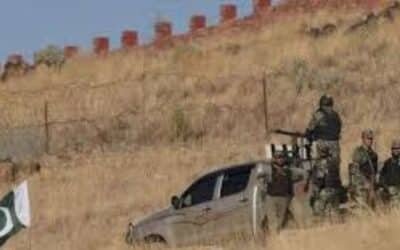




Since the tragic events of 9/11, Pakistan’s Armed Forces have been engaged in combatting militant organizations and insurgencies, especially in the Federally Administered Tribal Areas (FATA). Of the many operations launched, three notable and successful operations are Operation Rah-e-Rast in Swat, Operation Zarb-e-Azab in Waziristan, and Operation Radd-ul-Fasaad nationwide. Each counter-terrorism operation sought to destroy militant strongholds and their embedded networks in the country and displayed strong military and social results. Overall, these operations demonstrated Pakistan’s commitment to counter-terrorism initiatives and the promotion of new security policies.
Operation Rah-e-Rast
In May 2009, Operation Rah-e-Rast, or the Path of the Right, was launched in Swat with the goal of driving out the fighters of Fitna al Khwarij (FAK). It was a full-scale offensive by the government to push out the militants and take control of the infested regions. The Pakistan Army and affiliated parliamentarians employed methods such as fighter jets, artillery, and infantry to retake the valley. Soon, the city of Mingora, which the FAK had taken over after violation of a previous treaty, was recovered by Pakistan’s forces. The army moved in ground troops after heavily firing on Taliban positions. Commanders declared victory in July 2009 after eliminating the Taliban from Swat and killing “hundreds of militants.”
During the conflict, millions of civilians were displaced. Almost 2.5 million left Swat. The majority lived outside the valley in camps or with family. Families who had been displaced were gradually permitted to return home after the army had secured the area. Since Rah-e-Rast successfully drove the FAK out of Swat, it is generally considered to be “the most successful operation to date” against militants in Pakistan. However, the campaign severely damaged Swat’s infrastructure and economy, and many FAK leaders managed to flee. The operation was widely supported by the public because it ended the militants’ harsh rule over the valley, allowing women to return to school and restoring local government. The campaign was supported by Islamabad and the Punjab provincial government, and its relative success helped boost the military’s morale.
Operation Zarb-e-Azab
Operation Zarb-e-Azab or Sharp Strike began in June 2014 and lasted till 2017. It was launched in response to the Karachi Airport Attack and rampant suicide bombing in the country on June 8th against the FAK and allied foreign fighters. The operation was a joint military venture between the Pakistani Army, Air Force, and the paramilitary. Approximately 20,000-30,000 troops were deployed on all fronts. In the first few weeks, Pakistan’s security forces targeted militant hideouts, and by 2016, the army had largely recovered the previously militant-controlled area of North Waziristan. Soon, officials declared the operation a success and stated that most areas were cleared of militants and the remaining fighters had fled to Afghanistan. Military reports stated that about 3500 terrorists were killed along with 490 Pakistani soldiers. Strategic control of Waziristan’s roadways and towns was reclaimed, ensuring that the militants could no longer make it their hideout even if they tried.

Source: DAWN
Zarb-e-Azb is recognised militarily for having significantly decreased attacks within Pakistan. Following the operation, the general security situation “improved,” according to security experts, and terrorist violence decreased to levels not seen since before 2009. Some militants undoubtedly just moved to Afghanistan or took refuge in neighbouring tribal areas. According to the government, Zarb-e-Azb overthrew North Waziristan’s authority as a haven for militants. The next stage of the counterterrorism campaign began when the operation ended in early 2017.
Operation Radd-ul-Fasaad
In February 2017, Pakistan launched a nationwide sweep of terrorists known as Radd-ul-Fasaad or Elimination of Strife. This was in response to the Lal Shahbaz Qalandar shrine attack a week ago in Sehwan and following a new wave of terrorist bombings, most notably the February 16 suicide attack on a Sufi shrine that claimed 88 lives. Radd-ul-Fasaad was declared by the army leadership to “indiscriminately eliminate” the “residual/latent threat of terrorism” and to build on the successes of previous campaigns. The operation was a nationwide initiative, in contrast to previous operations that were limited to tribal areas. It involved the cooperation of local police and intelligence agencies, federal paramilitary Rangers, the air and navy, and regular army units. The goal was to target surviving militant cells and supporters in both urban and rural areas, including Pakistan’s heavily populated Punjab and Sindh.
In comparison to the previous operation, the scope of Radd-ul-Fasaad was much broader. It was responsible for border security, explosives control, and de-weaponisation in addition to raids and arrests. The Afghan frontier was sealed, and Rangers were given the authority to round up suspects, and intelligence-based operations were carried out in major cities. Official figures released in 2017 showcased an impressive detention of over a thousand terrorists, and ISPR press releases displayed the large quantity of weapons recovered.

Source: 24news
Additionally, Radd-ul-Fasaad reaffirmed the National Action Plan (NAP), a counterterrorism policy package initially unveiled following the devastating Peshawar school attack in 2014. The operation put NAP’s measures into practice, such as tougher mosque monitoring, a crackdown on hate speech, and court martials for terrorism cases to prevent future attacks. Pakistani leaders largely praised the joint military-civilian effort. The media portrayed this offensive as a joint effort by the military and public to counter terrorism in Pakistan. Although human rights organisations warned that extrajudicial detentions might take place during such large-scale sweeps, civilian oversight has so far persisted (provincial courts and police still work alongside the army-led operations). Radd-ul-Fassad has not seen an official end and instead has transformed into smaller-scale counter-terrorist actions in recent years.
Conclusion
Operations Rah-e-Rast, Zarb-e-Azb, and Radd-ul-Fassad demonstrate Pakistan’s long-standing commitment to fighting terrorism in the country. The results illustrate that the offensives have been largely successful; however, small-scale assaults and militant pockets continue to exist. Nonetheless, these operations have rooted out FAK and militant strongholds in the country and significantly reduced the frequency of terror attacks. More importantly, they have demonstrated that any insurgency in Pakistan would be met with a swift and brutal response. On the negative side, the country has seen considerable displacement as a result of these moves, which suggests a need for better military-civilian coordination. For the future, analysts predict that Pakistan’s next challenge will be to transform these military victories into long-term stability by eradicating radical ideologies, rebuilding impacted areas, and reforming institutions.
References
- Khattak, D. (2011, October). Evaluating Pakistan’s offensives in Swat and FATA. CTC Sentinel, 4(10). Combating Terrorism Center at West Point.
- Khan, Z. A. (2012). Military operations in FATA and PATA: Implications for Pakistan. Strategic Studies, 31(4), 120–129. Institute of Strategic Studies, Islamabad.