



The killing of prominent Pakistani investigative journalist Arshad Sharif in Kenya remains one of the most troubling and unresolved cases in recent memory. Sharif, known for his fearless reporting on issues of corruption, governance, and civil-military relations, had earned both respect and controversy for his uncompromising journalism. Before his death in October 2022, Arshad Sharif had left Pakistan citing threats to his safety, a move that underscored the increasingly perilous environment faced by journalists in the country.
Arshad Sharifs killing sent shockwaves through Pakistan’s media community and beyond, prompting widespread outrage and demands for a thorough, impartial investigation. Kenyan authorities initially described the incident as a case of “mistaken identity,” but inconsistencies in the official accounts, along with conflicting reports from various investigations, have fueled skepticism and suspicion about the true circumstances surrounding his death.
Politicization of Arshad’s Murder: The Primary Hurdle to Justice
The failure to definitively solve this transnational case stems directly from the country’s profound political polarization.
-
Exile and Death:
Arshad Sharif’s final months were marked by fear, uncertainty, and a growing sense of isolation. Forced into exile after facing multiple sedition cases and alleged threats, Arshad Sharif had become one of Pakistan’s most high-profile journalists in self-imposed exile. His outspoken criticism of the military establishment and the then-ruling coalition government placed him at the center of political tensions that increasingly blurred the line between dissent and danger. While he reportedly left Pakistan on the advice of specific individuals concerned for his safety, questions continue to linger over who specifically urged him to go and under what circumstances. That crucial detail remains unclear, an absence that fuels ongoing speculation and mistrust.
Arshad Sharif’s journey ended tragically in Kenya, where he was shot dead by local police in October 2022. Authorities initially described the incident as a case of “mistaken identity,” but inconsistencies in the official accounts and subsequent investigations have deepened doubts about that explanation. -
The Immediate Weaponization:
Almost immediately after the news of Arshad Sharif death broke, the tragedy became entangled in Pakistan’s polarized political landscape. The Pakistan Tehreek-e-Insaf (PTI) and the then-government engaged in mutual accusations, each framing Sharif’s killing to support their respective narratives. Rather than fostering a collective demand for accountability, the case became a tool for political rhetoric and public posturing. In this environment, the urgency to establish blame often outweighed the need for a thorough, coordinated, and transnational investigation—turning a quest for justice into yet another casualty of political division.
The Fact-Finding Report: Propaganda vs. Proof
The official Fact-Finding Report (FFT), a multi-hundred-page document produced by Pakistani investigators, became a symbol of the investigation’s failure and its political misuse.
- The FFT concluded the killing was a “planned, targeted assassination” involving “transnational characters.”
- However, media analysis, including reports by Al Jazeera, highlighted the FFT’s critical flaw: the report offered no concrete evidence to support its explosive claims, instead relying on contradictions in witness accounts and circumstantial links.
- Crucially, the PTI immediately seized upon the “targeted assassination” conclusion as absolute and definitive propaganda, using the FFT to validate their accusations against their political opponents and the military, regardless of the report’s lack of actionable evidence.
The Compromising Ambiguity of the PTI’s Role
A key layer of complexity in this politicized environment is the fact that the party most loudly demanding justice—the PTI—may not be innocent of potential negligence or connections to the tragedy.
- While the PTI directed its fiercest accusations toward the government and intelligence services, the investigation revealed potential ambiguity closer to home. The two Pakistani brothers who hosted Sharif in Kenya, Khurram and Waqar Ahmed—implicated as “suspects” with contradictory testimonies—were reportedly linked to the media house Sharif worked for and instrumental in facilitating his abrupt move to Kenya.
- Furthermore, in the early stages of the probe, applications were filed before the Supreme Court requesting that the then-PTI Chairman, Imran Khan, and other senior party members be included in the Joint Investigation Team (JIT) investigation. These individuals were sought not just as witnesses, but to investigate their claimed “knowledge of the conspiracy and execution of the murder.”
- This injection of serious counter-allegations shifts the question of accountability from a simple binary to a multifaceted inquiry, suggesting that the very party leading the charge for justice may also hold information relevant to the circumstances of the tragedy.
Was ISI Behind Arshad Sharif’s Murder?
The theory that the Inter-Services Intelligence (ISI) orchestrated the murder quickly gained traction, especially within the PTI’s narrative. This widespread speculation needs analytical framing. It is plausible that the PTI saw an opportunity to make this specific allegation because the top leadership of the ISI had recently changed. The former ISI chief, General Faiz Hameed, was widely seen as a supporter of the PTI’s political goals. However, the DG ISI at the time of the murder was Lieutenant General Nadeem Anjum, whose appointment was reportedly made against the wishes of the PTI Chairman and whose loyalty lay with the new military leadership. By blaming the intelligence agency under the new, politically hostile DG ISI, the PTI effectively turned the murder into a powerful attack on the figures they accused of orchestrating their government’s downfall. Therefore, the immediate and strong nature of the ISI accusation may have been as much about leveraging a moment of institutional transition for political advantage as it was about presenting factual evidence.
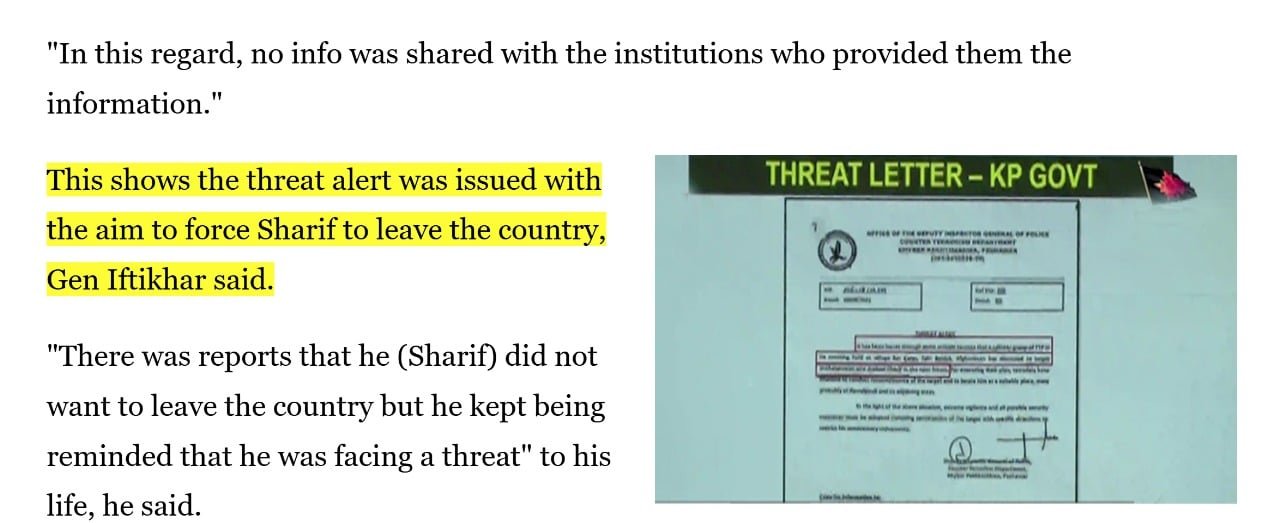
An excerpt from Dawn’s news report shows the threat letter.
Was FAK Behind Arshad Sharif’s Murder?
Another narrative that emerged early in the case suggested that the militant group Fitna al Khawarij (FAK) was responsible. This possibility appears highly conditional on the political context. The TTP threat was primarily referenced through a dubious “threat letter” issued by the PTI-led Khyber Pakhtunkhwa (KP) government, which warned of an assassination plot. This timing is noteworthy because the PTI was concurrently engaged in negotiations with the FAK for a potential peace deal. For the TTP to target a key supporter of the political party they were negotiating with is a significant contradiction. The ISI, in an unprecedented joint press conference, later questioned the very intent behind the KP government’s threat letter, suggesting it was part of a larger plan to pressure Sharif into leaving Pakistan. Thus, the TTP theory seems more like a narrative used by certain state actors to shift the focus onto a non-state enemy, while the information used to support it was highly politicized and immediately contested.
You May Like To Read: PHC Refers 10 Missing Persons’ Cases to Commission for Further Action
The Family’s Burden and International Contrast
Amidst the political noise and contradictory official reports, the genuine pursuit of justice has been shouldered almost entirely by Sharif’s family.
- While political leaders shouted slogans, the actual criminal investigation faltered. Teams complained of stalled cooperation from Kenyan authorities, and the Supreme Court-mandated JIT struggled to make progress.
- The only significant step toward accountability was secured through the family’s independent efforts in Kenya, where the local High Court eventually ruled the police shooting that killed Sharif to be “unlawful and unconstitutional.” This victory in a foreign court underscores the inability of Pakistan’s politicized system to deliver justice on its own terms.
The Lost Truth
What could have been a unified national effort to pursue justice for a fallen journalist has instead become entangled in political narratives and competing agendas. Different political factions have used the case to advance their own positions, turning a tragedy into a point of contention rather than consensus. This politicization has not only hampered the pursuit of accountability but has also deepened public mistrust in state institutions tasked with uncovering the truth.
More than two years later, the questions surrounding Arshad Sharif’s killing remain unanswered, reflecting broader challenges of transparency, press freedom, and the rule of law in Pakistan’s ongoing struggle to protect those who speak truth to power.
The final, bitter irony is that the investigation is perpetually paralyzed because, While everyone, including the political parties, publicly demands the government focus on genuine investigation and cease political scoring, the parties themselves continue to use the incident for political gain, thus actively making the process of delivering justice more opaque and muddy and ensuring the truth remains elusive.
The murder of Arshad Sharif remains an indelible marker of where political expediency triumphs over the rule of law.
You May Like To Read: Pakistani Cricketer Sohaib Maqsood Alleges Rs 1.4 Crore Car Fraud in Multan — Calls for Justice