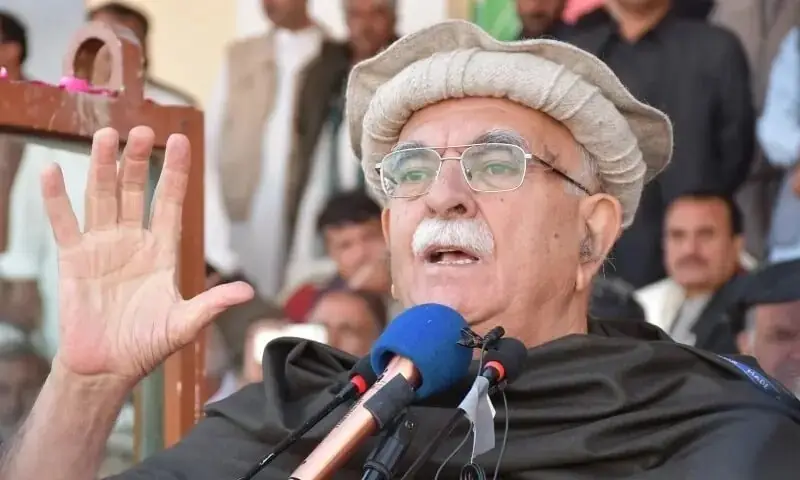


QUETTA — Leader of the Opposition in the National Assembly and Pakhtunkhwa Milli Awami Party (PkMAP) Chairman, Mehmood Khan Achakzai, has petitioned the Balochistan High Court (BHC) to quash a police case registered against him in Chaman. Speaking to journalists and lawyers at the high court on Wednesday, Achakzai dismissed the allegations and categorized the country’s prevailing crises as inherently political rather than legal.
Key Highlights
- National Assembly Opposition Leader Mehmood Khan Achakzai has legally challenged a controversial speech FIR at the BHC.
- The case was originally registered at the Chaman City Police Station on a complaint filed by a citizen named Wali Achakzai.
- Achakzai argued that the FIR fails to meet constitutional and legal requirements and should be declared null and void.
- The veteran politician called for an absolute end to interference in Pakistan’s electoral processes.
- He emphasized that vital internal and foreign policy decisions must be made independently by a truly elected parliament.
محمود اچکزئی پر مقدمے کیخلاف آئینی درخواست بلوچستان ہائیکورٹ میں دائر، ایف آئی آر غیر آئینی ہے، خارج کی جائے، پشتونخوامیپ لائرز فورم https://t.co/qpmu9ByiXJ #Balochistan #Quetta @MKAchakzaiPKMAP @TTAP_OFFICIAL @PTIofficial pic.twitter.com/8tBkhIxxJK
— Daily Intekhab (@Intekhabhd) June 3, 2026
Challenging the Legal Basis of the Speech FIR
The First Information Report (FIR) in question was lodged at the Chaman City Police Station by a local complainant, Wali Achakzai, following a recent public speech delivered by the PkMAP chairman. Addressing the media at the high court, Achakzai maintained that the registration of the case bypasses standard constitutional and legal prerequisites. He requested that the judiciary intervene and declare the police file null and void, asserting that those who advocate for constitutional supremacy are unfairly subjected to state criticism.
Demanding Civil Institutional Independence
Beyond his personal legal battles, the veteran politician used the platform to highlight broader structural issues affecting Pakistan’s governance. Achakzai argued that recurring national crises cannot be overcome without establishing transparent mechanisms and securing independent policy-making powers for civilian institutions.
He reminded the gathering that the country’s constitution is the hard-won product of a long political struggle and democratic consensus. Continuous interference in the electoral process, he warned, has severely weakened civil institutions. Achakzai concluded by stating that national progress remains entirely dependent on establishing a true democratic society governed strictly by a genuinely elected parliament.