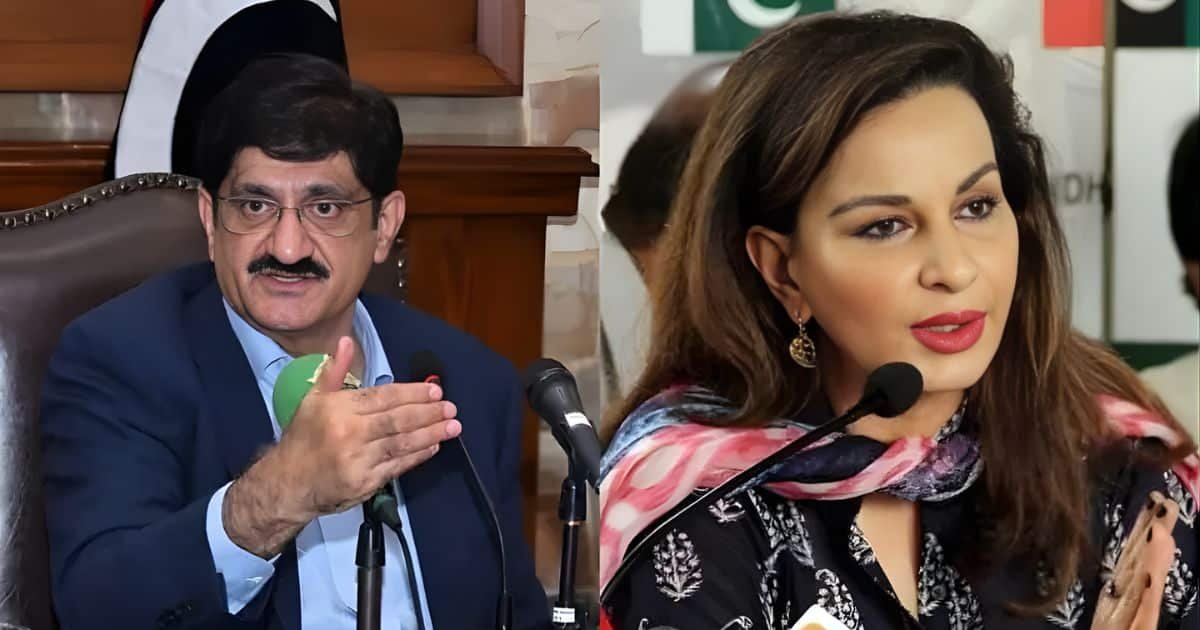


Sindh Chief Minister Syed Murad Ali Shah and Pakistan Peoples Party’s (PPP) Parliamentary Leader in the Senate Sherry Rehman on Monday issued strong condemnations of recent comments made by Indian Defence Minister Rajnath Singh regarding Pakistan’s Sindh province, calling the remarks historically inaccurate, provocative and destabilising.
In a recent speech, Singh said that although Sindh is not part of India today, “borders can change in the future,” suggesting Sindh could “return” to India — a statement sharply criticised across Pakistan’s political spectrum for challenging internationally recognised boundaries and sovereignty norms.
Responding to the comments, CM Murad termed the Indian minister’s remarks “a historically illiterate and diplomatically reckless statement.” Writing on X (formerly Twitter), he emphasised that Sindh’s political identity existed long before Partition. “Sindh chose to separate from the Bombay Presidency in 1936, even before the Partition of Pakistan, because the people of Sindh sought autonomy, dignity and their own political identity,” he said. “Sindh is an integral, inseparable part of Pakistan — yesterday, today, and forever.”
He further advised the Indian leadership to focus on its own internal issues. “India’s defence minister should concentrate on his own country’s internal divisions instead of daydreaming about ours,” he wrote.
Senator Sherry Rehman also criticised Singh’s remarks, describing them as “provocative, revisionist, and deeply irresponsible.” In a statement, she warned that such rhetoric undermines regional stability and violates established norms governing interstate relations. “These comments are not just factually baseless but reflect a dangerous escalation in the expansionist Hindutva narrative that has no place in responsible statecraft,” she said.
You May Also Like: Sindh Farmers Face Another Sugarcane Crisis Amid Delays, IMF Conditions and Power Dynamics
Rehman added that the Indian minister’s assertions demonstrated an alarming disregard for historical realities. “The remarks on Sindh are not only offensive, but expose an aversion or ignorance of history that borders on self-sabotage,” she stated.
A historically illiterate and diplomatically reckless statement
Sindh chose to separate from the Bombay Presidency in 1936, even before the Partition of Pakistan, because the people of Sindh sought autonomy, dignity and their own political identity.
Sindh is an integral, ………— Murad Ali Shah (@MuradAliShahPPP) November 24, 2025
The statements from both senior PPP leaders highlight growing concern in Islamabad over increasingly assertive political messaging from New Delhi. Pakistan has long rejected Indian officials’ claims over its territories, calling them attempts to project domestic political ideologies onto regional geopolitics.
The latest remarks come at a time of strained bilateral relations between the two nuclear-armed neighbours, with dialogue stalled and diplomatic channels limited. Analysts warn that such comments, if left unchecked, risk fuelling tensions in an already fragile regional environment.
The Foreign Office is expected to issue a formal response, as Pakistan maintains that Sindh’s identity, history and political status are non-negotiable and firmly anchored within the constitutional framework of the Pakistani federation.