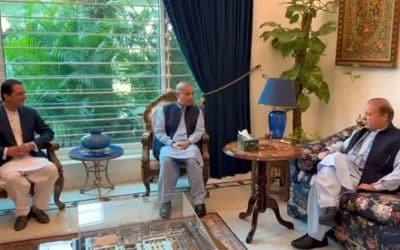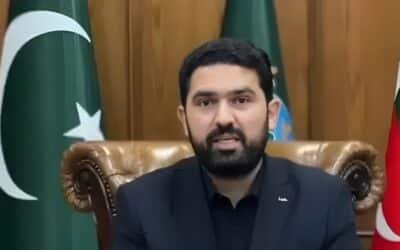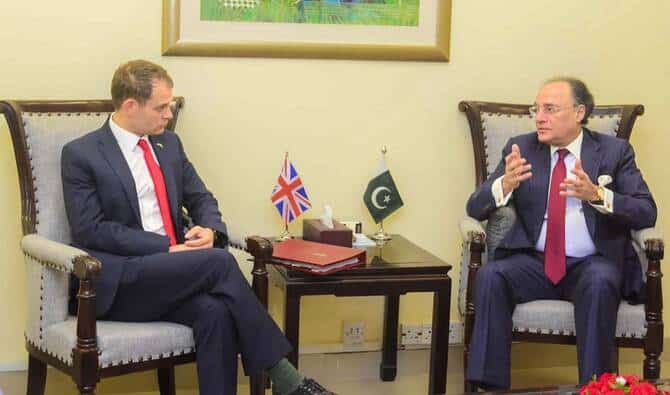




ISLAMABAD — Pakistan and the United Kingdom have agreed to significantly broaden bilateral cooperation across internal security, counterterrorism operations, and joint efforts against human smuggling and illegal migration. The comprehensive security understanding was finalized during a high-level meeting in Islamabad on Wednesday between Interior Minister Mohsin Naqvi and British Minister of State for the Middle East, South Asia, and the United Nations Hamish Falconer.
Key Highlights
- Both nations agreed to elevate joint operations against illegal migration and fake student visa networks.
- The UK announced an additional £8 million to support joint anti-crime and migration border frameworks.
- Minister Falconer praised Pakistan’s “historic role” in mediating the recent US-Iran peace deal.
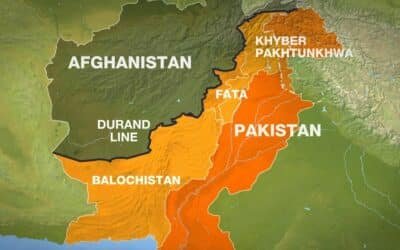
- Interior Minister Naqvi demanded Afghan authorities stop cross-border terrorism targeting Pakistan.
- The UK formally acknowledged Pakistan’s legal right to self-defense against threats from Afghan soil.
Pakistan and the United Kingdom have reaffirmed their commitment to further strengthening bilateral relations, particularly in counterterrorism, security, and immigration domains@MohsinnaqviC42 @HFalconerMP #RadioPakistan #News
https://t.co/5X7lgyY9sQ pic.twitter.com/DWohEWN3a6— Radio Pakistan (@RadioPakistan) June 17, 2026
Border Enforcement, Crime Funds, and Regional Tensions
According to an official statement issued by the interior ministry, the two sides reviewed the ongoing structural progress of the UPSCALE Project, a joint security initiative aimed at enhancing the technical capacity of Pakistani law enforcement. Minister Naqvi assured the British delegation that Pakistan is pursuing an indiscriminate, zero-tolerance crackdown against organized human smuggling rings. To disrupt specialized fraud networks, both leaders agreed to launch a synchronized mechanism to identify and dismantle fake student visa rackets exploiting immigration pathways.
The operational expansion is backed by a newly announced £8 million funding package from London, dedicated entirely to fortifying joint UK-Pakistan anti-crime operations and maritime/land border management. Turning to regional defense, Naqvi underscored that multiple hostile terrorist groups continue to operate freely out of safe havens in neighboring Afghanistan, reiterating that the Afghan government must comply with international obligations to prevent its soil from being used to launch cross-border attacks. The briefing follows Minister Falconer’s earlier diplomatic sessions with Foreign Minister Ishaq Dar, where the UK formally acknowledged Pakistan’s explicit right under international law to defend its territory against attacks originating from Afghanistan.
British Praise for Middle East Peace Mediation
Beyond localized defense parameters, the high-level meeting focused heavily on Pakistan’s rapidly rising geopolitical prestige following its successful backchannel diplomacy in the Middle East. Minister Falconer expressed deep appreciation for the state’s tireless diplomatic interventions, noting that the successful cessation of hostilities between Washington and Tehran has projected Pakistan as a primary flag-bearer of global stability.
Key Agreements: Pakistan-UK Security Dialogue
• Financial Injection: Additional £8 million British grant to combat organized crime.
• Enforcement Target: Indiscriminate crackdowns on human smuggling rings.
• Visa Fraud: Coordinated tracking to neutralize fake student visa syndicates.
• Border Security: UK backing of Pakistan’s legal right to cross-border self-defense.
The British minister explicitly credited Prime Minister Shehbaz Sharif and Chief of Defence Forces Field Marshal Asim Munir for playing a historic, stabilizing role in preventing a wider regional conflagration. Both sides concluded the session by reaffirming their mutual intent to continuously expand the strategic partnership between Islamabad and London ahead of the formal US-Iran accord signing in Geneva.