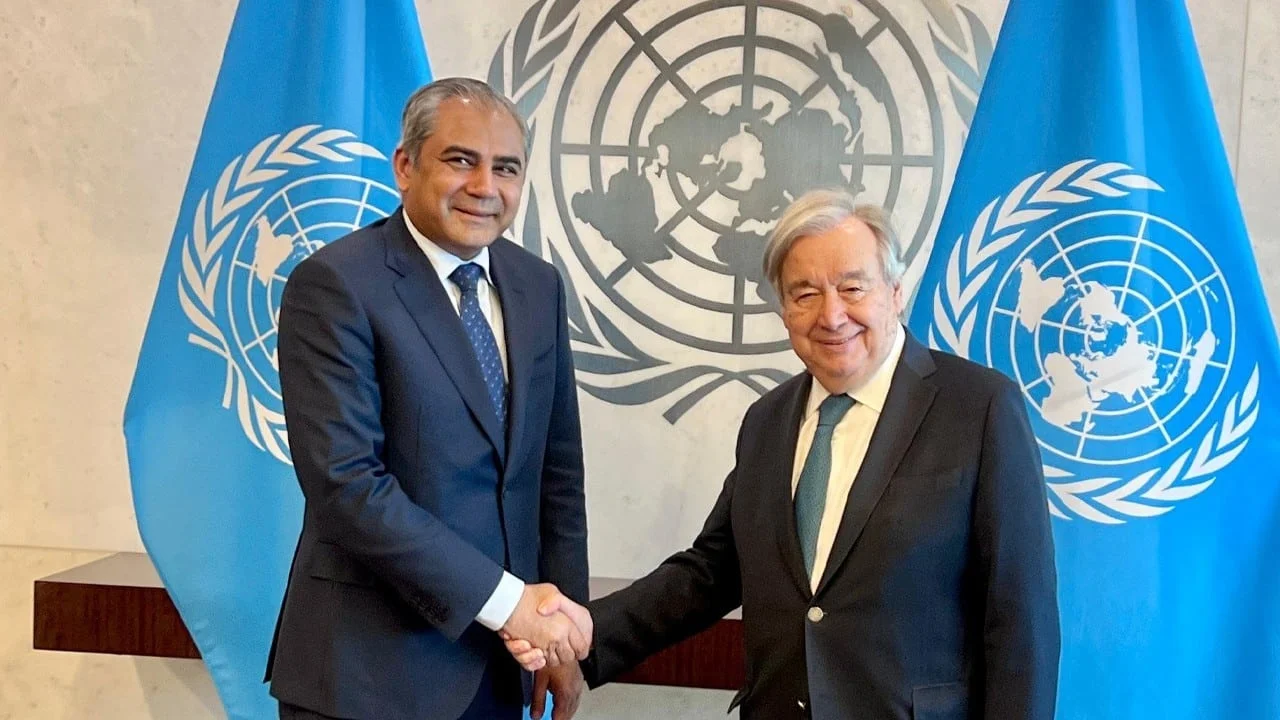



NEW YORK — United Nations Secretary-General António Guterres praised Pakistan’s proactive diplomatic efforts in promoting global and regional stability during a high-profile meeting with Interior Minister Mohsin Naqvi at the UN headquarters.
The meeting took place on Thursday on the sidelines of the fifth United Nations Chiefs of Police Summit (UNCOPS 2026). During the session, Guterres specifically commended Pakistan’s successful mediation role between the United States and Iran, which recently culminated in the signing of the Islamabad Memorandum of Understanding, alongside the country’s historic contributions to international peacekeeping operations.
Key Takeaways
- Secretary-General Guterres explicitly lauded Pakistan’s strategic mediation and its continuous efforts to defuse geopolitical flashpoints.
- Addressing the UNCOPS assembly, Interior Minister Naqvi urged global police chiefs to build airtight information-sharing partnerships to counter borderless threats like cybercrime, drug trafficking, and money laundering.
- Pakistan advanced bilateral law-enforcement frameworks with Russia and China, securing agreements for joint police exercises and streamlined border management.
Pakistan’s interior minister addresses UNCOPS in New York pic.twitter.com/dwZMZamcsp
— Pakistan TV Digital (@PakistanTVcom) July 9, 2026
Pakistan and Russia to Ink Security MoU Against Afghan-Based Terror Networks
On the sidelines of the summit, Naqvi held a crucial strategy meeting with Russian Interior Minister Vladimir Kolokoltsev. The two leaders focused heavily on the volatile security matrix in Southwest Asia, with Naqvi highlighting that more than 25 active terrorist organizations are currently operating out of Afghanistan.
Emplacing a collective responsibility framework, Islamabad and Moscow agreed to finalize a formal Memorandum of Understanding (MoU) to institutionalize cooperation. The upcoming pact will cover:
- Joint police training exercises and tactical law-enforcement maneuvers.
- Coordinated operations targeting regional narcotics pipelines and cyber syndicates.
- Shared intelligence strategies to dismantle cross-border extremist networks.
This follows a high-level meeting earlier in the week between Naqvi and China’s Minister of State for Public Security, Ling Zhifeng, where Beijing and Islamabad reaffirmed tight security cooperation on counter-terrorism, combating irregular migration, and robust border management systems.
Global Police Forces Must Weaponize Tech to Defeat Modern Criminals
In his central address to the global UNCOPS delegation, Minister Naqvi emphasized that traditional policing boundaries are obsolete in the face of modern technology. “The world faces common security challenges that do not stop at national borders,” Naqvi stated, pointing out that syndicated criminals are rapidly adapting to new software and digital tools.
He called on member states to actively modernize their local police forces through rigorous technological training, institutional innovation, and real-time data integration. Naqvi concluded by urging international law enforcement agencies to move past isolated operations and embrace unified, cross-border strategies to secure global peace.