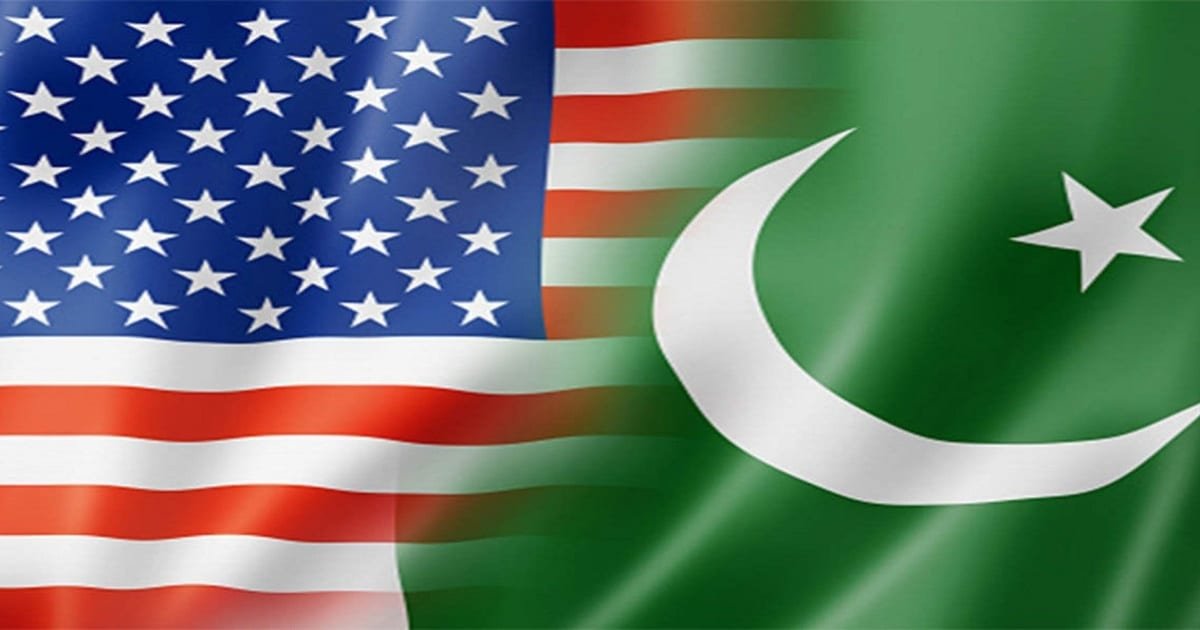





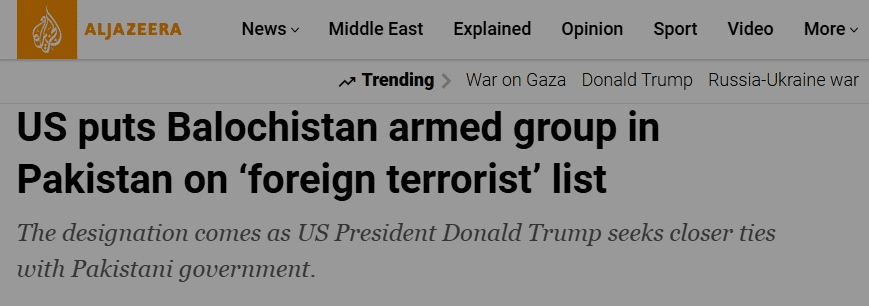
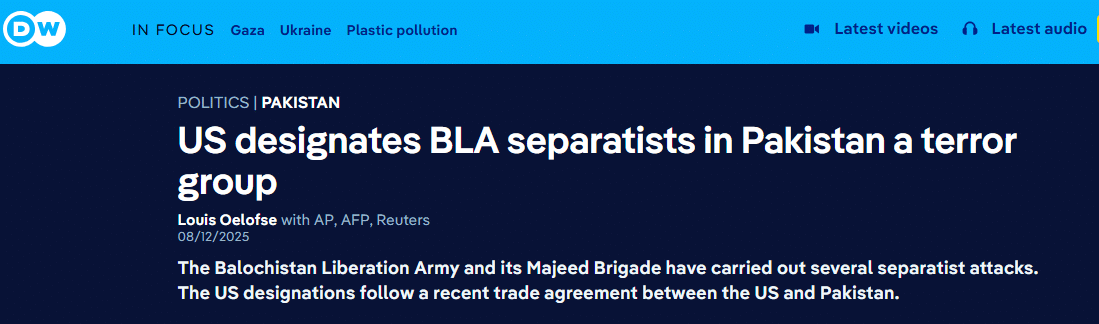
The strategic alignment between the United States and Pakistan reached a turning point on August 11, 2025. On this day, the U.S. State Department designated the Fitna-al-Hindustan (FAH), formerly known as BLA, and its Majeed Brigade wing as a Foreign Terrorist Organization (FTO). Secretary of State Marco Rubio endorsed the move at the highest level. This was more than symbolic diplomacy. For Pakistan, it signals a new phase in Balochistan’s journey. It disrupts the insurgency’s lifelines. It also speeds the province’s integration into Pakistan’s economic mainstream.
U.S. Terror Listing Weakens FAH’s Reach
FTO designation is a severe, non-kinetic strike against Baloch separatists. It disrupts their operational network. Before this relocation, the FAH used international backing. These channels financed weapons, fighters, and large-scale acts of violence, like the March 2025 hijacking of the Jaffar Express. Today, it is possible to dismantle these pipelines, criminalize material support, and take action in Europe due to U.S. Treasury sanctions. This financial pressure significantly hampers the group’s ability to operate.
Source: Al Jazeera
The decision leaves the FAH financially and logistically isolated. It now struggles to cross international borders, especially via Afghan safe havens where it once obtained abandoned U.S. military equipment. Global attention is turning toward these networks. Politically, the move supports Pakistan’s long-held position that the FAH is a terrorist group, not a nationalist cause, and harms the group’s reputation.
U.S. Move Strengthens CPEC Security and Investment Prospects
The epicenter of the $62 billion China-Pakistan Economic Corridor (CPEC) is Balochistan. Its significance is enormous. The project was threatened by years of violence and attacks on Chinese engineers and the Gwadar Port. The U.S. designation transforms this situation. It brings the US-Pakistan shared counterterrorism policy into alignment. This gives the multinational investors a clear message that stability is resurging. Industrial and residential projects can attract foreign investment from Gulf and European companies.
Security on the ground is also getting better. As the strength of the FAH is diminished, there will be increased availability of military resources that Pakistan could allocate to guarding CPEC instead of combating insurgents. The Special Security Division, protecting Chinese nationals, will enjoy better intelligence and fewer attacks. This will directly solve the biggest issue of Beijing, keeping its workers safe and strengthening its status as a secure investment hub in Balochistan.
The U.S. has designated the Balochistan Liberation Army (BLA) and its alias The Majeed Brigade as a Foreign Terrorist Organization. The action taken by the Department of State demonstrates the Trump Administration’s commitment to countering terrorism. Read complete statement…
— U.S. Embassy Islamabad (@usembislamabad) August 12, 2025
The U.S.-Pakistan Naval Synergy Strengthens Regional Trade Security
The FTO designation comes as U.S. and Pakistani interests align in the Arabian Sea and Western Indian Ocean. Houthi attacks have disrupted Red Sea traffic, which handles 12% of global trade. Gwadar’s value as an alternative trade hub has risen sharply. The U.S. sees Pakistan’s naval stability, strengthened by containing the Baloch insurgency, as critical for regional commerce. Joint naval drills and intelligence sharing through the Combined Maritime Forces are growing. Pakistan is becoming a key security player in the North Arabian Sea.
This allows Pakistan to market itself as a protector of trade bound for China and Central Asia. The U.S. move also sidelines Iran, which also faces Baloch unrest. At the same time, it indirectly backs Pakistan’s plan to link Gwadar and Chabahar ports. This trade corridor aims for $10 billion in annual commerce while reducing space for cross-border militants near the Rimdan-Gabd border.
Commentary |
Strategic Shift: USA Declares BLA and Majeed Brigade a Foreign Terrorist Organization
On August 11, the USA took a decisive step, officially designating the BLA including its lethal elite suicide wing, the Majeed Brigade, as a Foreign Terrorist Organization⤵️
1/6 pic.twitter.com/xUr6E3y6zx
— South Asia Times (@_southasiatimes) August 12, 2025
U.S. Move Opens Door to Balochistan’s Economic Revival
The real test of the U.S. designation is its ability to bring real economic change to Balochistan, Pakistan’s most marginalized province. The Reko Diq copper-gold mines hold world-class reserves. The Sui gas fields are also rich in resources. Both have faced decades of underinvestment due to insecurity. Now, with the FAH weakened, Pakistani firms can partner with U.S. energy companies under the new trade pact. This can speed up extraction. Higher revenue shares for the province can address old grievances over resource exploitation. These steps can directly improve trust between the state and the local population.
- You May Like To Read:
Gwadar is on its way to becoming a major commercial hub. Its growth will create thousands of jobs in logistics, construction, and services. Lower violence also creates political space. Islamabad can talk to non-violent Baloch leaders. It can push forward constitutional reforms under the 18th Amendment. Greater control over resources and cultural rights can meet the core demands of the Baloch people. This can turn a cycle of conflict into a path toward stability and growth.
U.S. Backing Boosts Pakistan’s Regional Role
The U.S. designation lifts Pakistan’s standing in regional politics. Washington’s support for Pakistan’s view of the FAH gives Islamabad greater counterterrorism credibility. Pakistan also uses the move to balance relations with both Beijing and Washington. The August 2025 U.S.-Pakistan trade deal on Gwadar proves this balance, bringing American investment into a China-led corridor without friction. Stabilization in Balochistan strengthens Pakistan’s vision as a bridge for transcontinental trade.
Source: DW
Conclusion
The U.S. FTO designation against the FAH does not solve all of Balochistan’s problems. Long-standing disputes over autonomy and resource control still demand political solutions. Full enforcement of the 18th Amendment and guaranteed provincial revenues remain critical. Yet the move has delivered swift gains. Militant supply lines are broken. New economic space is opening. Regional trade links are taking shape. For Pakistan, this is a rare chance to turn a neglected conflict zone into the heart of its economic future. The image of Gwadar’s cranes replacing militant guns is now within reach. Investors see proof that Pakistan’s resolve, backed by great-power support, can push militancy to the margins