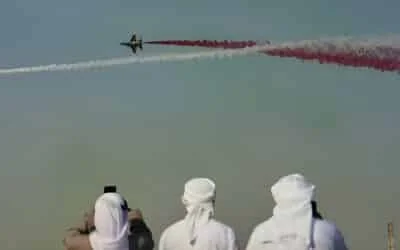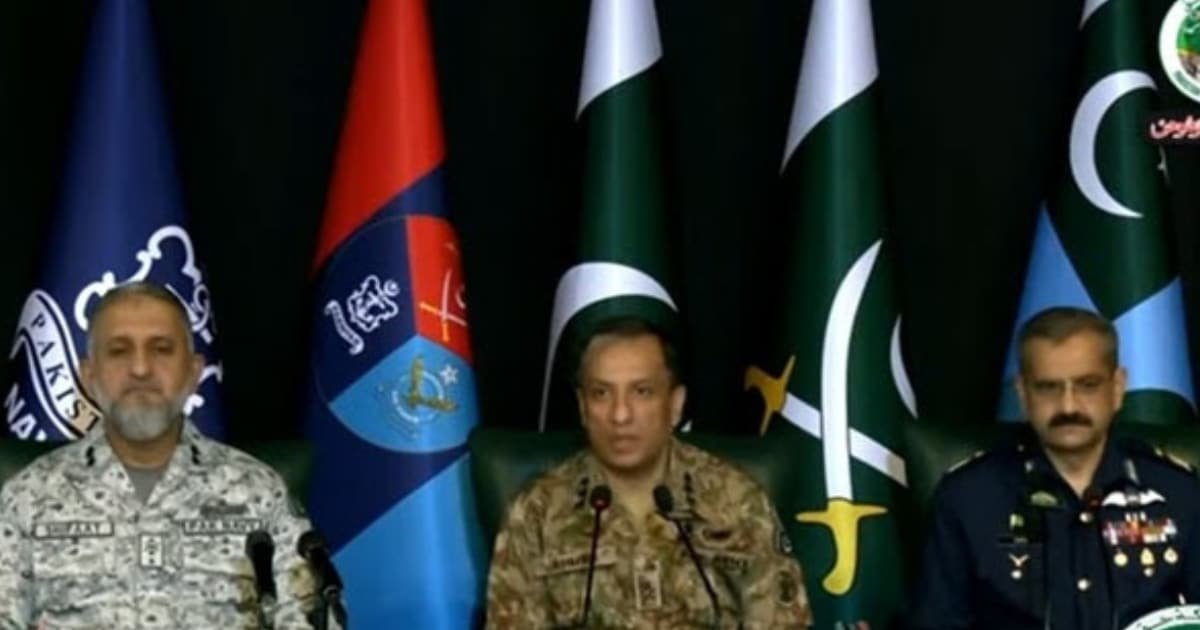




ISLAMABAD: On the first anniversary of the ‘Marka-i-Haq’ conflict, Director General of Inter-Services Public Relations (ISPR) Lt Gen Ahmed Sharif Chaudhry held a comprehensive briefing on Thursday, showcasing Pakistan’s indigenous military advancements and the strategic fallout of the 2025 escalation with India. Accompanied by senior leadership from the Navy and Air Force, the DG ISPR asserted that Pakistan has emerged as the “net security stabilizer” in the region, successfully countering a larger adversary through superior multi-domain operations. The military spokesperson emphasized that Pakistan’s current operational readiness is backed by a “homegrown kill chain” and a “Bunyanum Marsoos” synergy between the people and the armed forces, warning that any future miscalculation by the neighbor would be met with even swifter consequences.
Field Marshal Syed Asim Munir, NI (M), HJ, COAS & CDF of Pakistan congratulates the Nation and Armed Forces on the first anniversary of Marka-e-Haq, recognising it as a defining moment reflecting national unity, collective resolve, and an unyielding commitment to safeguard… pic.twitter.com/JpD5pVFqiB
— Pakistan Armed Forces News 🇵🇰 (@PakistanFauj) May 7, 2026
Strategic Highlights & Performance Metrics
- Aerial Dominance: The Pakistan Air Force (PAF) confirmed an 8-0 kill streak during the conflict, including the downing of 4 Rafales, 1 Su-30, 1 MiG-29, 1 Mirage 2000, and a high-value multi-role UAS.
- Infrastructure Strikes: Indigenous JF-17 Block III aircraft and hypersonic vectors neutralized 16 Indian air bases, key command centers, and 2 prized S-400 batteries.
- Naval Resilience: The Pakistan Navy maintained uninterrupted maritime trade and protected all national ports despite Indian attempts to deploy assets in the northern Arabian Sea.
- Counter-Terrorism: Following the 2025 ceasefire, the military noted a surge in Indian-backed proxy terrorism, which was countered by striking support infrastructure in Afghanistan during Operation Ghazab lil-Haq.
- Indigenous Arsenal: The ISPR showcased “homegrown” tech, including the Army Rocket Force Command, loitering munitions, electro-optical satellites, and integrated fire control systems.
Strategic Consequences of Marka-i-Haq
Lt Gen Ahmed Sharif Chaudhry outlined ten strategic shifts following the conflict, primarily the burial of the Indian narrative that sought to frame Pakistan as a source of terrorism. He noted that the global community now recognizes India’s “hubristic attitude” and its attempts to externalize internal repressions, particularly in Kashmir. The DG ISPR argued that while India has politicized its military leadership, Pakistan has consolidated its role as a responsible middle power that effectively manages and dominates regional escalation.
The Pakistan Air Force officially announces that it will be:
1. Procuring next-generation (stealth) fighter platforms.
2. Procuring more J-10Cs.
3. Further upgrading the JF-17 Thunder. pic.twitter.com/jowqPidtEF
— The STRATCOM Bureau (@OSPSF) May 7, 2026
PAF’s “8-0” Tally and Technological Edge
Air Vice Marshal Tariq Ghazi detailed how the PAF transformed a defensive posture into a crippling ambush for the Indian Air Force (IAF). He stated that the “prowess of PAF’s homegrown kill chain” allowed Pakistan to target high-tech fighters at will, leaving the adversary with no aerial presence for the remainder of the conflict. Ghazi revealed that the PAF is currently pursuing 160 development projects to retain a qualitative edge, including an “initial collaborative mechanism” for the J-35A fifth-generation stealth fighter.
The Pakistan Air Forces integrated Air defence under the command of Air officer commanding Air Defence Command insured enemy threats were detected, tracked and neutralised !
Marka-e-Haq (MeH)
Operation #BunyanUmMarsoos#PAF #Pakistan #ISPR pic.twitter.com/ad8VsIS2Tk
— Pakistan Armed Forces News 🇵🇰 (@PakistanFauj) May 7, 2026
Naval Deterrence and Trade Protection
Rear Admiral Shifaat Ali highlighted that despite the Indian Navy’s massive budget and “Blue Water” ambitions, it failed to muster the courage to move beyond its sanctuaries. He recalled that the Pakistan Navy and PAF were fully prepared to destroy the Indian aircraft carrier Vikrant had it attempted to disrupt Pakistan’s waterways. Through modern surveillance and effective strategy, the Navy ensured that Pakistan’s economic lifeblood—its maritime trade—remained entirely operational throughout the hostilities.
Countering Proxies and Regional Diplomacy
Addressing the post-conflict surge in terrorism, the DG ISPR alleged that India remains the primary financier of unrest in Pakistan, using Afghan soil as a base. He clarified that Operation Ghazab lil-Haq remains active despite “temporary pauses” for diplomatic logistics. On the international front, Lt Gen Chaudhry reaffirmed the “mutual defense pact” with Saudi Arabia, stating that “any threat to Saudi Arabia is a threat to us,” while reiterating that Kashmir remains Pakistan’s “jugular vein” as per the vision of Field Marshal Asim Munir.
Pakistan’s military spokesperson casually ROASTS the Afghan Taliban here: pic.twitter.com/AkO5loQ6wq
— The STRATCOM Bureau (@OSPSF) May 7, 2026
The “Bunyanum Marsoos” Effect
The military spokesperson concluded that the most vital consequence of the victory was the unshakeable synergy between the state, the public, and the military. He dismissed Indian assessments of a rift between the army and the people as a “strategic miscalculation,” asserting that the military represents the common citizen rather than any elite. “If you want to test us again, you are more than welcome,” the DG ISPR remarked, adding that Pakistan could “show reality in a matter of minutes” should New Delhi choose further aggression.
You May Like To Read: Punjab completes Rs120m restoration of historic Derawar Fort
Check out our latest video: