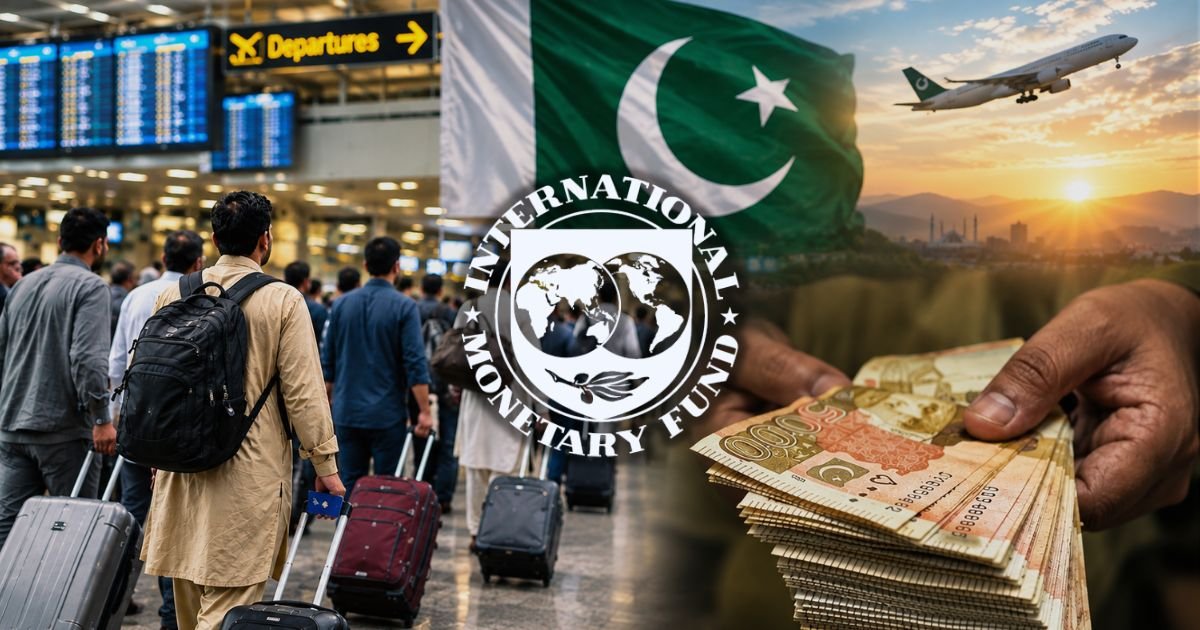




Every few months, the same thing happens in Islamabad. In Washington, there’s an agreement at the staff level. There’s a board meeting scheduled. There’s a payment of around a billion dollars wired to the State Bank of Pakistan. It’s tweeted about by finance ministry advisers, toasted by TV hosts as a lifeline, and the rupee takes a breather for a day or two. No news till next review.
In the same fiscal year, Pakistanis working in Riyadh, Dubai, London and Houston sent home more money in one month than the IMF usually gives out in a review cycle. At the end of the year, they sent almost six times what Pakistan’s 37-month IMF program is worth. That comparison doesn’t often make the evening news, but it is the more important of the two stories.
Key Highlights
- Overseas Pakistanis sent home a record $41.6 billion in workers’ remittances in FY26 (July 2025-June 2026), up 8.6 percent from $38.3 billion in FY25, and higher than the country’s entire export earnings of $30.1 billion for the year.
- Saudi Arabia ($9.78 billion) and the UAE ($8.81 billion) together supplied nearly 45 percent of the total, with the UK, the EU, and other GCC states filling out the rest of the picture; inflows from the United States actually fell 3 percent on the year.
- Pakistan’s current IMF Extended Fund Facility is a 37-month, $7 billion program, disbursed in tranches of roughly $1 billion to $1.3 billion every few months; remittances now clear that amount most months on their own.
- Saudi Arabia’s 2026 overhaul of its Nitaqat “Saudization” quota system, the toughest since 2021, raises the risk that a decent share of the 530,000-plus Pakistanis working there could face tighter visa and renewal conditions in the coming years.
- Pakistan is also losing skilled professionals at a rate researchers now rank third in South Asia and sixth globally, a trend that inflates remittance figures in the near term while quietly hollowing out the workforce those remittances are supposed to sustain.
The Real Comparison: Remittances vs. IMF Tranches
When you line up the two values, it is easy to see the difference between them. Pakistan has an ongoing agreement with the IMF that was approved in September 2024. It’s worth $7 billion and is spread over 37 months, with payments of about $1 billion to $1.3 billion each. The most recent payment, totaling approximately $1.32 billion, was received in May 2026 and came from the Extended Fund Facility and the Resilience and Sustainability Facility. That one payment took months of review missions, budget talks, and policy conditions.
This is a drop in the bucket compared to $4.25 billion that Pakistanis living abroad transferred through official banking channels in May 2026, a record for any single month in the country’s history. Even the June total of about $3.5 billion would have dwarfed the latest IMF tranche alone. The remittances amounted to $41.6 billion in the fiscal year. This is in stark contrast to the IMF payments under the current program, which have been well below $5 billion since 2024.
The difference is important beyond size. The money from the IMF is in the form of debt, which is tied to things like changes to taxes, energy prices, and how state businesses are run, and which has to be paid back with interest at some point. Sending money back to family and friends in Lahore, Peshawar, and Multan is like giving a gift; it goes straight to bank accounts with no terms of repayment. One is a loan based on strict future budgeting. The other is more like a constant flow from one part of Pakistan to another with only a border in between.”
Where the Money Actually Comes From
The mix has shifted a little over the last two years, but the total continues to grow. Saudi Arabia remains the largest supplier. It shipped $9.78 billion in FY26, up 5 percent from the previous year. The UAE was second, with $8.81 billion, a cooler 12 percent rise. One reason was that Dubai remains a popular place for mid-level professionals and small business owners who do import and export. Together, the two Gulf economies accounted for nearly half of all the money coming in.
The UK sent $6.33 billion, up 7 percent. This is still mostly from a diaspora that has been there for two or three generations and moves money around for property, family support, and long-term savings rather than short-term work income. The European Union was the fastest-growing major corridor overall at 15% and $5.23 billion. Within the EU, the biggest contributors were Italy, Spain, and Germany.
But it’s different here in the U.S. The total amount of money sent back to Pakistan by Americans is up, but remittances are down 3% year-on-year to $3.62 billion. It is less than 9 percent of the total, so it does not make much difference to the headline number. But take into account that Pakistan’s most educated and well-paid diaspora is sending less, not more, proportionally, even as record numbers of new people are leaving for the Gulf.
What Record Inflows Are Actually Doing
The mechanics are pretty simple, but they are not often explained in simple terms. Remittances are just foreign exchange with no import costs attached, unlike export earnings, which usually need imported raw materials or machinery for production. This means that each dollar sent home is worth more to the current account than a dollar earned by, say, exporting textiles.
In FY26, remittances came in higher than Pakistan’s entire net export bill of $30.1 billion, a gap officials at the finance ministry were quick to highlight when the numbers were released in July. That gap is doing real work. It finances a meaningful share of the trade deficit without adding to external debt; it gives the State Bank room to keep buying dollars on the interbank market to rebuild reserves, which officials say has added roughly $20 billion to the reserve position over three years, and it takes pressure off the rupee that would otherwise show up as speculative volatility every time an import bill comes due.
The effect is less vague at the household level. It can pay school fees or a hospital bill, or the shock of a bad harvest for a family in a medium-sized Punjabi town whose son works as a builder in Dammam and whose daughter works as a nurse in Manchester. For these families, it’s more than a figure. It’s the difference between being in control and not in control.
The Saudi Arabia Risk: Nitaqat’s New Teeth
It is here that the simple optimism faces a more difficult question that deserves more attention than it has so far received. Saudi Arabia has just entered the most difficult phase of its Nitaqat program to localize the workforce, which was originally overhauled in 2021. The old three-year cycle ended in April 2026, and the new cycle began in April 2027. The “Yellow” level of compliance was eliminated completely. This means companies that do not meet localization goals will now go straight to “Red,” which will have immediate effects on their ability to get visas and renew work permits.
The quotas themselves have been raised across healthcare, engineering, accounting, procurement, and sales, expanding to cover 269 separate professions. The minimum salary threshold for a position to count toward Saudization has risen from SAR 3,000 to SAR 4,000 a month, and every employment contract now has to be documented on the government’s Qiwa digital platform to count at all. The Saudi labor ministry’s stated target is to localize more than 340,000 additional private-sector jobs by 2028.
But it does not mean a lot of Pakistani jobs will be lost immediately. It is still early days, and Saudi companies are apparently struggling more with paperwork than shedding workers so far. But the trajectory is clear and follows a pattern Pakistan has seen before. When Saudi Arabia tightened Nitaqat rules in 2013 and 2017, remittance corridors from the kingdom saw noticeable but short-term declines as workers changed their sponsorship status or left before the rules came into effect. In 2025, Saudi Arabia alone had over 530,000 Pakistani applicants, more than any other country. If visa renewals keep getting rejected, or if there is a shift to lower-paying contract work, which some labor analysts who follow the Gulf say is already happening as construction and service jobs remain open while administrative positions close, it will show up first in the remittance data.
The Brain Drain Behind the Numbers
Islamabad likes to boast about the same data, but there is a second, less obvious risk. The Pakistan Institute of Development Economics has ranked the country third in South Asia and sixth in the world on the scale of human capital migration. The change in the last two years has gone beyond the usual migration of drivers, cooks and laborers and has directly impacted the professional class.
Government figures say around 5,000 doctors, 11,000 engineers and 13,000 accountants have left the country in the two years leading up to late 2025, according to recent news reports. In 2025 alone, more than 763,000 Pakistanis signed up to work abroad through the Bureau of Emigration and Overseas Employment. Most were unskilled or semi-skilled laborers heading to construction sites in the Gulf, but there were also almost 3,800 doctors, close to 6,000 engineers, and over 5,600 accountants. In addition, 1,061 Pakistani doctors matched to US medical residency positions in 2025 – the highest number ever in a single year.
According to PIDE’s own estimates, the country loses around $4.2 billion every year in lost tax revenues and economic activity as a consequence of this exodus. This is very close to the value of a single IMF tranche. In the short term, each doctor or engineer who leaves adds to the total sent back the next year. Each, in the long run, is a taxpayer, a teacher, and a chunk of institutional knowledge that Pakistan’s hospitals, universities and businesses no longer have. The same thing that is helping keep the rupee stable this year is also reducing the number of people working, which would otherwise help build an economy that doesn’t need as many IMF programs.”
What the Numbers Actually Tell Us
None of this argues that remittances are a problem. A country that did not have this inflow would be considerably worse off than Pakistan is today, and pretending otherwise would be dishonest. But treating $41.6 billion as a permanent, self-sustaining feature of the economy, rather than a flow that depends on Gulf labor policy, Pakistani professionals’ willingness to leave, and household decisions made thousands of miles away, is its own kind of complacency.
The State Bank’s own target for FY27 is a more modest $41.3 billion, and independent analysts at Topline Securities have pegged growth for the year ahead as likely to slow further, partly because the government has already withdrawn incentive schemes that pushed money through formal banking channels and partly because outward migration itself is showing early signs of leveling off. If Saudi Arabia’s Nitaqat enforcement tightens as planned through 2028, and if the brain drain among doctors and engineers continues at anything like its current pace, the next few years will test how much of Pakistan’s external stability was ever really structural, as opposed to borrowed time paid for by its own citizens abroad.
FAQs
Pakistan received $33.3 billion in remittances in FY26.
Overseas Pakistanis sent a record $41.6 billion in workers’ remittances during FY26 (July 2025-June 2026), 8.6 percent higher than $38.3 billion in FY25, according to the State Bank of Pakistan data.
Which country sends the highest remittances to Pakistan?
Saudi Arabia remained the largest single source, with $9.78 billion in FY26, followed by the UAE with $8.81 billion, the UK with $6.33 billion, and the European Union with $5.23 billion.
Why are remittances more important than one tranche of the IMF?
Pakistan’s existing $7 billion IMF program is disbursed in reviewed tranches of about $1 billion to $1.3 billion every few months and is subject to policy conditions and a repayment requirement. Remittances, for their part, are non-debt inflows that came in at a pace of $3.5 billion or more most months in FY26 and go straight to household accounts rather than the treasury.
Will Saudi Arabia’s Nitaqat reforms affect remittances from Pakistani workers?
Saudi Arabia’s 2026 Nitaqat reform raised localization quotas, eliminated the compliance buffer tier, and hiked salary and documentation requirements for foreign workers in 269 professions. It is too early to see a clear effect on remittance volumes, but previous rounds of Nitaqat tightening in 2013 and 2017 did coincide with temporary declines in Saudi-sourced remittances.
Is Pakistan’s remittances growing due to brain drain?
Yes, in a two-fold manner. Pakistan ranks third and sixth in the world in terms of human capital migration in South Asia, and the increasing outflow of doctors, engineers, and accountants will boost remittance totals in the near term. Researchers at the Pakistan Institute of Development Economics estimate the long-term cost of this exodus at about $4.2 billion a year in lost economic activity and tax revenue.
You May Like To Read: 11 Jinnah Myths Debunked on His 78th Death Anniversary