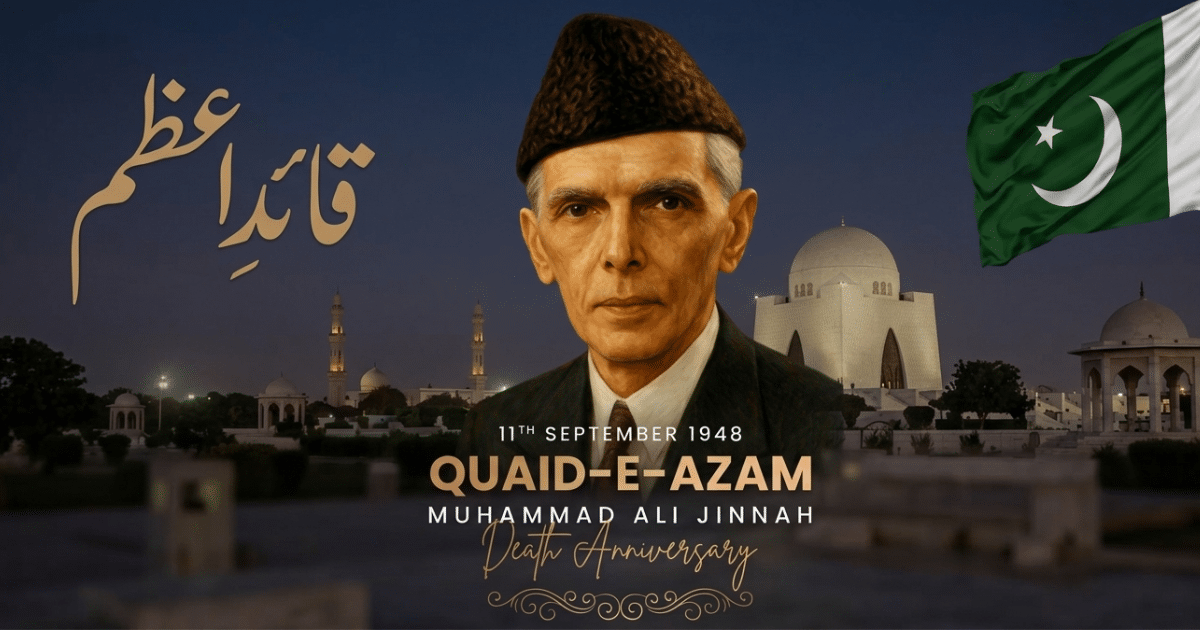





Thirteen months after Pakistan’s creation, Muhammad Ali Jinnah died on September 11, 1948. Every year on this date, his picture is given another coat of official respect: newspaper supplements, television specials, and the country treats him like settled history. And every year the same handful of claims are made about him again. Most are untrue, some even contradictory.
That’s the strange thing about Jinnah in Pakistan. He is simultaneously the most quoted and the least read founding father in the postcolonial world. Everyone can recite a line from his August 11 speech. Far fewer have read the speech in full, or the decade of correspondence that came before it, or the biographies written by people who spent years in the archives instead of the textbook committee room.
On his 78th death anniversary, here are eleven claims about Jinnah that don’t survive contact with the historical record, along with a few extra ones that keep coming up in the same conversations.
Myth 1: A PhD on Jinnah is banned in Pakistan
This is probably the most repeated line in Pakistani political conversation, usually deployed to make a point about state censorship in general. It isn’t true, and it has never been true in any documented sense.
The Higher Education Commission’s own repository lists multiple doctoral theses on Jinnah’s constitutional thought, his legal career, and his role as Governor-General. Sikandar Hayat, now Distinguished Professor of History and Public Policy at Forman Christian College, built an academic career partly on Jinnah scholarship, including his book “The Charismatic Leader: Quaid-i-Azam Mohammad Ali Jinnah and the Creation of Pakistan,” which went through a revised Oxford University Press edition in 2014. Muhammad Farooq Dar’s doctoral work on Jinnah as Governor-General sits in the same tradition. Quaid-i-Azam University in Islamabad, named after the man himself, has hosted this research for decades.

The Charismatic Leader: Quaid-i-Azam Mohammad Ali Jinnah and the Creation of Pakistan
It wasn’t as hard or as dramatic as a ban would have been. School and college textbooks, particularly after Zia’s curriculum reforms in the 1980s, portray Jinnah in a simplistic one-note fashion: as a religious founder and a steadfast Islamic visionary who is above criticism. That picture is complicated by serious academic work, and people who have only seen the textbook version see that as heresy. What is taught in ninth-grade Pakistan Studies and what is published in scholarly history journals are two very different things. This is really what the myth of a ban is all about. The second thing was not illegal. It’s something most people never get to watch.
Myth 2: He wanted a theocracy
This one is rooted in a real fear: was Pakistan to be ruled by clerics? Should religious leaders make the laws, rather than an elected legislature?
Jinnah answered the question himself, more than once, in language that leaves little room for reinterpretation. In a February 1948 broadcast to the people of the United States, he said Pakistan was “not going to be a theocratic State, to be ruled by priests with a divine mission.” He wasn’t being defensive or diplomatic for a Western audience either; he had said versions of the same thing to Muslim League audiences at home. His model of governance, drawn from decades practicing constitutional law at the Bombay High Court, was parliamentary and legislative. He wanted a state built on justice, equality and fair play as he understood them through Islamic ethical principles, not a state where unelected religious scholars held a veto over Parliament.
It’s worth remembering that the clerical establishment of the 1940s was mostly against the making of Pakistan in the first place. Prominent ulema were supporters of the Congress or opponents of the Muslim League. Jinnah’s Pakistan and the clergy’s Pakistan were not the same project, and the conflation of the two obscures a real and important difference.
Myth 3: He wanted a fully secular, religion-free state on the Turkish model
The opposite claim shows up just as often, usually from people trying to recruit Jinnah for a specific kind of liberal nationalism. It overcorrects.
Jinnah’s August 11, 1947 address to the Constituent Assembly is the evidence usually cited for this reading, and it’s genuinely important: he told the assembly that people were free to go to their temples, mosques, or any other place of worship, and that religion would have nothing to do with the business of the state as citizens of one nation. That’s a real and significant statement of civic equality. But Jinnah never called for an Atatürk-style program of state-enforced secularization, never proposed abolishing religious courts for personal law, and continued invoking Islamic concepts of brotherhood and social justice as the ethical scaffolding for the new country right up to his death. He was arguing for equal citizenship regardless of faith, which is a different and narrower claim than the wholesale removal of religion from public life.
Myth 4: The August 11 speech was suppressed or a one-off aberration
Many say that Jinnah’s most famous speech was either censored by the government at the time, or a brief deviation from his true beliefs that was soon forgotten thereafter.
Neither one works. Evidence suggests a government press aide softened or delayed only some newspaper coverage of the speech. This is where the story of suppression gets its basic truth. But the whole thing was read out in the Constituent Assembly, was printed in newspapers of the time, and is part of the official debates of the Constituent Assembly to date. It was not new what was said either. From 1916 to 1937, Jinnah tried to negotiate Hindu-Muslim power-sharing agreements like the Lucknow Pact, believing that people of different religions could work together to run the country as long as they agreed on certain constitutional protections. He stuck to his familiar position in his speech of August 11, even when the situation had changed. It was not an error, as he said later, that he had made.
Myth 5: He wanted partition from the very beginning
Jinnah’s rebranding, in Pakistani textbooks, as a man born with the two-nation theory fully formed erases the most interesting part of his career.
For roughly two decades, contemporaries called him the “Ambassador of Hindu-Muslim Unity,” a title he earned by negotiating the Lucknow Pact between the Congress and the Muslim League in 1916. Through the 1920s and much of the 1930s, his political energy went into securing constitutional guarantees for Muslims as a minority within a unified, federated India, not into building a separate state.
The turning point came later, after the 1937 provincial elections and the Congress’s subsequent refusal to form coalition ministries with the Muslim League in several provinces, which convinced Jinnah that power-sharing within a single Indian state wasn’t going to be honored in practice. The Lahore Resolution came in 1940, more than two decades into his political career. Pakistan was the product of failed negotiation, not a lifelong master plan.
Myth 6: He coined “Nazriya-e-Pakistan,” the Ideology of Pakistan
Search Jinnah’s speeches, his correspondence, or the record of the Constituent Assembly debates, and the phrase “Nazriya-e-Pakistan” does not appear. It was formulated and institutionalized later, largely during the 1960s and hardened further under Zia-ul-Haq’s regime in the late 1970s and 1980s, as a curriculum concept meant to define Pakistan’s founding purpose in explicitly religious-ideological terms.
This is important because Nazriya-e-Pakistan is taught in schools as if it was Jinnah’s own idea, a kind of founding doctrine that he personally bequeathed. It was not. It’s a later government’s old framework for a later political purpose, applied to a man who never used the term.
Myth 7: He founded the Department of Islamic Reconstruction to Islamize the new state
Here’s an example of how institutional history can get murky. The Department of Islamic Reconstruction was set up in Punjab before the partition of India. It was run by the provincial government. The head of the department was Allama Muhammad Asad, an Austrian convert and scholar, who was born Leopold Weiss. It is older than Pakistan as a country and was not started by Jinnah as a central government project after the independence of Pakistan. Later versions of the story transformed a provincial project into something federal under Jinnah, which it wasn’t.
Myth 8: He was quietly promoting a specific sect, or his own faith was irrelevant to his politics
Jinnah was born into a Khoja Ismaili family and, in matters of personal law, later aligned himself with Twelver Shia practice. Both facts are on the record. What isn’t on the record is any effort by Jinnah to build political capital around sectarian identity, in either direction.
He refused publicly to be pinned to a sect, and the most quoted version of that refusal is his rhetorical question to critics: was the Holy Prophet himself a Shia or a Sunni? He treated the question as beside the point of what he was trying to build, which was a state for Muslims defined by a shared political and civic project, not a state defined by which fiqh its founder personally followed.
Myth 9: Non-Muslims were meant to be second-class citizens
The argument is that if Pakistan was created as a home for Muslims, its non-Muslim citizens were at best an afterthought.
This is not true, as Jinnah’s own schedules prove. One of the key posts in the first cabinet was that of Minister of Law and Labor. It was given to Jogendra Nath Mandal, a Hindu Dalit leader from Bengal. In his public speeches on minority rights after 11 August, Jinnah promised that all would have complete freedom of worship and equal rights like others regardless of religion. It is only fair and important to look at what happened to that promise in the decades following his death, when minorities’ rights in Pakistani institutions declined. But it is just a story of what happened after Jinnah, not proof of what he meant.

Jogendra Nath Mandal, 1st Minister for Law and Justice, Government of Pakistan, from 15 August 1947 to 8 October 1950
Myth 10: The Governor-General role was Jinnah setting up autocratic rule
Mountbatten was not made Governor-General. Jinnah was. He also headed the early cabinet, unchallenged as the most important person in it. Over the past seven decades of military coups and executive overreach, this might seem like the basic plan for Pakistani authoritarianism.

Muhammad Ali Jinnah took the oath as the first Governor-General of Pakistan on August 15, 1947
It’s not a good fit for the man’s actual job. Jinnah was a constitutional lawyer who practiced in the Bombay High Court. He built his political platform through legislation, not by organizing the masses on the streets, or by a military alliance. In 1947 and 1948, when there was an emergency- a new state with no bureaucracy, a huge number of refugees, and not enough time to build consensus institutions from scratch- he gathered a lot of power. He rejected Mountbatten’s offer of being Governor-General of both India and Pakistan at the same time. A new country, he argued, should have its own head of state from the very beginning, not share one with a larger, stronger neighbor. This is not a glimpse of martial law. It is a verdict on sovereignty.
Myth 11: His death was hastened by deliberate state neglect
The final myth concerns his death. It occurred on the way back from Ziarat when the ambulance taking him from the airport to Karachi broke down on the road. Jinnah sat in the hot weather for more than an hour while his sister Fatima Jinnah tried to get help. People have been telling this story for decades as proof of a plot: either officials wanted him out, or they were too lazy or indifferent to protect the one man whose standing could have stopped their plans.

The Quaid-e-Azam Residency in Ziarat, Balochistan, where Pakistan’s founder, Muhammad Ali Jinnah, spent his final months in 1948.
The medical record doesn’t support a conspiracy, though it does support the incompetence part. Jinnah had been diagnosed years earlier with advanced tuberculosis complicated by lung cancer, a diagnosis he deliberately hid from nearly everyone, including most of his own cabinet, because he feared what his political opponents would do with the knowledge that Pakistan’s founder was dying. By September 1948, he was in the terminal stage of that illness. The ambulance breakdown was a real and damning failure of state logistics during a period of general administrative chaos. It compounded his suffering in his final hours. It did not cause his death, which had been medically inevitable for some time.
A few more that come up constantly
Some other claims don’t quite rise to the level of the eleven above but get asked often enough to deal with directly.
Did Jinnah drink?
Jinnah smoked heavily, favoring Craven A cigarettes and cigars, and lived an outwardly Westernized life in his Bombay years. His public focus after taking over Muslim League leadership in the late 1930s shifted almost entirely to constitutional politics rather than personal religious observance, which is a separate question from whether he was personally observant, a subject his biographers treat with more caution than certainty either way. There isn’t any evidence that he used to consume alcohol.
Did Jinnah speak Urdu?
His Urdu was limited. English was the language of his legal training, his courtroom career, and most of his political life. He made a genuine effort in his later public appearances to end speeches in Urdu, most memorably with “Pakistan Zindabad,” but his fluency in the language commonly associated with Pakistani nationalism was modest at best.
Why did Jinnah choose Urdu as the national Language?
The 1948 decision to make Urdu the sole national language is often read backward through the lens of 1971, as though Jinnah had set out to erase Bengali identity. In his March 1948 address in Dhaka, he explicitly said provincial languages, Bengali included, would remain in use for regional administrative and academic purposes, while proposing Urdu specifically as a neutral federal link language across a state that included Punjabis, Bengalis, Sindhis, Baloch and Pashtuns. Whether that policy was wise, given what followed over the next two decades, is a fair question. Whether it was designed as an attack on Bengali culture is a different question, and the record doesn’t support it.
Did Jinnah leave any property in India?
On property, Jinnah kept his Malabar Hill mansion in Bombay for years after independence, hoping India and Pakistan would settle into a relationship closer to Canada and the United States than to hostile neighbors, a hope that didn’t survive the violence of Partition. His 1939 will, though, left the bulk of his estate to educational institutions, including Aligarh Muslim University, Sindh Madressatul Islam and Islamia College Peshawar.
Did Jinnah support feudalism?
On class politics, Jinnah warned his own party as early as 1943 against the landlords and capitalists inside it, telling a Muslim League session in Delhi that the exploitation of the masses had “gone into their blood” and that he would have no part in a Pakistan built on that exploitation. He allied with landed elites for electoral reasons under the colonial franchise rules of the period, which is different from sharing their politics.
What were Jinnah’s views on women?
And on women, he brought his sister Fatima Jinnah into nearly every major political meeting of his later career, an unusual choice in the political culture of 1940s South Asia, and told an audience that no nation could rise to greatness while its women stayed behind.
You May Like To Read: NAVTTC’s Free Livestock, Fisheries, and Export Logistics Training: What You Need to Know
The biographies worth reading, and why none of them settles the argument
If the myths above have a common root, it’s that most people’s picture of Jinnah comes from textbooks, television specials, and secondhand quotation rather than from the biographical literature itself. That literature exists, it’s substantial, and it disagrees with itself in instructive ways.
Stanley Wolpert’s “Jinnah of Pakistan” (1984)
It is no accident that newcomers to the subject are usually told to start by reading Stanley Wolpert’s “Jinnah of Pakistan” (1984). Wolpert, an American historian with no political dog in the fight of either country’s founding mythology, wrote what remains the most widely read single-volume biography of Jinnah. It traces his life from his childhood in Karachi to his training as a lawyer in London to the founding of a state. His famous opening line, “Few people significantly alter the course of history, fewer still modify the map of the world, hardly anyone gets credit for creating a nation-state,” sets the tone: he is admiring but not uncritical, and his writing is based on facts, not hagiography.

Ayesha Jalal’s “The Sole Spokesman: Jinnah, the Muslim League and the Demand for Pakistan” (1985)
Ayesha Jalal’s “The Sole Spokesman: Jinnah, the Muslim League and the Demand for Pakistan” (1985) is the more argumentative and more academically consequential of the two major mid-1980s biographies. Jalal’s central and still-debated thesis is that Jinnah may have used the demand for Pakistan as a maximalist bargaining position to extract genuine autonomy for Muslim-majority provinces within a loose Indian federation, rather than pursuing full partition as an end in itself, and that partition became the outcome less by original design than by the collapse of negotiations in 1946 and 1947. Historians still argue over how much weight this reading can bear. It remains one of the most cited works in the field regardless.

Ayesha Jalal’s “The Sole Spokesman: Jinnah, the Muslim League and the Demand for Pakistan” (1985)
Sikandar Hayat’s “The Charismatic Leader: Quaid-i-Azam Mohammad Ali Jinnah and the Creation of Pakistan”
Sikandar Hayat’s “The Charismatic Leader: Quaid-i-Azam Mohammad Ali Jinnah and the Creation of Pakistan” applies Max Weber’s theory of charismatic authority to the rise of Jinnah. It argues that Jinnah’s authority over the Muslim League was not based on an institutional position or an inherited status, but on a particular form of personal authority. Some reviewers have quibbled with some elements of it, particularly the sections where Jinnah is compared to people like Lenin or Kemal Atatürk, which some historians feel are a bit over the top. It’s serious scholarship, not some secret or forbidden paper the way the PhD myth makes it sound.
Jinnah: Myth and Reality” (2012)
Yasser Latif Hamdani, a Lahore-based lawyer, has written two books that speak most directly to the myths in this piece: “Jinnah: Myth and Reality” (2012), an extended argument rather than a chronological biography, built around the claim that Jinnah never envisioned a theocratic state and that Pakistan’s Islamization since his death runs contrary to his own vision, and the later “Jinnah: A Life,” a fuller biographical treatment covering his personal and political life together rather than separating them, a gap Hamdani argues earlier biographies left open.

Jinnah: Myth and Reality” (2012) by Yasir Latif Hamdani
Jaswant Singh’s “Jinnah: India, Partition, Independence” (2009)
Worth naming too: Jaswant Singh’s “Jinnah: India, Partition, Independence” (2009), written by a senior Indian politician rather than an academic historian, which controversially argued that Jinnah has been unfairly demonized in Indian nationalist memory. The irony is worth sitting with. The book that got formally banned, and got its author expelled from his own party, was banned in India, not Pakistan, over a sympathetic reading of Jinnah. The country that actually restricted a Jinnah book is the one usually accused, wrongly, of banning research on him.
None of this settles the argument about who Jinnah really was, and treating any single biography as the final word would repeat the same mistake as the textbook version, just with better footnotes. Jalal and Wolpert disagree on how deliberately Jinnah pursued partition. Hamdani writes with an explicit corrective agenda against Islamist appropriation of Jinnah’s legacy, which is a legitimate project but not a neutral one. Sikandar Hayat’s framework has been challenged on its own terms by other South Asianists. Large parts of Jinnah’s personal correspondence were lost, destroyed, or never made fully accessible to researchers, and his own guardedness about his private life- he described himself simply as “plain Mr. Jinnah,” gave biographers less primary material to work with than they had for contemporaries like Nehru or Gandhi, both prolific writers of letters and memoirs. Every biography of Jinnah is working with real gaps, filled in with inference and interpretation that reflects the biographer’s own priors as much as the surviving record.
What the record does settle, repeatedly and without much room for dispute, is the specific set of claims examined here. He didn’t want a theocracy. He didn’t invent Nazriya-e-Pakistan. Nobody banned research on him. He didn’t sideline non-Muslims from his first cabinet. And whatever failed him in his final hours on that Karachi road, it wasn’t a plot. The bigger, genuinely contested questions about his politics- whether partition was his goal from the start or his last resort, whether his vision for the state could have survived the decades that followed- are exactly the kind of questions serious historians keep arguing about in the books named above. That argument is worth having. It’s a different argument than the myths.
You May Like To Read: UN’s New World Map Resolution 2026: Why the Kashmir Dispute Is Back in Global Focus