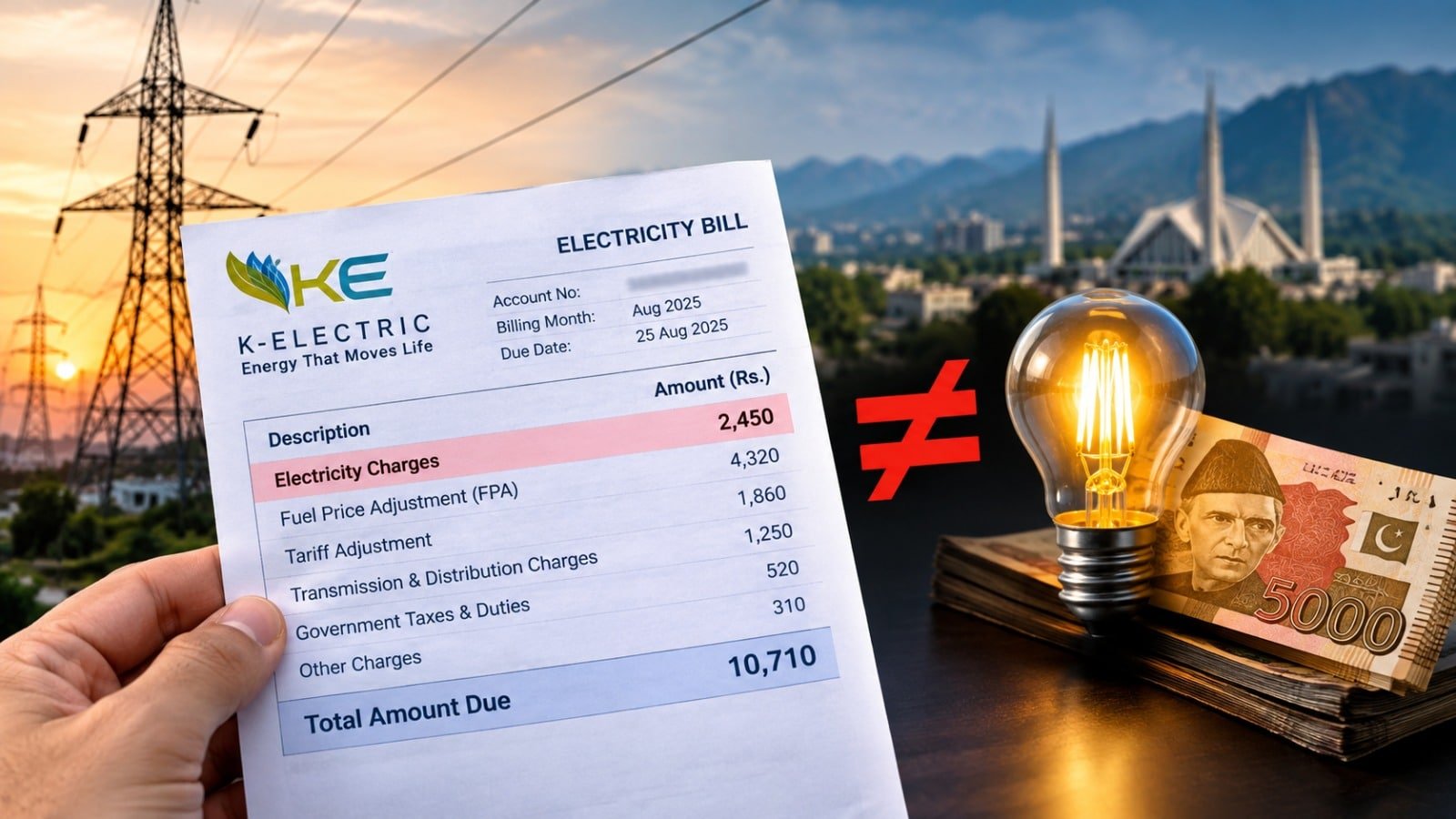




A shopkeeper in Lahore puts on his fan and one air conditioner for a few hours every night in July. His electricity bill is Rs 38,000. He reads it through twice. He asks his neighbor, who got the same amount on his bill. Both of them walk out of the store and take out their phones to calculate. Neither of them has any idea why they have to pay this large amount for only a few hours of electricity usage.
They’re not alone. Most Pakistani households can’t say what’s inside their electricity bill. They know the total. They know it hurts. They don’t know that a big slice of it has nothing to do with the power they used.
This post walks through that bill line by line. It explains where the money goes, why the price keeps climbing, and why millions of people are putting solar panels on their roofs and leaving the grid behind.
What’s actually on your bill
Pick up a recent bill from LESCO, MEPCO, IESCO, K-Electric, or any other distribution company. You’ll see a small table near the top. It looks like a list of charges. It’s really a list of everything the system needs to recover from you.
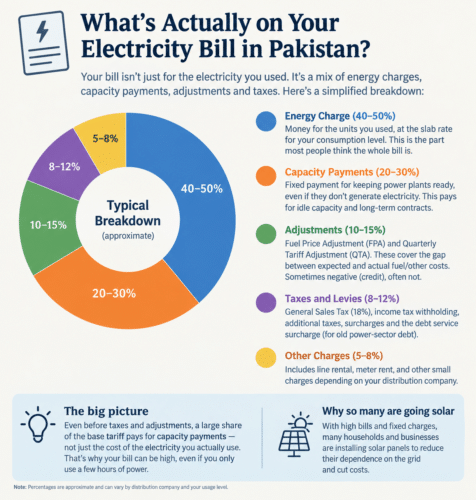
The first line is the energy charge. This is the money for the units you used, at the slab rate for your consumption level. It’s the part most people think the whole bill is.
Then come the adjustments. The fuel price adjustment, or FPA, corrects for the gap between the fuel cost NEPRA assumed and the cost the power plants really had. If gas, coal, or imported fuel cost more than planned, you pay the difference a month or two later. The quarterly tariff adjustment, or QTA, does something similar every three months for other costs. Sometimes these adjustments are negative and you get a small credit. Often they’re not.
Next are the taxes and levies. General sales tax is 18 percent on the bill. There can be income tax withholding, an extra tax, and various surcharges. Some of these have changed in recent budgets, so check your own bill. There has also been a debt service surcharge, which goes toward paying off old power-sector debt. You’re paying, in part, for money the system borrowed years ago.
Add it all up, and you get the number that shows up on your phone at the start of the month.
Here’s the catch. Even before the taxes and adjustments, the base tariff you’re charged for each unit isn’t just the cost of making that unit. A large share of it pays for power plants sitting idle.
Capacity payments: paying for power you didn’t get
The simplest way to understand a capacity payment is to think of a taxi.
Say you hire a taxi driver by the month. You promise to pay him Rs 100,000 whether you take one ride or a hundred. If you take a hundred rides, you also pay for fuel. If you take none, you still owe the Rs 100,000.
That’s a capacity payment. The government promised power plant owners a fixed payment for having their plants ready to run. It doesn’t matter whether the grid asks them to produce anything. Fuel costs are on top of that, and only when the plant runs.
This isn’t a crazy idea by itself. A power plant is expensive to build. An investor won’t spend hundreds of millions of dollars without a guaranteed return. Capacity payments give them that promise. Around the world, plenty of countries use some version of this.
The problem in Pakistan is the size of the promise, and the size of the gap between what was promised and what the country needed.
How it got so big
In the 1990s, Pakistan had blackouts and needed power fast. The government offered generous terms to attract private investors. Payments were tied to the US dollar. Returns were guaranteed. The government, not the investor, took most of the risk.
Then came a second wave of projects in the 2010s, including big coal plants and other energy projects under CPEC, the China-Pakistan Economic Corridor. Load shedding was hurting the economy and the government wanted it gone. New plants were built on similar terms.
The plants worked. The blackouts eased. But demand didn’t grow as fast as planners expected. Roughly speaking, Pakistan built a system with a capacity of around 46,000 megawatts. Peak demand on the hottest days sits near 29,000 megawatts, and for much of the year it’s lower. That leaves a lot of plant capacity idle, and the contracts say idle plants still get paid.
Capacity payments have run to around Rs 2 trillion a year in recent years. Think about that figure. It’s more than the government spends on many of its big departments. And it’s charged to households and businesses, unit by unit, whether they want to buy that capacity or not.
The dollar and the rupee
Many of these payments are linked to the dollar. When the rupee falls, the payments go up in rupee terms. Between 2018 and 2023, the rupee lost a huge share of its value. Every drop pushed capacity payments higher, and the bill went up with it.
That’s one reason why your bill can jump even when you use the same number of units as last year. The unit price didn’t rise because electricity got more expensive to make. It rose because the fixed obligations got more expensive to pay.
Who gets the money
It’s easy to picture a small group of rich plant owners cashing checks. Part of that is true. Independent power producers, or IPPs, receive a large share. Some of them earned high returns under the old contracts, and that has been a political fight for years.
But it’s not the full picture. A big chunk of capacity payments also goes to government-owned plants. Hydropower and nuclear plants, and plants built under government-to-government deals, get paid too. Some of the largest payments go to Chinese-financed coal plants under CPEC agreements. Those deals involve loans, foreign partners, and diplomatic weight, which makes them hard to change quickly.
The lesson here is that no single villain sits behind your bill. Successive governments signed contracts. Regulators approved them. Planners overestimated demand. Each decision made sense at the time, and together they created a system that costs more than the country can comfortably pay.
Circular debt: the hole that keeps growing
If capacity payments explain why the bill is so high, circular debt explains why it never seems to get better.
Here’s how it works. The power system is a chain. Consumers pay the distribution companies. The distribution companies pay the government-owned power buyer. The buyer pays the power plants. The plants pay their fuel suppliers.
Now suppose money goes missing at the start of the chain. Some customers don’t pay. Some steal power. Some government bodies pay late or not at all. The distribution company can’t send the full amount up the chain. The buyer can’t pay the plants on time. The plants can’t pay their fuel suppliers. Everyone waits for someone else. The unpaid amount piles up, and the pile has a name: circular debt.
Circular debt has crossed the Rs 2 trillion mark in recent years. The government has tried several times to clear it. It has arranged loans from banks to pay off a large chunk. But paying off the debt with a loan just moves the problem. Somebody has to repay the loan, and that somebody is the electricity consumer, through a surcharge that shows up on the bill.
Unless the gap between what the system costs and what it collects gets closed, the debt grows back. It’s a bathtub with the tap on and the drain half open.
Line losses and theft: the honest customer pays twice
There’s one more leak, and it hits people who pay their bills on time the hardest.
Some electricity is lost between the power plant and your meter. Some is lost as heat in old wires and weak transformers. Some is stolen through illegal connections or by tampering with meters. In some areas, the distribution company doesn’t even try to collect from certain customers.
In official terms, these are called transmission and distribution losses. In some distribution company areas, they run well into double digits. In a few, they’re much worse than the national average.
Regulators allow a certain level of loss to be built into the tariff. Anything above that level is supposed to be the distribution company’s problem. In practice, a lot of it still ends up spread across paying customers. If you’re in an area with low theft and honest meter readers, you help cover the cost of areas with high theft.
That’s the part that makes people angriest. The system rewards the ones who don’t pay and charges the ones who do.
Taxes on top of everything
After the tariff, the adjustments, and the surcharges, the taxes arrive.
General sales tax adds 18 percent to a big portion of the bill. Other taxes and duties have come and gone over the years, depending on the budget and on what the provinces and the federal government agreed. Some households also pay income tax withholding on the bill, based on their usage.
Governments like electricity bills as a tax tool. Almost every household has a connection. The bill arrives every month. Collection is automatic. It’s far easier than chasing shopkeepers or landowners to file returns. So a bill that carries the cost of idle plants and old debt also carries a share of the national tax burden.
That’s how a bill can end up feeling like a tax notice with a few units of electricity attached.
The solar revolt
Now we get to what’s changed most in the last three years. Ordinary people found a way out.
Solar panels from China got cheap. Very cheap. At the same time, grid electricity got expensive. In 2024, the gap between the two became too big to ignore. A family could spend a few lakh rupees on panels and an inverter, and stop paying a monthly bill that had grown to Rs 30,000 or more. The payback period dropped to a couple of years, sometimes less.
Pakistan imported panels at a staggering pace. Ember, an energy research group, estimated that the country brought in about 17 gigawatts of solar panels in 2024 alone. That’s a lot of capacity added, mostly by individual households, shops, farms, and small factories, with no government program behind it. Solar in Pakistan spread from the ground up, and it happened fast.
You can see it in the neighborhoods. Rooftops in Lahore, Karachi, Islamabad, and Faisalabad are covered in panels. Tube wells in Punjab run on solar. Small mills and offices have their own systems. People aren’t doing it because they love the environment (though some do). They’re doing it because it saves money.
Why the grid gets worse when people leave
Planners will be concerned with this section. Every household that switches to solar energy reduces the grid demand. But the grid is expensive. Very expensive. “The payments for capacity do not change. Debt payments remain the same. Transformers and wires need constant attention.
That means the same fixed costs are spread over fewer units. The unit price goes up. This means more and more people are using solar energy. This leads to an additional reduction in demand. Some analysts call it a death spiral. It is not a poetic term. It is quite straightforward arithmetic. If the rent of a stadium is fixed, and half of the fans decide to stay at home, the costs of the tickets for the remaining fans go up.
Households that can pay for solar panels are permitted to do so. The bill is therefore due to those who cannot do so. This increases the financial burden on poor families, renters, and apartment dwellers who are not responsible for their roof.
The net metering fight
Many solar households remain connected to the grid so they can push excess power onto the grid and get credit for it. This is called net metering. The government paid solar users for a long time at a rate close to the retail price of the electricity. This further improved the value of solar, and some people thought it was too generous.
In 2025, the government cut the rate paid for exported electricity to around Rs 10 or 11 per unit from the earlier rate of more than Rs 20. The reason given was that the grid was buying power from the rooftop users at a higher rate than it could buy from other sources, and it was being passed on to other consumers. Solar owners said it was a bait-and-switch; they’d invested, and the government betrayed them. Rules can still change, and both sides have a good point. Make sure to check the latest NEPRA regulations before you sign a contract or size a system.
What the government has done so far
The government isn’t standing still. Over the past two years, it has tried a few things.
It renegotiated contracts with a number of IPPs. Some older plants agreed to lower returns. A few contracts were ended. The government said this would save a big sum over the life of the deals. Details and the final numbers are still being argued over.
Per-unit price relief was announced. In April 2025, the prime minister had said households and businesses would get a cut of around Rs 7 per unit. It also provided families a little breathing room. The bill was not changed in structure.
It has spoken about bettering recovery and reducing losses in the worst-performing distribution areas, and it has secured financing to reduce circular debt. The privatization of distribution companies is also a matter that has been discussed and revisited.
None of these procedures by themselves solves the underlying problem. The contracts are still in effect. There is still overcapacity. The debt needs to be serviced more. A tweak two months later can wipe out the relief gained in one month.
What you can do about your own bill
‘We won’t be able to renegotiate a power contract. But there is a way to have some control over what comes to your door.
First, look at the bill. Read it carefully. Units used, last reading, current reading. Compare them to your own meter. Take a picture of the meter each month. Meter readers are human, and estimated readings can lead to a higher rate.
Know the slabs. The more electricity you use, the higher the rates go. When you reach a threshold of, say, 200 units, you can change the rate on all your units, not just the incremental ones. Some households are paying substantially more because of an overage of a few units. Track your usage in the last week of the billing cycle.
If you think your bill is wrong, raise a complaint. Start with the complaint center or app of your distribution company. In case of no response, escalate the matter to the provincial office of the electricity ombudsman or the NEPRA complaint system. Save your receipts, photos, and old bills. Those who document their case are more likely to win than those who argue on the phone.
Take a look at your heaviest loads. Usually it’s the air conditioner in summer. An old fixed-speed unit consumes more energy than an inverter AC does. A few degrees more temperature means a lot of energy saved. Turn off irons and water pumps when not in use. Energy-efficient LED lights and fans are inexpensive and pay for themselves quickly.
Thinking of installing solar panels? Get a few quotes. Ask about the warranty, the inverter type, the brand of the panel, and what happens in a power failure. Ask about whether the system will be grid-connected and under what regulations. If the system is poorly proportioned, there will be no appreciable savings. A size that is too large may not be economically viable in light of the revised export rate. Never trust someone who promises a zero bill without asking your usage first.
What to watch next
The next few years will see your bill driven by three things.
First, what about the rest of the IPP agreements? Every rupee taken off capacity payments is a rupee taken off the base tariff for everyone. Watch the length of the negotiations and the depth of the negotiations.
Then, the treatment of solar users by the government. If the grid charges them an extra fee to continue using the grid, then some will leave the grid altogether. This will reduce the demand for the grid even further . So if the grid continues to buy their power at a low cost, they get some relief, but solar households get less value.
Third, whether distribution companies recover their losses. This is the least glamorous, but perhaps the most important one. Better meters, better theft prevention, and transparent collection practices would be a relief for every paying customer.
Frequently asked questions
Why is my electricity bill so high in Pakistan?
There are a lot of reasons. Within the base tariff, power plants receive large fixed capacity payments. Fuel and quarterly adjustments are not added until later. Taxes and surcharges are added on top of this. Losses and theft inside the system increase the costs of paying customers. The rupee’s decline has also led to more payments being made in dollars.
What are capacity payments?
They’re fixed payments to power plants for being available, whether or not the grid uses their power. They’re meant to protect investors, but Pakistan’s system has more capacity than it needs, so a lot of money goes to plants that run below their potential.
What is circular debt in the power sector?
It’s the growing pile of unpaid money between consumers, distribution companies, the government power buyer, power plants, and fuel suppliers. When one link doesn’t pay in full, the shortage travels down the chain and builds up over time.
Is solar worth it in Pakistan?
For many households and small businesses, the answer is “yes.” Grids are expensive, and panels are cheap, so the payback period is often short. But the rules for net metering have been changed, resulting in lower rates for exported power. Get a couple of quotes and check the latest rules before you buy.
How can I check if my electricity bill is correct?
Compare the meter reading on the bill to the reading on your meter. Check the slab rate, units, and changes needed. Keep photos on a monthly basis. Have a problem? Lodge a complaint with your distribution company and, if need be, escalate it to NEPRA or the ombudsman.
Does using less electricity lower my bill?
Indeed, and often to a greater extent than one might expect. The rates increase by slab so if you can keep under a threshold you can reduce the rate on all of your units. The highest impact is obtained through the use of energy-efficient appliances and the smart operation of air conditioning units.
You May Like To Read: How to Get Pakistan’s Rs100-Per-Litre Petrol Subsidy: Complete Registration Guide