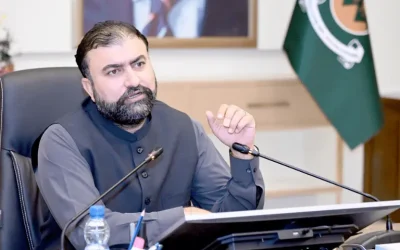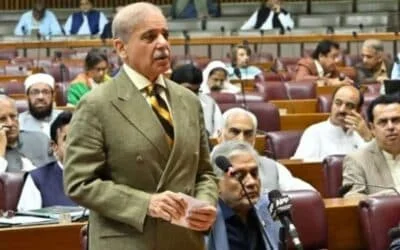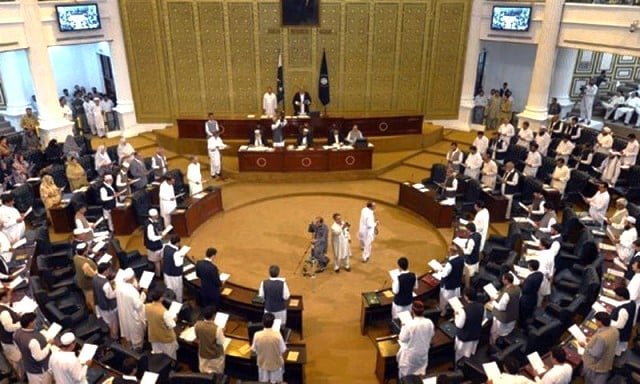





The Balochistan Assembly passed several bills and resolutions on Monday, including new legislation on child labor and reproductive healthcare rights. The House passed the Balochistan Employment of Children (Prohibition and Regulation) (Amendment) Bill 2026, the Balochistan Protection and Promotion of Reproductive Healthcare Rights Bill 2026 and a bill for the construction of safe homes in various districts.
Main Highlights
- Assembly approves bills on child labor, reproductive healthcare rights
- House passes resolution demanding legislation to end acid attacks
- Irrigation minister says 886 dams completed, 223 under construction
- CM Bugti discusses liquor shop licensing in session
- Water resources, criminal procedure bills go to committee
Presenting the #Balochistan Employment of Children (Prohibition and Regulation) Amendment Bill during the Assembly session, as part of our continued commitment to protecting children’s rights and strengthening their welfare in Balochistan. pic.twitter.com/pY9TwrdFAj
— Dr Rubaba Khan Buledi (Sitara-E-Imtiaz) (@Dr_RubabaBuledi) August 31, 2026
A Comprehensive Legislative Agenda In One Sitting
Besides child labor and reproductive health bills, the House passed a resolution demanding effective implementation of the National Action Plan to strengthen law and order and fight extremism, terrorism and unrest in the province. Two other bills, the Balochistan Water Resources Management Bill 2026 and the Code of Criminal Procedure (Balochistan Amendment) Bill 2026, were not passed but referred to the relevant standing committees for further review.
The session also saw a wider debate on the law and order situation in the province, chaired by Speaker Abdul Khaliq Achakzai. Members from the treasury and opposition benches called for a joint strategy to address the ongoing security challenges, as well as an in-camera session to speak freely on the matter.
CM Bugti’s Comments on Liquor Shop Controversy
During the session, Chief Minister Mir Sarfraz Bugti answered the questions about liquor shops working in the province. “These shops are exclusively for non-Muslim residents and were there even before the creation of Pakistan,” he said. He said that he himself does not drink alcohol, and if any liquor shop has been named after a particular locality which has caused concern for some reason, then the government will change the name of the shop or take action against it.
In another matter, MPA Rahmat Saleh Baloch moved a call-attention notice on implementation of an employment quota for the families of deceased persons in Panjgur. The issue was resolved after the provincial health minister assured the House. In reply to another call-attention notice of MPA Maulana Hidayatur Rehman about dams and canals, the provincial irrigation minister told the House that 886 dams have been completed across Balochistan with another 223 under construction. That notice too was disposed of after the minister’s assurance.
Lawmakers Reach Consensus on Acid Attack Legislation
One of the more emotional moments in the session was the adoption of a joint resolution calling for effective legislation to prevent acid attacks and protect the victims. The resolution was presented by MPA Shahida Rauf on behalf of the Women Parliamentary Caucus, strongly condemning the recent attack on Dr Mahnoor Nasar and calling for stronger legal action to curb such incidents in the future.
In the broader debate, lawmakers exchanged heated remarks, with several members talking over one another at times. But the tension later eased when female members of the assembly united to show solidarity with women victims of acid attacks, a moment that rose above some of the more bitter exchanges of the session.
A Province Passing Difficult, Overdue Laws
Monday’s session was notable for the number of issues addressed in a single sitting. In Balochistan specifically, child labor, access to reproductive healthcare, safe homes for vulnerable residents and acid attack prevention are all issues that disproportionately affect women and children – groups that have historically had less legislative attention directed their way. Passing substantive bills on child labor and reproductive health in the same session, instead of treating them as isolated one-off measures, suggests that these issues are getting sustained attention from the current assembly rather than sporadic mentions.
With that in mind, it’s worth being clear about what this session does and doesn’t prove. A single productive sitting is a really good sign, but it’s not evidence of a longer, multi-year trend by itself, without a broader record to compare it to. What can be said with confidence is that this session in particular advanced a few pieces of meaningful social legislation together, dealt with acid attack prevention with rare cross-party unity, and left two more substantial bills, on water resources and criminal procedure, in committee for further work. Whether this is a real turning point for the assembly’s legislative output will be seen in subsequent sessions in the months ahead.