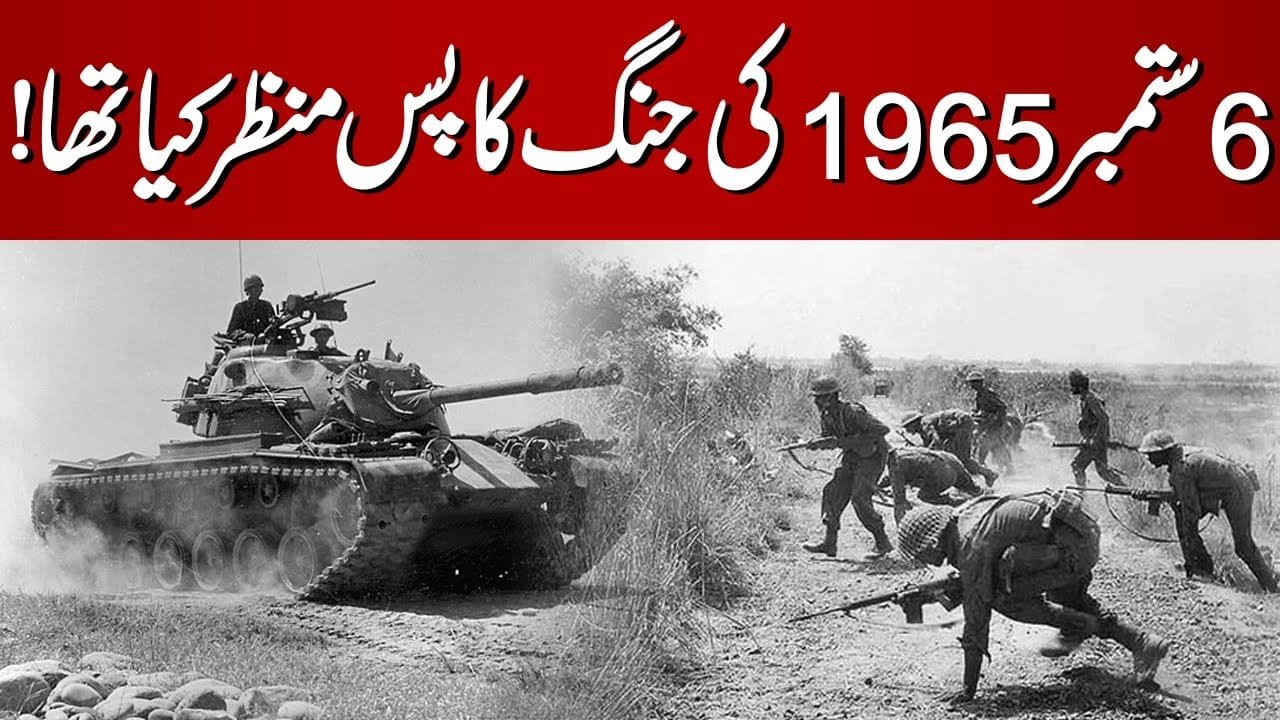





Every year, Pakistan observes Defense Day on September 6, the day when the Indian forces crossed the international border and the war with India began in earnest. But September 5 has its own significance in that story: the last full day before a limited conflict over Kashmir escalated into a full-scale war along the Punjab frontier, and the day when the die was effectively cast for what followed.
Key Highlights
- September 5, 1965 was the last day before India’s full-scale attack on Lahore.
- The war had started in Kashmir with Operation Grand Slam on September 1
- India used September 5 to finalize plans for a three-pronged attack on Lahore
- Pakistani troops and civilians spent the day preparing for an assault that came before dawn on September 6
The War is Already Raging, But Not Yet at Its Peak
By September 5, the war of 1965 had technically been going on for several days, though not yet in the form of the border-wide conflict it would soon become. On September 1, Pakistan launched Operation Grand Slam, advancing into the Chamb sector of Jammu to seize Akhnoor, an Indian logistical hub. That offensive had made early gains, unsettling Indian military planners and creating real concern in New Delhi that Akhnoor, and with it, India’s supply lines into Kashmir, could fall.
That concern shaped the events of September 5. As the Indian military and political leadership faced the prospect of losing Akhnoor, they made a consequential decision. Rather than fighting on just in Kashmir, India would open up a whole new front, striking directly at Pakistani Punjab to take the pressure off Chamb and to force Pakistan to divert its forces. September 5 was the day the plan was born and set in motion.
The Calm Before Three Prong Attack
On the Pakistani side of the border, September 5 dawned a strange, uneasy quiet. Fighting went on in the Chamb-Jaurian sector, but there had been no major hostilities along the international border near Lahore and Sialkot. That would be in a few hours. On September 5, Indian forces spent the day getting ready for a three-pronged attack on Lahore, an attack aimed at catching Pakistan unawares and not giving it time to reinforce itself.
The attack came before dawn on September 6, taking much of Pakistan by surprise in its scale, but tensions had clearly been building for days. On several axes, the Indian troops crossed the international border, pushing toward Lahore itself, a city only a few kilometers from the frontier and offering little natural defensive depth. What followed became the defining chapter of the war, soldiers and ordinary residents of Lahore standing together to hold the Bambanwala-Ravi-Bedian Canal line, an improvised but ultimately successful defense that would become the defining role of the city in the conflict.
Why Sept. 5 Remains Important
History tends to remember the day an attack starts rather than the day it was decided upon, and September 6 has rightly become the day Pakistan observes as Defense Day, marking the moment the nation’s soldiers and civilians rose to defend Lahore against the crossing. September 5 itself is a date worth remembering. The last moment before the defining chapter began, when Pakistan’s military and political leadership still had only partial knowledge of what was coming, and ordinary citizens in Lahore, Sialkot and around Punjab had no idea that the next morning would bring them directly into a war that, until then, many had assumed would remain confined to Kashmir.
September 5 is a reminder, in that sense, of how quickly the character of the war changed in 1965, from a limited operation over disputed territory into a full-scale national conflict that would last seventeen days and leave a permanent mark on how Pakistan remembers its own history. Sixty-one years later, that quiet, uncertain day before the storm is a small but meaningful part of the larger story Pakistanis tell every September of resilience, sacrifice and the defense of the homeland.