


Islamabad | November 15, 2025: The newly created Federal Constitutional Court (FCC) formally began functioning on Friday, but its inauguration was overshadowed by a widening judicial and political crisis, a boycott by senior Islamabad High Court (IHC) judges, and persistent questions over the criteria — or lack thereof — used to select its judges.
The court’s formation, enabled under the controversial 27th Constitutional Amendment, continues to spark fierce criticism from lawyers, constitutional experts and sections of the judiciary who fear that the amendment — and the FCC itself — undermine judicial independence, sideline the Supreme Court, and give the executive unprecedented power over judicial appointments.
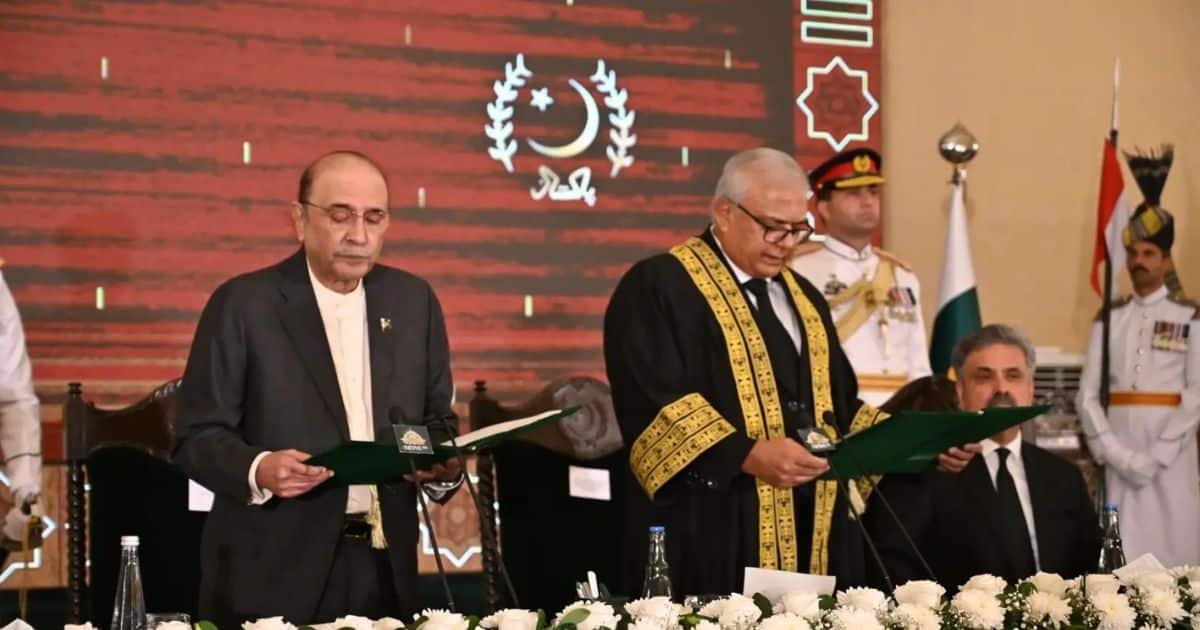
You May Also Like: Justice Aminuddin Khan Takes Oath as Pakistan’s First Federal Constitutional Court Chief Justice
Boycott and Questions of Legitimacy
Despite the government’s insistence that the FCC would strengthen constitutional adjudication, the absence of five senior IHC judges from the oath-taking ceremony told a different story. Justices Mohsin Akhtar Kayani, Tariq Mehmood Jahangiri, Sardar Ejaz Ishaq Khan, Babar Sattar, and Saman Rafat Imtiaz boycotted the event, signalling acute discomfort within judicial ranks.
Equally striking was the absence of Chief Justice of Pakistan Yahya Afridi and other Supreme Court judges from the IHC ceremony, although the CJP did attend the earlier oath administered at the Presidency.
At the heart of the controversy lies a recurring question: What principle guided these appointments?
If seniority was the standard, several judges from the Supreme Court’s now-defunct Constitutional Bench (CB) — including those who authored major constitutional judgments — were overlooked. If expertise in constitutional jurisprudence was the criterion, critics argue that only Justice Aminuddin Khan, now FCC Chief Justice, has a significant record in the field.
A senior constitutional lawyer remarked that “people have every right to know the transparent criteria on which these judges were picked,” adding that the FCC had become controversial even before its first sitting, especially after the resignation of two Supreme Court judges.
Resignations Accepted — Lawyers Call Them ‘National Heroes’
President Asif Ali Zardari on Friday formally accepted the resignations of Supreme Court Justices Syed Mansoor Ali Shah and Athar Minallah, who stepped down in protest immediately after the 27th Amendment became law. Both termed the amendment a grave assault on the 1973 Constitution.
In a statement, 14 prominent lawyers, including Muneer A. Malik and Makhdoom Ali Khan, expressed sorrow but hailed the judges as “national heroes who prized principles over expediency.”
They warned that the resignations marked “the demise of the Supreme Court and the extinguishment of the last members of an independent judiciary.”
Allegations of Court-Packing
Legal experts fear that the government has engaged in court-packing — appointing judges perceived as loyal or compliant in order to influence future constitutional rulings.
Former additional attorney general Tariq Mehmood Khokhar did not mince words, calling the FCC’s inauguration “the death rites of the nation’s constitutional order,” arguing that the government had used an “unelected legislature to disempower the Supreme Court.”
Veteran lawyer Muneer A. Malik echoed this concern, vowing to oppose the 27th Amendment “tooth and nail”. He said the opaque appointment process was “non-transparent and absolutely a joke.”
Who Was Appointed?
According to the law ministry’s notification, the FCC judges appointed under Articles 175A(3) and 175C include:
-
Justice Aminuddin Khan – Chief Justice, FCC
-
Justices Syed Hasan Azhar Rizvi, Aamer Farooq, Ali Baqar Najafi, Muhammad Karim Khan Agha, Rozi Khan Barrech, and Arshad Hussain Shah
Justice Musarrat Hilali declined elevation to the FCC, sources said.
Administrative Uncertainty and Makeshift Arrangements
Though the FCC began proceedings on Friday, it currently lacks a permanent building. Temporary arrangements are being negotiated because:
-
The Federal Shariat Court objected to relocating to the IHC building.
-
The FCC Chief Justice is attempting to secure courtrooms inside the Supreme Court building, a move likely to heighten tensions between the two institutions.
If the Supreme Court administration denies space, the FCC will temporarily operate from the IHC beginning Monday.
Full Court Avoids Controversy, Approves New SC Rules
Contrary to expectations, the Supreme Court’s full court meeting, chaired by CJP Yahya Afridi, did not discuss:
-
The FCC appointments
-
The 27th Amendment
-
The resignations of Justices Minallah and Mansoor Ali Shah
Instead, the full court approved the Supreme Court Rules 2025, and granted senior advocate status to Muhammad Munir Paracha.
This silence on key constitutional developments has surprised many, given the gravity of the institutional crisis.
“People have every right to know the transparent criteria on the basis of which these judges were picked to create history by becoming judges of the FCC, and on what basis other CB judges were sidelined,” commented a senior counsel.https://t.co/XINVd2Ipn2
— Dawn.com (@dawn_com) November 15, 2025
A New Court, A Deepening Crisis
The FCC was designed — at least on paper — to exclusively handle constitutional questions and reduce the Supreme Court’s backlog. Yet even before the first case has been heard, the court faces:
-
Questions of legitimacy
-
A boycott from senior judges
-
Opaque appointment procedures
-
A perceived executive attempt to dominate the judiciary
-
An unresolved institutional clash with the Supreme Court
Critics warn that the FCC risks being viewed as a politically engineered institution, rather than an impartial guardian of the Constitution.
With Pakistan’s judiciary already fractured, the operationalisation of the FCC marks not a fresh chapter, they argue, but the beginning of an unprecedented constitutional confrontation — one whose outcome may reshape the country’s judicial architecture for decades to come.
Check out our latest video: