


The Hunger Games is a book-turned-movie by Suzanne Collins that presents a dystopian world in which a powerful Capitol exploits and oppresses the 12 districts by using hunger, violence, and fear as tools of control. Audiences around the world have cheered on its main protagonist, Katniss Everdeen, who rebels against the oppressive regime. Audiences applaud as the oppressed stand tall, while oppression crumbles and moral justice triumphs in the end. The irony, however, is palpable. When life starts imitating art, most recently in Gaza, the same predominantly Western audiences and governments look the other way. The morality they become so enamored of in theaters does not normally apply in real life.
Parallels Between ‘The Hunger Games’ and Gaza
A controlled and isolated population
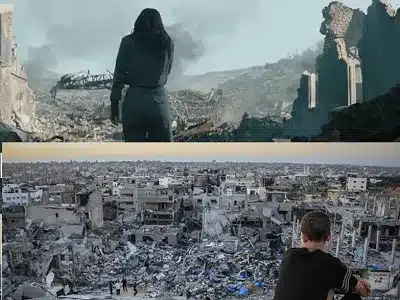
In The Hunger Games, the Capitol limits access to resources, mobility, and basic needs in the districts. Similarly, Gaza is being strangled from all sides by an Israeli blockade that is from land, air, and sea. It restricts their movement, trade, and access to medicine and food severely. Since 2020, Gaza has been declared “unlivable” because of the blockade, which began in 2007, according to UN OCHA. District 12’s starvation and despair scenes are observed in today’s Gaza, where more than half the population is suffering from severe food insecurity, and UN aid shipments have become all but impossible to reach because of the Israeli government’s oppressive tactics.
Satellite photos show Gaza Strip before and after Israeli airstrikes!#Gaza_under_attack#CeasefireNow#Palestine#Israeliwarcrimes pic.twitter.com/XnmZ221elr
— State of Palestine – MFA 🇵🇸🇵🇸 (@pmofa) November 4, 2023
Spectacles of extreme violence
In The Hunger Games, the televised spectacle of kids being forced to kill one another for survival was horrifying for the audience but when the same kind of violence in Gaza has turned their pain into spectacle on social media reels for consumers worldwide, people are desensitized. More than 38000 Palestinians have been killed since October 7, 2023, by the Israeli fascist regime, most of them women and children, as reported by the Gaza Health Ministry. The gassing of refugee camps, schools, and hospitals is shown on television screens every day, and yet the global outcry that even the fictional Capitol audiences display never occurs in real life. Instead, media narratives are watered down with euphemisms like ‘collateral damage’ or ‘self-defense’.
Demonization of the rebellion
Katniss is a symbol of resistance who is admired for standing up to oppression; meanwhile, Palestinians who resist the occupation through peaceful or armed means are dismissed as terrorists, and their intentions are reduced by erasing their history. The Capitol propaganda engine in the movie reflects how Western media channels present resistance in Gaza. They rarely account for decades of occupation, settler colonialism, or apartheid, as have been documented by Amnesty International’s report on Israeli war crimes.
#Media Genocide Sponsorship
❝ In today’s media whirlwind, an unwavering commitment to unassailable impartiality is the bedrock of responsible journalism. However, recent global conflicts and atrocities frequently bring to light a troubling and pervasive bias in media coverage.… pic.twitter.com/Hz9uSEZrDK
— Emelia (@vikingwarior20) November 17, 2023
Selective morality of the West
Western audiences and politicians are self-proclaimed champions of justice, equality, and anti-oppression when it is only imaginary or happening in someone else’s backyard. The international popularity of movies like The Hunger Games, Avatar, and Black Panther, as well as other narratives of resistance, displays a broader desire for justice, but only from a safe distance. Creating Katniss’ resistance edits on Instagram is considered safe and revolutionary, whereas speaking out about Gaza is perceived as risky. Reasons like potential backlash, accusations of being antisemitic, or political isolation are cited to avoid accountability. This disconnect between action and belief is not a new phenomenon. It is crafted through decades of political, economic, and media alignment with Israeli agendas, as well as Islamophobic undertones that dehumanize Palestinians. Despite explicit documentation of war crimes by Israeli actors from groups like Human Rights Watch, no substantive intervention or punishment of Israel has occurred. Western morality is performative at best. It plays in narrative realms where it can be managed, where the rebel prevails, the evil empire collapses, and the viewer feels good about having watched it. Morality in the real world is only seen as disruptive. It necessitates responsibility, privilege loss, or confrontation of allies, which is where the West draws the line.
“As humanitarians, we cannot accept that Palestinian civilians are dehumanized to the point of being unworthy of survival.”#Gaza is a war without laws, humanity and accountability.
Member States must use their political and economic leverage to enforce international law. pic.twitter.com/XpzqmFEesA
— UN Humanitarian (@UNOCHA) April 3, 2025
Fictional vs. real child victims
One of the most emotional moments of The Hunger Games is Rue’s death, who is a young Black girl whose innocence and killing represent the wickedness of Panem. The audience grieves for her, and Katniss’s salute then becomes a gesture of resistance. More than 15000 children have been killed since the start of the 2023 war in Gaza, many of them in their residences, in hospitals, or buried under debris, and yet, there is no Katniss to mourn them, no Hollywood public accolades, or no worldwide mass salute. Western media sources instead tend to cast doubt on the validity of the numbers of the casualties or shift the focus towards Israeli hostages as the ultimate moral imperative.
The parallels between The Hunger Games movie and what has happened in Gaza now.
But this time, the deaths are very real. pic.twitter.com/UIYPu0DdLz
— Januar Haikal (@Januarhaikal) November 5, 2023
Weaponization of silence
In The Hunger Games, the silence of the Capitol’s people is part of their complicity in continued oppression. It takes the Districts joining together for change to come. In the West, silence about Gaza is just as complicit. The U.S. and most European nations continue to supply arms to Israel and veto ceasefire motions in the UN Security Council. The silence of Western intellectuals, artists, and liberals who were very vocal about the George Floyd riots or the Ukrainian struggle is telling. Palestinians do not fit the mold of a worthy victim to them. Their color, religion, and political affiliations are too complicated, too inflammatory, too dangerous to involve oneself with. The West would rather preserve itself than be involved in these matters.
The world does not require more dystopian literature as it is already experiencing a dystopian present. Gaza’s reality is not a film. They should receive more than prayers and good thoughts. They should get the same moral indignation, solidarity, and response that cinematic rebels get.