




When it comes to global conflicts, especially in the Middle East and Eastern Europe, the way stories are told matters just as much as the events themselves. Language is not neutral—it can expose suffering, assign blame, or silently excuse atrocities. A close look at CNN’s recent coverage of two unfolding crises—Russia’s drone attacks on Ukraine and Israeli airstrikes on Syria—reveals a troubling pattern: an uneven attribution of agency, responsibility, and emotion, depending on who the perpetrator is.
This is not just academic discourse analysis; it’s about whose pain is named and whose aggression is veiled.
Russia’s Attack on Ukraine: Active Voice, Clear Villain
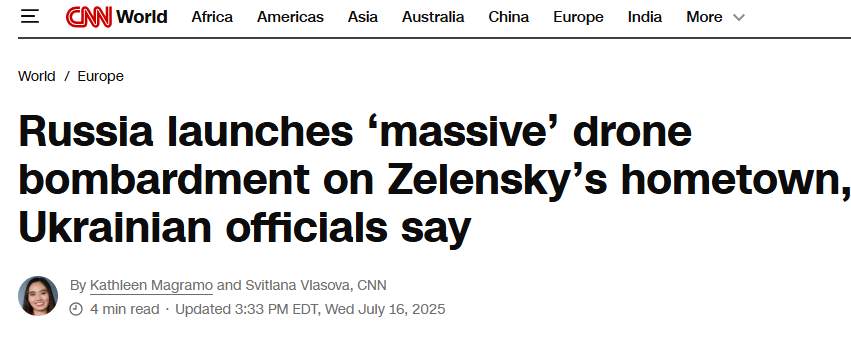
In CNN’s article titled “Russia launches ‘massive’ drone bombardment on Zelensky’s hometown,” the framing is explicit from the headline itself. Russia is the aggressor, acting with intention and violence: “Moscow barreled hundreds of drones,” and “the Kremlin unleashed 400 long-range drones.” These are strong, active verbs. They show that Russia is initiating the violence, and they give the audience a clear sense of responsibility.
Source: CNN
CNN goes further by using emotionally charged phrases like “the most massive attack … since the beginning of the war,” and “targeted energy infrastructure,” portraying Ukrainian suffering vividly. Victims are named (“15 people had been wounded”), and places are personalized (“Zelensky’s hometown”), emphasizing human cost and locality.
The article also connects these attacks to broader political stakes, including U.S. responses and NATO alliances. Even Trump’s frustration is quoted to humanize the Western narrative: “My conversations with him are very pleasant, and then the missiles go off at night.”
The result? A clear villain (Russia), a clear victim (Ukraine), and an active effort by CNN to frame the conflict in terms of moral outrage and injustice.
Israel’s Airstrikes on Syria: Passive Voice, Murky Morality
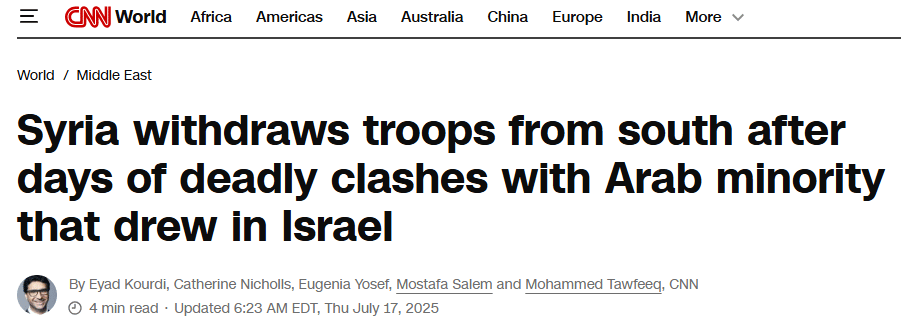
Contrast this with CNN’s coverage of Israel’s military involvement in Syria under the headline: “Syria withdraws troops from south after days of deadly clashes with Arab minority that drew in Israel.”
Note the phrasing: Israel is not described as launching an attack or escalating violence. Instead, they are “drawn in”—a phrase that implies reluctance or necessity. The violence is referred to passively: “Israeli airstrikes on the Syrian capital,” without explicitly stating that Israel killed anyone, though we later learn “at least three people were killed.” Even then, the cause is obscured by bureaucratic language.
Source: CNN
Where Russia “unleashes” drones, Israel simply “acts to protect the Druze.” Israel is defending, not attacking. Their motives are reported as noble: “Israel says it was acting to protect the Druze.” There is no equivalent of “the most massive attack,” no vivid human cost attributed directly to Israeli actions. Civilian casualties? Mentioned passively and without emotional depth.
Moreover, Syria’s own president is portrayed as the one facing difficult moral choices: “an open war… or allowing Druze clerics to return to reason.” The focus shifts from Israeli strikes to internal Syrian tensions, deflecting the narrative of foreign aggression.
The phrase “Israel has stepped up strikes despite pressure from the US” is the closest CNN comes to criticism, but even this is muted and passive. Compare that to the laser focus on Russian accountability.
Two Wars, Two Standards
Both articles were published within a day of each other. Both describe acts of war. Yet, the structure, tone, and word choice create very different impressions.
| Russia on Ukraine | Israel on Syria |
|---|---|
| “Moscow barreled hundreds of drones” | “Clashes… that drew in Israel” |
| “Russia is not changing its strategy” | “Israel says it was acting to protect…” |
| “One of the fiercest escalations” | “Misunderstanding” (Rubio on strikes) |
| “Kremlin unleashed” | “Stepped up strikes despite pressure” |
This double standard is not trivial—it shapes how global audiences interpret violence, resistance, and legitimacy. If Pakistan were in Syria’s place, would we expect our pain to be reported so passively? Would our attackers be treated so gently?
Why This Matters for Pakistani Readers
As a country that has faced its own struggles with terrorism, military interventions, and foreign narratives, Pakistanis know too well how language in international media can influence public perception, policy, and even war.
We must be vigilant consumers of global news. When media organizations like CNN use one set of moral standards for U.S. allies (like Israel) and another for adversaries (like Russia), they are not just reporting the news—they are shaping it.
Conclusion: Read Between the Lines
Media literacy is not about rejecting the news; it’s about critically evaluating it and understanding its layers. When one nation’s bombs are called “massive attacks” and another’s are simply part of “clashes,” ask yourself: Who is speaking? Who is silent? And who benefits from the narrative?
Let’s not allow passive verbs and moral vagueness to obscure oppression. Every civilian death deserves clarity, justice, and equal outrage.