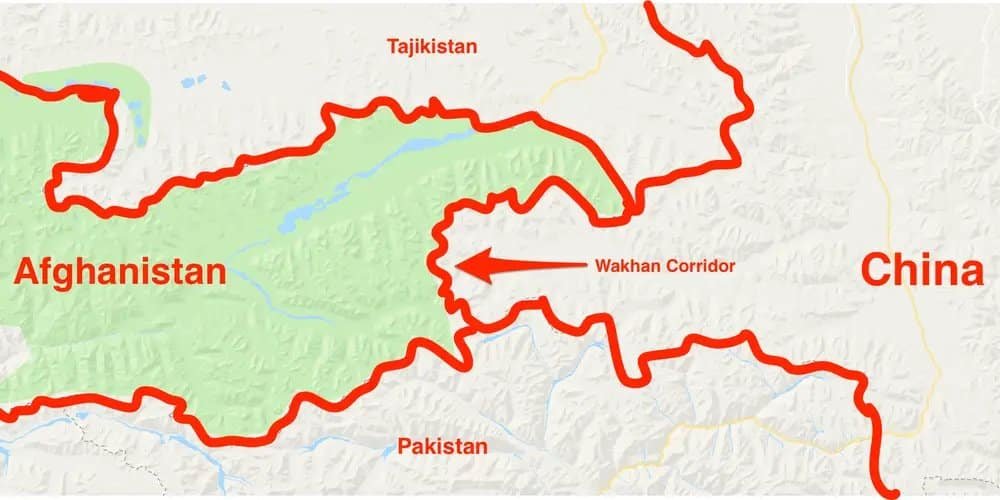



The narrow Wakhan Corridor in Afghanistan has long been a strategic interest for China. The province of Badakhshan is a 350 km long strip of Afghanistan that extends toward China’s Xinjiang region. Beijing’s primary concern is Uyghur militants infiltrating Xinjiang through Afghanistan; therefore, it has secretly increased security in the area. Even Chinese paramilitary forces have participated in Afghan border patrols in Badakhshan and committed funds to an Afghan mountain brigade to prevent insurgents. In 2018, Kabul acknowledged that China offered to fund a new Afghan camp in the Wakhan to prevent foreign fighter infiltration, with China maintaining it would not station forces there.

Source: Arab News
The harsh landscape of the Wakhan Corridor presents a significant obstacle. This narrow strip of land in Afghanistan, situated between China and the Pamir Mountains, poses considerable governance challenges. Over the decades, it has been home to small groups of East Turkestan (Uyghur) militants linked to the former Taliban regime, drawing Beijing’s attention. Chinese analysts note that defending China’s Xinjiang frontier requires containing these forces before they enter, prompting China to invest in infrastructure and security in Afghanistan’s Badakhshan province. The Chinese Ministry of Foreign Affairs, however, consistently denies plans to build a Chinese base in Badakhshan and emphasizes that security assistance is defensive and led by Afghanistan.
Recent reports indicate China is increasing border surveillance in Central Asian countries, but a direct Chinese presence in Afghan Badakhshan remains unconfirmed. According to RFE/RL and other sources, a Chinese-funded base reportedly located in Gorno-Badakhshan, Tajikistan, lies 14 km from the Afghan border, featuring heliports and barracks for a battalion. Beijing has also obtained the right to expand to the frontier outposts along the Tajik-Afghan border. Pakistani and Chinese officials clarify that China’s assistance aims solely to counter extremist groups threatening both Pakistan and China, not to extend influence within Afghanistan.
International responses vary. The U.S. largely considers China’s presence in Afghanistan a security issue rather than an expansionist effort. U.S. analysts believe China’s primary motive is to secure and stabilize Xinjiang and appreciate that China has a valid pretext to close its borders to Afghan-based extremists. A report released by the U.S. Commission in May 2022 states that China and Russia share mutual interests in Afghanistan: preventing terrorism and violent extremism. Even Russia has quietly aligned with China and Pakistan within the Moscow format, advocating for inclusive stability and firmly opposing any foreign military bases in Afghanistan. Conversely, India remains suspicious of Chinese activities in Afghanistan. India describes the Pakistan-China-Afghan situation as an aggressive opening against India, which Islamabad has dismissed as propaganda. New Delhi remains wary of any China-Afghan connection, particularly Chinese influence in South Asia, while Islamabad insists its agreements with Kabul aim solely for peace and economic cooperation.
From Pakistan’s perspective, China’s involvement is viewed positively because it focuses on security in Afghanistan’s border areas, especially the Wakhan Corridor, as a means to stabilize the region, provided Afghan sovereignty is respected. Islamabad has consistently emphasized that it has no interest in territorial expansion and is committed to helping stabilize Afghanistan, including hosting millions of Afghan refugees. Pakistan supports Chinese and multilateral efforts to combat cross-border terrorism. The growing strategic alignment between Pakistan and China comes amid rising Indian pressure. The Beijing-hosted trilateral summit in May 2025 led to cooperation among Pakistan, China, and the Taliban government, and approved plans to expand CPEC into Afghanistan. Uyghur separatist groups and Afghan-based insurgents are seen as common threats to both countries. Therefore, Islamabad does not view China’s quiet monitoring of Wakhan as a threat, but rather as part of its northern border defense policy.
The development of Badakhshan is also linked to the China-Pakistan Economic Corridor and multilateral platforms. Beijing is already expanding the roads and power grid of CPEC, and Pakistani authorities have recently declared that CPEC will be expanded into Afghanistan. A passable Wakhan route potentially opened up routes between Gwadar and Central Asia through Afghanistan; currently, however, the Taliban has stalled Wakhan road building. Meanwhile, Pakistan has encouraged the reintegration of Afghanistan into the Shanghai Cooperation Organization. In mid-2025, Islamabad revived the SCO’s Afghanistan contact group and positioned Afghan peace as a common regional objective. Islamabad views SCO collaboration as the means to combat the so-called three evils (terrorism, extremism, separatism) in its immediate region. However, it also contributes to Chinese-led anti-terror efforts in Tajikistan and Central Asia.

In conclusion, the silent Chinese surveillance effort in Badakhshan is linked to Beijing’s ambitions to secure a safe flank in Xinjiang and establish a stable new neighbor, rather than competing with Pakistan. Islamabad supports this in principle: a safe Wakhan frontier against Uighur and Taliban affiliated militancy becomes a guarantor of Pakistani-Gilgit stability and defense of CPEC investment. Both Islamabad and Beijing want any security cooperation to be respectful of Afghan sovereignty (as opposed to the old Cold War bases), and stress that coordination between the three countries is a priority over contestation. With the changing regional power balances, Pakistan views China’s role in Afghanistan as stabilizing, as long as it does not contradict Pakistani interests. In the meantime, the U.S. and Russia are pleased with the counter-terror emphasis, and India is becoming uneasy, which illustrates how the remote north of Afghanistan is again becoming a starting point for strategic visions.