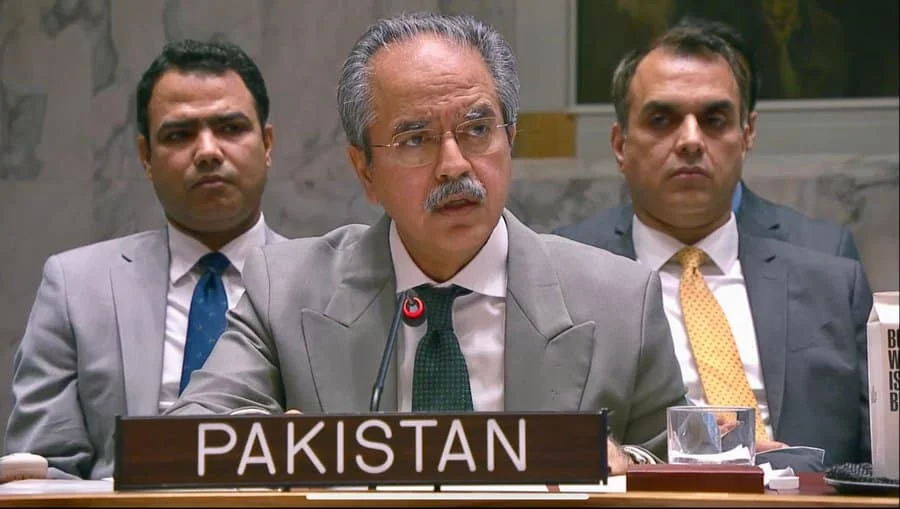





WASHINGTON — Pakistan’s Permanent Representative to the United Nations, Ambassador Asim Iftikhar Ahmad, delivered a scathing address at a UN Security Council (UNSC) session on Monday, accusing India of exploiting Afghan soil to launch destabilizing terror operations inside Pakistan. The envoy asserted that India’s purported humanitarian and developmental projects in Afghanistan are merely a front masking a singular, hostile objective directed at Pakistan’s national security.
Key Highlights
- Pakistan’s UN envoy accused India of funding banned terrorist groups like the TTP and BLA from Afghan territory.
- Islamabad defended its recent surgical airstrikes in Afghanistan, classifying them as precise, anti-terror operations.
- Over 5,300 terrorist incidents hit Pakistan in 2025, resulting in more than 1,200 fatalities linked to Afghan-based sanctuaries.
- Ambassador Ahmad demanded “verifiable and non-reversible action” from the Afghan Taliban against cross-border militancy.
- The envoy criticized UNAMA’s reporting for misclassifying neutralized terrorists as civilian casualties.
Pakistan’s actions, including those conducted in March, were directed solely against the terrorist and military support infrastructure that is operating from Afghanistan. And it is in no way directed against the brotherly people of Afghanistan. These targets included drone…
— Asim Iftikhar Ahmad, PR of Pakistan to the UN (@PakistanPR_UN) June 9, 2026
Exposing the Proxy Network and Policy Shifts
Addressing the council, Ambassador Ahmad highlighted a concerning policy shift, noting what he described as India’s “newfound love for the Taliban”. He argued that this diplomatic realignment directly follows Pakistan’s successful counter-terrorism strikes against border hideouts funded by Indian networks.
According to Islamabad, New Delhi actively finances and supports proscribed networks—specifically the Tehreek-i-Taliban Pakistan (TTP) and the Baloch Liberation Army (BLA), or Fitna al Hindustan—using them as proxies to execute deadly bombings and subvert peace within Pakistani borders. The ambassador firmly reminded the council that the Indian representative failed to offer a single word of condemnation against these designated terrorist groups.
Defending Sovereign Airstrikes and Rebuffing Propaganda
Responding to comments made by Afghan representative Nasir Ahmad Faiq regarding Pakistan’s recent cross-border military maneuvers, the Pakistani envoy defended the precision of his country’s security forces. He clarified that the targeted operations—such as those conducted in March—strictly aimed to dismantle drone storage, technical infrastructure, and ammunition dumps used by militants to target Pakistani civilians.
Ambassador Ahmad categorically denied allegations that Pakistani forces struck civilian hospitals or rehabilitation clinics, stating that the Ministry of Information’s released video footage clearly shows secondary explosions confirming ammunition hits. “All insinuations to the contrary are not based on facts and are in fact just propaganda,” he stated.
Right of Reply (Further Statement) by Ambassador Asim Iftikhar Ahmad
Permanent Representative of Pakistan to the United Nations
During Meeting of the UN Security Council on the Situation in Afghanistan
(8 June 2026)
*******Thank you, Madam President,
I have, in fact, been… pic.twitter.com/WajanpaEgD
— Permanent Mission of Pakistan to the UN (@PakistanUN_NY) June 9, 2026
Demands to the Taliban and Critiques of UN Reporting
The ambassador voiced severe frustration with the current Afghan Taliban regime, stating it has reverted to providing safe havens for hostile actors. He cited a critical May 9 vehicle-borne IED attack in Khyber Pakhtunkhwa that martyred 15 police officers, which investigations traced back to handlers in Afghanistan. Islamabad’s stance remains unequivocal: the Taliban must take verifiable, permanent action against these cross-border threats.
Furthermore, Pakistan raised questions regarding the credibility of the UN Assistance Mission in Afghanistan (UNAMA). Ahmad criticized a recent report by the UN Secretary-General for externalizing Afghanistan’s failures and inappropriately listing neutralized terrorists under the umbrella of “civilian casualties” while ignoring the complex web of money laundering and illicit hawala networks fueling terror finance inside the country.
Broader Violations and Regional Obligations
Ambassador Ahmad concluded by broadening his critique of India’s stance on international law, describing it as “laughable” given New Delhi’s human rights record in India-occupied Kashmir and its suppression of domestic religious minorities. He noted that India’s complicity in terrorism is no longer a regional issue, pointing toward its ongoing involvement in state-sponsored extraterritorial assassinations stretching as far as the United States and Canada, alongside its unilateral violation of the Indus Waters Treaty.