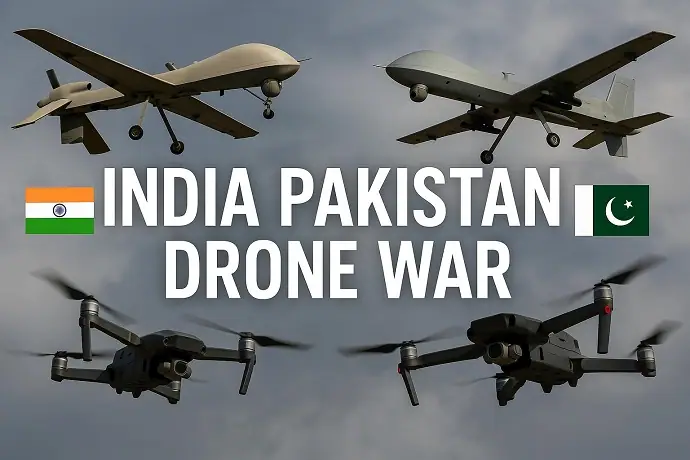





Early in May 2025, India and Pakistan engaged in a four-day conflict, which saw the introduction of offensive drone warfare into their rivalry. Reuters reported that it was the first time New Delhi and Islamabad had utilized unmanned aerial vehicles against each other. Namely, Operation Sindoor (India) and Bunyan-ul-Marsoos (Pakistan), the standoff involved waves of loitering and kamikaze drones being launched over the Line of Control. Analysts note that this was the first official drone strike between the nuclear neighbours; one referred to it as the first example of drone warfare, where both sides used drones with the sole purpose of inflicting harm.
The armed forces of India unleashed loitering munitions and suicide UAVs against the defence of Pakistan. During the initial assault, about 30 Israeli Harop suicide drones were used to infiltrate Pakistani radar installations, which were intercepted by Islamabad, where 29 of the drones were neutralized. Still, the equipment was destroyed, and four soldiers were wounded. On May 8 night, Pakistan claimed to have shot down roughly 25 drones belonging to India (with a single civilian reported killed and five injured). On May 10, Islamabad responded by launching its UAVs (excluding Chinese Wing Loong and Turkish Bayraktar UAVs) against Indian depots and military bases.
#BREAKING: Using both soft kill (technical) and hard kill (weapons) methods, Pakistan Armed Forces have successfully shot down 25 #Israeli-made Harop drones — ISPR. pic.twitter.com/2aN9nD88FL
— Defence Index (@Defence_Index) May 8, 2025
The fights demonstrated the potential and limits of UAV attacks. The drones allowed them to conduct stand-off strikes that posed no threat to pilots, enabling leaders to apply military pressure without necessarily causing large-scale escalation. Many Indian sorties were either reconnaissance or SEAD (suppression of air defences) missions; Pakistan sent decoys, electronic jammers, and anti-aircraft guns to shoot down most of the Indian slow drones. Even when UAVs carried only small payloads, they reportedly caused significant anxiety among civilians because they hovered overhead and emitted wailing sounds. Analysts say drones are cheap and easy to deploy in large numbers, which makes them less likely to escalate conflicts. This suggests drones will be used more often in future patrols and skirmishes.
Strategically, the conflicts have sparked a drone arms race in the region. Both parties are rapidly increasing their UAV inventories and countermeasures. India quickly placed a series of orders for new radars and anti-drone weapons, such as the IDDIS system used to shoot down Pakistani UAV flights. It ordered hundreds of domestically produced loitering bombs. India’s Ministry of Defence subsequently signed 13 contracts worth a total of 19.82 billion rupees (approximately US$231.6 million).
Ministry of Defence has cleared thirteen contracts under the Emergency Procurement mechanism.
These contracts, amounting to one thousand 981 crore rupees, have been finalised against an overall sanctioned outlay of two thousand crore rupees for the Indian Army.… pic.twitter.com/oSfNr8Xhnr
— DD India (@DDIndialive) June 24, 2025
According to Reuters, New Delhi is likely to triple its UAV budget to approximately $ 470 million within 1-2 years, similar to major jet fighter programs. Observers say that both nations are now in some form of a drone arms race, each competing to strengthen its UAV capabilities. Meanwhile, Pakistan is boosting co-development with Turkey to manufacture the YIHA-III drone.
Both parties have integrated UAVs into their new doctrine. The leaders of India welcomed Operation Sindoor as a “strategic approach” that was decisive, promising to take the same attitude towards the militants and their state financiers. The commanders of Pakistan also threatened immediate UAV retaliation against any attack. In practice, drones have become part of the deterrence strategy for both sides, a cheap, low-cost way to show a willingness to go to war in the nuclear shadow.
Prime Minister Narendra Modi said: “Operation Sindoor is now the nation’s established policy in the fight against terrorism.” https://t.co/P02znzUeyw
— Defense News (@defense_news) June 30, 2025
In the future, drones seem likely to be unavoidable in any India-Pakistan conflict. They can patrol mountains or cities with minimal risk, enabling prolonged and low-intensity clashes. In upcoming crises, analysts expect routine cross-border drone patrols and almost simultaneous counter-fire. In such a volatile situation, a UAV skirmish could quickly escalate; unless new communication methods or trust-building measures are adopted, every drone intrusion might be seen as an act of aggression.
The May 2025 duels marked a turning point: cheap UAVs have established a lasting presence in South Asian combat, supplementing missiles and artillery. To analysts and planners, the message is clear: UAVs will remain a permanent aspect of Indo-Pakistan crisis planning.