

The issue of gender-based violence (GBV) remains one of the key challenges in Pakistan. Although there is a system of progressive legislation, violence against women, girls, and gender minorities continues to hinder justice and empowerment. In recent years, multi-faceted approaches such as provincial reform, grassroots initiatives, and online platforms have begun transforming the GBV response landscape.
Pakistan is undergoing a transformation with better helplines and shelters, vibrant public awareness campaigns, and even victims feeling empowered, while communities become actively involved in long-term change.
Pakistan’s Response to GBV
Awareness creation is essential in such a society as Pakistan, where gender-based violence (GBV) is considered a private matter. Nevertheless, a variety of campaigns in the country are actively challenging this attitude and shifting the national discourse. The government of Punjab has also organised an impressive “16 Days of Activism” event in November 2023, as part of which it lit up landmarks like the Minar-e-Pakistan in orange to make a symbolic gesture of support against GBV. Educational materials were also distributed, government officials were trained on gender-responsive budgeting and planning, and broad outreach (via public transport and media) was conducted to enhance awareness activities.
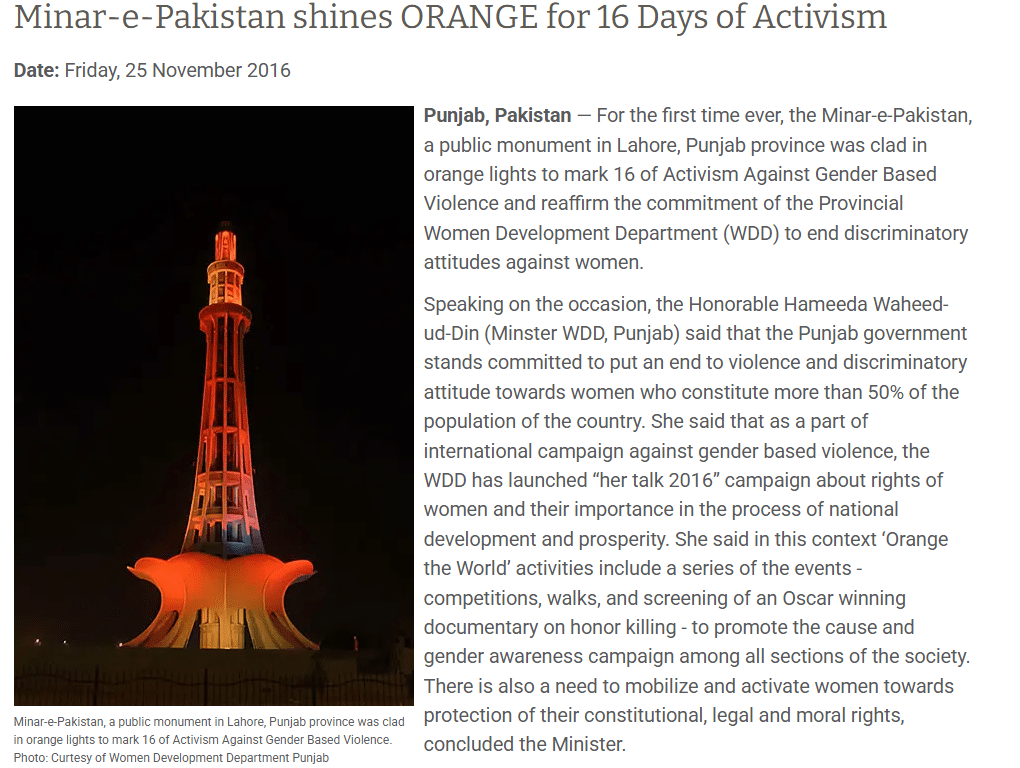
Minar-e-Pakistan shines ORANGE | UN Women – Asia-Pacific
The Pakistan Government has made bold decisions with the help of its Chief Minister, Maryam Nawaz Sharif, who said, “Women are my red line”, to create survivor-centred support systems. In January 2025, the province implemented a four-year, JICA-supported initiative to enhance mental health services, vocational training, and shelter for survivors of GBV in such districts as Lahore, Rawalpindi, and Faisalabad.
How Punjab’s leadership is transforming women’s safety
Women Protection Centres in the province were activated after the revision of the Punjab Protection of Women Against Violence Act (2016). All the centres provide relief through legal, medical, and psychological services under one roof, increasing convenience and effectiveness. The helpline set up in Rawalpindi also registered more than 1,256 complaint calls last year, most of which got prompt responses and resolution.
Meanwhile, in Balochistan, the GBV awareness initiative in universities was sponsored through the United States Embassy and UNODC. Besides empowering female students through education and engagement in the program, they were referred to the necessary reporting and support services offered in the Women and Juvenile Facilitation Centres (WJFCs). It also provided training to police officials as well as university employees to enhance institutional action against gender-based violence.
In Sindh, UN Women collaborated with Lawyers for Human Rights and Legal Aid (LHRLA) and the provincial Women’s Development Department to introduce Women Protection Units (WPUs) and assist in maintaining the national helpline, Madadgar 1098. All these units have together offered legal assistance and psychosocial services to over 2000 GBV survivors.
Moreover, women can now be empowered to get help anytime, through special apps like Never Again or virtual police stations. These reforms represent how strong political will and intelligent policy are creating on-the-ground advantages.
Civil society is playing a crucial role in changing societal attitudes. Since 2018, Aurat March has shaped the national discourse, which is held annually to a large extent. Local champions such as Girls at Dhabas work to challenge the cultural taboos and empower women by enabling them to participate in the male-dominated public places. Meanwhile, the Behavioural Change Communication (BCC) campaigns employed by the Aurat Foundation as a tool utilise public theatre, radio programs, and school seminars to break down stereotypes and inform people at the grassroots level.
Expanding Support Systems for GBV Survivors in Pakistan
Pakistan has drastically developed its support systems for the victims of gender-based violence (GBV). Helplines (such as 1099, 1043, and 1094) are available nationally and provincially, providing access to legal, medical, and psychological assistance on a timely basis. NGOs like AGHS, Rozan, and Blue Veins offer valuable support through legal facilities, counseling, and vocational training. In contrast, organizations like the Punjab Commission on the Status of Women (PCSW) tasked with reviewing government laws, policies, and programs, and monitoring their implementation to promote gender equality and eliminate discrimination against women. Several initiatives in Balochistan, supported under the UNODC, link students to support centres, demonstrating a growing and coordinated effort by both the government and various stakeholders in the civil society to develop a responsive, survivor-led GBV infrastructure.
Digital Rights Foundation (DRF), under the leadership of Nighat Dad, has become one of the first organizations to address technology-facilitated gender-based violence. Through its cyber-harassment helpline (0800-39393), more than 20,000 cases were registered since 2016, including 3,171 in 2024 itself, ranging from unauthorized distribution of photos, defamation, to stalking. The international prominence of Nighat Dad further speaks of the increased leadership in digital safety and technological policymaking concerning women in Pakistan.
› Over 20,000 cases of Technology-Facilitated Gender-Based Violence (TFGBV) received by Digital Rights Foundation’s Helpline during 8 years of operation
Pakistan’s Efforts to Support GBV Survivors
The gender-based violence (GBV) response in Pakistan is in a process of developing from reactive support to proactive empowerment. Vocational training schemes in Punjab and Khyber Pakhtunkhwa are assisting the survivors, among them transgender people and people with disability, to re-emerge as productive members of society, financially independent. The plan to renovate 125 training centres by KP is an indication of inclusiveness and rehabilitation. This is more than just protection, as it involves dignity, autonomy, and long-term resilience. Nonetheless, more support is visible through a similar trend in the use of helplines and general involvement with the population. Pakistan is gradually transforming its GBV response into a survivor-centred, empowering model, thanks to digital reporting, community activism, and international collaboration.
Conclusion
Pakistan is experiencing a transformative moment. The evolving landscape, which includes institutional reforms and helplines in Punjab, vocational programmes, and digital advocacy by DRF and grassroots cultural movements in KP, promises a country that recognises the need to challenge GBV. By using survivor-centred models and collaborating with sector groups, the nation is shifting from passive responses to proactive action. Pakistan must continue raising awareness, strengthening enforcement efforts, assisting survivors with respect, and celebrating allies across society to maintain this momentum. Strong, safe, and united, with resilience and innovation, Pakistan will create a resilient and better future where everyone’s rights are protected and every voice is heard.