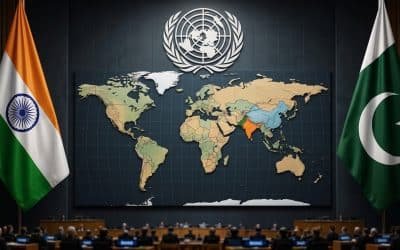



In a direct and forceful response, Pakistan’s Defence Minister Khawaja Asif on Sunday dismissed statements by India’s military and political leadership, calling them a “failed attempt to restore their lost reputation.”
Although he did not cite specific remarks, Asif’s reaction came after a series of aggressive statements from India referring to terrorism and hinting at possible military action. Islamabad has consistently rejected such accusations as unfounded.
“The statements made by the Indian army and its political leadership are a failed attempt to restore its lost reputation,” Asif stated on X (formerly Twitter).
Highlights
- Defence Minister Khawaja Asif calls Indian military and political statements a “failed attempt” to regain lost credibility.
- Refers to the May escalation where Pakistan claims to have downed six Indian jets.
- ISPR warns future conflict could lead to “cataclysmic devastation.”
- Indian civil-military leadership issues aggressive rhetoric; Pakistan responds sharply.
- Strategic shift follows May conflict with the creation of the Army Rocket Force Command.
“Score: 6–0… and Next Time, It Will Be Worse”
Asif reminded India of the four-day escalation in May, during which Pakistan says it downed six Indian jets.
“India faced a decisive defeat with a score of 6-0. If they try again, God willing, the score will be much better than the last time,” he asserted, adding that the shift in Indian public opinion against its government after the conflict clearly showed the leadership was under pressure.
He concluded with a sharp warning:
“This time, God willing, India will get buried under the rubble of its own jets.”
Military Warning: “Cataclysmic Devastation” If India Tries Again
A day earlier, Pakistan’s military issued a stern warning through the Inter-Services Public Relations (ISPR), cautioning that any future conflict could lead to “cataclysmic devastation.”
“In case a fresh round of hostilities is triggered, Pakistan shall not hold back. We shall resolutely respond, without any qualms or restraint,” the statement read.
The warning followed provocative remarks from Indian Army Chief Gen Upendra Dwivedi, who threatened that Pakistan “must stop state-sponsored terrorism or risk being wiped off the map.” Indian Air Force Chief Amar Preet Singh claimed, without evidence, that Indian forces had downed five Pakistani jets during the May fighting. Defence Minister Rajnath Singh echoed these sentiments in speeches asserting India’s military superiority.
ISPR termed these statements “delusional, provocative and jingoistic,” warning that such rhetoric could have “serious consequences for peace and stability in South Asia.”
The May Conflict: A Strategic Turning Point
The May confrontation, the most intense in decades, erupted after an attack on Hindu tourists in occupied Kashmir. India blamed Pakistan, but Islamabad denied involvement, calling New Delhi’s account “replete with fabrications.”
The four-day conflict saw the use of fighter jets, missiles, artillery, and drones, resulting in dozens of casualties before a ceasefire was reached. Pakistan claimed to have shot down six Indian jets, including Rafales, while India admitted to “some losses” but denied that figure.
In August, Pakistan announced the formation of the Army Rocket Force Command, a new branch tasked with building long-range conventional strike capabilities. This move was a direct strategic response to operational lessons from the conflict, aiming to strengthen Pakistan’s conventional deterrence against India.
Analysis: High Stakes, Escalating Rhetoric
The current exchange reflects the volatile state of India-Pakistan relations. With both nations armed with nuclear capabilities, heightened rhetoric carries real risks. The May conflict remains fresh in strategic memory, and both sides appear keen to shape narratives and domestic perceptions.
For now, the confrontation remains confined to statements. But as history has shown, rhetoric between these two rivals can rapidly escalate into action.