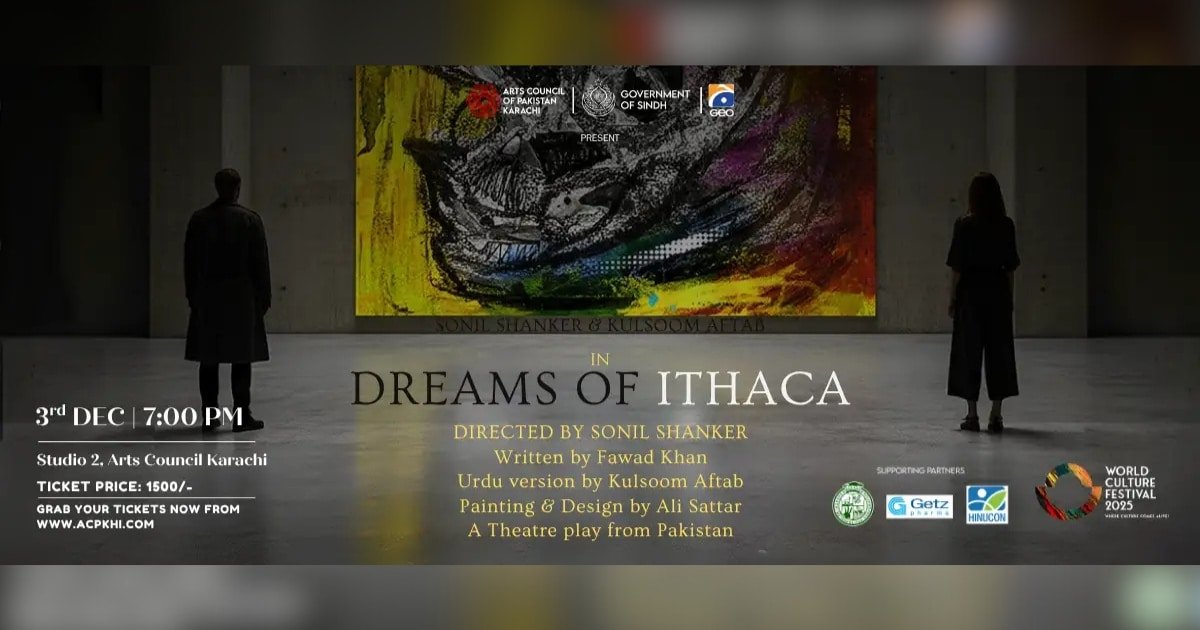





The play “Dreams of Ithaca” made waves upon its recent premiere at the World Culture Festival 2025 held at the Arts Council of Pakistan in Karachi. It immediately sparked conversation among theatre enthusiasts for its challenging subject matter, dark humour, and adherence to the traditions of absurdist theatre.
Home, Identity, and Existential Chaos
The play, which runs for a tight 55 minutes, is far from conventional. It is described by its creators as an “absurdist odyssey through dreams, nightmares, and strange trams and signals.”
The plot centers primarily on a disorienting journey anchored in conversations between two unnamed characters (a man and a woman). Their dialogue explores the intricacies and contradictions of human nature and the fragile, shifting idea of ‘home.’
Writer Fawad Khan drew inspiration from his own experiences after moving to Ireland, grappling with the meaning of ‘home,’ the sense of belonging, and the feeling of leaving or losing a rooted identity. The title itself references Ithaca, the mythical homeland of Odysseus, symbolizing the yearning for return.
In one memorable, darkly comic scene, the male character is trapped at a local pedestrian signal, frantically pacing as he runs late, only to be repeatedly blocked or hit by passing vehicles in a sequence that descends into sudden, unsettling chaos and violence.
Glimpses of Dreams of Ithaca theatre play by Sonil Shankar.
The World Culture Festival will continue till December 07, 2025 at Arts Council Karachi. For more details and tickets visit https://t.co/U9jcT3THPZ#ArtsCouncil #ACPKHI #WorldCultureFestival #WCFK pic.twitter.com/knGK5IkI8b
— Arts Council of Pakistan Karachi (@ACPKHI) December 3, 2025
Production and Reception
The production was a collaborative effort to bring a complex text to a local audience.
The play was directed by Sonil Shanker, written by Fawad Khan, and translated into Urdu by Kulsoom Aftab, who also starred as the female character. The translation and adaptation were crucial, rewriting elements (like the signal scene) for a relatable Pakistani setting.
The play’s intensity required the team to deliver a humorous yet stark warning to the audience before the lights dimmed, advising anyone sensitive to “intense violence” to leave, reinforcing its controversial nature.
The play was designed to be dark yet comic, and the audience response reflected this duality, with reports of people laughing at the dark humour while simultaneously feeling a creeping sense of unease or disgust at moments of violence.