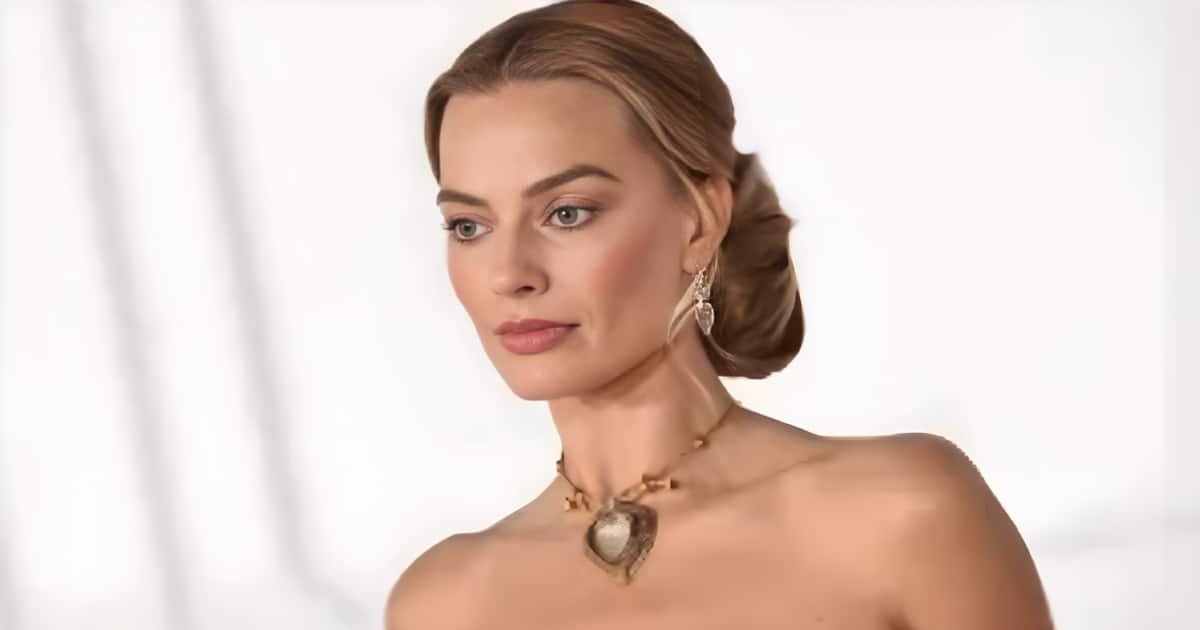




On the evening of January 28, 2026, Margot Robbie arrived at the Los Angeles premiere of Wuthering Heights wearing a piece of history that effectively upstaged the film itself. Clad in a sculptural, gothic-inspired Schiaparelli gown, Robbie’s neck was adorned with a heart-shaped, table-cut diamond pendant set in jade and suspended from a gold-and-ruby chain. To the flashing bulbs of the Western paparazzi, Robbie was wearing “Elizabeth Taylor’s Taj Mahal Necklace.” To the millions of South Asians watching online, she was wearing a fragment of a looted empire.
The pendant bears a Persian inscription in Nastaliq script that explicitly names Empress Nur Jahan, one of the most known woman of the Mughal era. The resulting controversy has transformed a red-carpet “moment” into a global debate on the ethics of fashion, the “laundering” of history, and the deep, unresolved scars of colonialism.
A Document in Stone: The Mughal Origin
The story of the “Taj Mahal Diamond” does not begin with a Hollywood romance in 1972. It begins in the early 17th century in the Mughal court, an era when jewelry was a ledger of sovereignty. The pendant was originally a gift from Emperor Jahangir to his wife, Nur Jahan. She was no mere consort; she was a polymath who minted coins in her own name and effectively ran the empire during Jahangir’s illness. The inscription, which includes her name, the phrase “Lady of the Padshah,” and the Hijri date 1037 (approx. 1627 CE), is a 400-year-old document of female power.
The stone later passed to Mumtaz Mahal, the woman for whom the Taj Mahal was built. It is a piece of “living heritage” that connects the modern world to a pre-partition, pre-colonial subcontinent. To label it “Elizabeth Taylor’s” is not just a misnomer; it is a profound cultural flattening. This diamond is an artifact of the Golconda mines, crafted using the Kundan technique, a method of setting stones in 24k gold foil that remains a hallmark of Pakistani and Indian bridal heritage today.
No inscriptions on this pendant say Love is everlasting/forever. They mention Nur Jahan’s name & year 1037 A.H. (1627-28 CE), which corresponds to end of her husband Emperor Jahangir’s reign & life. The pendant would have been suspended in a pearl necklace in its original form. https://t.co/RrYmTZ5sqk pic.twitter.com/C0DgwKZnZ0
— Neha (@nehavermani) January 31, 2026
The Architecture of Amnesia: From Delhi to Cartier
The central friction of the Robbie controversy lies in how the necklace reached the West. Like many Mughal treasures, it “found its way” out of South Asia following the collapse of the empire and the British sack of Delhi in 1857. For over a century, the jewel was part of a “displaced” collection of royal loot that circulated through European auction houses. When it reached Cartier in 1971, the narrative was reset.
By rebranding the pendant as a “Cartier piece” or “Elizabeth Taylor’s necklace,” the luxury industry participates in a form of historical amnesia. This rebranding prioritizes a forty-year Hollywood association over a four-hundred-year imperial legacy. This isn’t an isolated incident. The red carpet has a long history of utilizing displaced South Asian heritage.
In 2022, YouTuber Emma Chamberlain wore the restored Patiala Necklace, originally commissioned by the Maharaja of Patiala, to the Met Gala. The diamonds had been stripped and the setting found in a London thrift shop, yet it was presented as a “Cartier masterpiece.”
View this post on Instagram
Robbie’s appearance has reignited the perennial debate over the Koh-i-Noor, which remains the ultimate symbol of colonial extraction. Every time a Mughal jewel appears on a Western celebrity, it serves as a reminder of the thousands of artifacts that sit in private collections, their origins “glossed over” with romantic backstories.
The Double Standard of Custodianship
One of the most biting critiques from the South Asian diaspora involves the gatekeeping of these artifacts. In late 2025, reports surfaced that a prominent South Asian icon was refused access to borrow a historic Indian jewel from a Western archive on the grounds of “fragility.” Yet, for Robbie, or Kim Kardashian wearing Marilyn Monroe’s dress, the seals are broken.
When Western stars are granted access to these relics while the communities they belong to are denied, it reinforces a colonial-era hierarchy: the West as the only responsible custodian of world history. Enraged fans on X (formerly Twitter) pointed out that anyone who reads Urdu or Persian can see the name of the Empress on Robbie’s neck, yet the actress referred to it purely as “Taylor’s.” One viral comment noted: “Wearing history without knowing where it comes from isn’t a luxury; it’s ignorance.”
I love how Indians are sticking up for Nur Jahan’s necklace against the white people atrocities/colonisation except they will never own the Mughals when they have to diss on their own Muslim minority or trace their history through them. Lelz.
— Cassandra has issues (@PoltclCassandra) January 31, 2026
Fashion as a Political Act
In 2026, a red-carpet choice is a political act. Robbie’s stylist, Andrew Mukamal, selected the piece as a stylized tribute to the tempestuous love of Elizabeth Taylor and Richard Burton, which supposedly mirrors the relationship between Cathy and Heathcliff in the new Wuthering Heights. However, the ‘love’ inscribed on that stone wasn’t a gothic fiction; it was the sovereign love of a woman who ruled an important part of the the world.
By reducing Nur Jahan’s legacy to a mood board for film promotion, the industry treats the Global South as a costume shop. The diamond’s inscription, erroneously cited by the Taylor Estate as saying “Love is Everlasting”, is actually a formal imperial seal. Reductionist storytelling like this strips the object of its weight, turning a symbol of a sophisticated civilization into a mere prop for Western melodrama.
@extra_tv Margot Robbie wows in custom Schiaparelli and Elizabeth Taylor’s Taj Mahal Diamond necklace at the #WutheringHeights L.A. premiere! ❤️💎 #margotrobbie @Wuthering Heights Movie ♬ original sound – ExtraTV
Returning the Narrative
The controversy surrounding Margot Robbie and the Nur Jahan necklace is a wake-up call for the “New Luxury” era. It suggests that glamour can no longer exist in a vacuum of historical ignorance. If luxury houses and private estates wish to loan these pieces, they must lead with their true provenance.
This remarkable pendant originally belonged to Empress Nur Jahan, gifted to her by her husband Emperor Jahangir.
The necklace was taken during British colonial rule and later surfaced in the possession of Hollywood actress Elizabeth Taylor. It is now held by Cartier.
Nur Jahan’s… pic.twitter.com/5CqSUCn05S— Dr Shama Junejo (@ShamaJunejo) January 31, 2026
They must acknowledge the Persian script, the Mughal empresses, and the colonial routes these jewels traveled. Until then, the “Taj Mahal Diamond” will remain a symbol of what has been lost, and a reminder that for many, the history of these jewels is still waiting to be returned. True luxury in 2026 isn’t just about the clarity of the diamond; it’s about the clarity of the conscience behind it.
You May Like To Read: The Mountains Sing: PNCA’s Mystical Odyssey through the Karakoram
Check out our latest video: