


Pakistan is improving its air power through multinational air exercises. These exercises involve major ally countries, including China, Turkey, Saudi Arabia, and Qatar. They serve as force multipliers to the Pakistan Air Force (PAF). These operations are integrated with modern fighter jets, such as the J-10C and JF-17 Block III. The training is designed to improve joint combat tactics. They facilitate industrial collaboration in defense technologies as well. This enhances the combat capabilities of the PAF. Meanwhile, the significance of Pakistan as a security partner increases. These efforts are essential to the security of an increasingly unstable region.
Joint Air Drills Expand Pakistan’s Regional Defense Reach
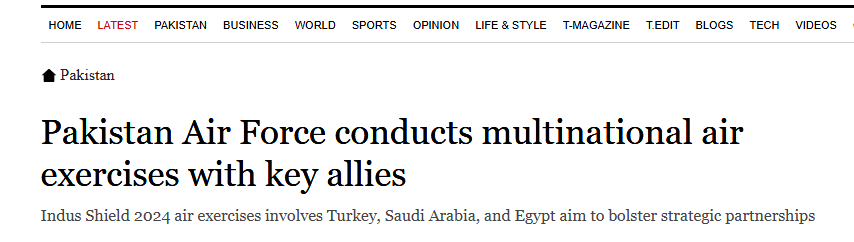
Joint exercises are also employed to advance Pakistan’s relations. This is creating a defensive belt between the Mediterranean and the Arabian Sea. This strategy is reflected in the Indus Shield 2024 exercise. It brings together the F-16s of Turkey, Tornados of Saudi Arabia, and Mirage 2000s of Egypt on the territory of Pakistan. Such exercises enhance the coordination of complex air operations. They are also sending a powerful signal of unified determination against regional dangers. The exercise was personally supervised by the Army Chief General Syed Asim Munir. This shows its significance in national defense. Likewise, the Bright Star exercise in Egypt enables the PAF to spread its wings to the Middle East and North Africa. The JF-17 Thunder of Pakistan trains with its regional partners to counter the multi-domain threat. Such exercises expose the PAF pilots to various combat tactics. They also provide information about Western-produced planes that allies are using. This intelligence is critical in combating regional enemies.
Source: The Express Tribune
Expanding Global Air Partnerships: Pakistan’s Strategic Outreach
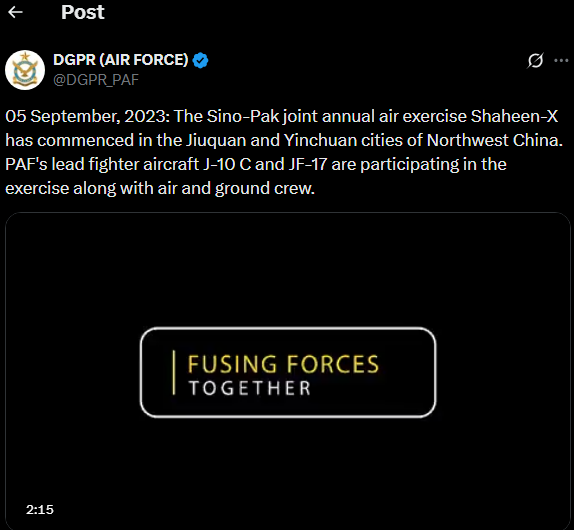
Pakistan is also taking its air diplomacy beyond the regional spheres. It is enhancing its historic alliances and forming new ones with the emergent powers. A prime example is the Shaheen-X exercise with China that was conducted in the northwest parts of China. It indicates a seamless integration of systems such as PL-15 missiles and AEW&C aircraft. This exercise improves Pakistan’s capability to execute long-distance strikes. It also enhances the coordination of the complex kill chains. They were demonstrated in the 2025 conflict with India. In the combat, Pakistani ground radars, Pakistani J-10Cs, and early warning aircraft collaborated to destroy the advanced Indian fighter jets, i.e., Rafale.
Source: X/@DGPR_PAF
Meanwhile, defense discussions were revived by Zaheer Ahmed Baber Sidhu, the Air Chief of Staff, visiting the United States in 2025. This was the first visit of a PAF Chief to the U.S. in more than ten years. Negotiations were conducted regarding the technology exchange and collaborative training with officials from the Pentagon and the State Department. This outreach was made because Pakistan had great success using Chinese-made systems during combat. It makes Pakistan a strategic security actor and, in addition, allows it to obtain better aerospace technologies through various partners.
| Exercise Name | Participating Nations | PAF Assets Deployed | Primary Objectives |
|---|---|---|---|
| Indus Shield 2024 | Turkey, Saudi Arabia, Egypt | J-10C, JF-17 | Enhance interoperability with Gulf allies; counter regional threats |
| Shaheen-X | China | J-10C, JF-17 Block III | Integrate Chinese avionics/weapons; long-range strike drills |
| Bright Star | Egypt + Arab partners | J-10C, JF-17 | Power projection in MENA: multi-domain warfare |
| Zilzal-II | Qatar | J-10C | Tactical testing against Rafale jets |
| Red Flag | US/NATO allies | F-16s (Historic) | Access Western tactics/technology |
From Training Grounds to Combat Edge: Pakistan’s Tactical and Technological Gains
Joint exercises act as testing grounds for new platforms and tactics. They simulate near-real combat conditions. The J-10C is a prime example of fast-track deployment. It was sent for international missions just months after induction. This reflects the PAF’s rapid modernization under Air Chief Marshal Sidhu. Exercises like Zilzal-II with Qatar were crucial. Insights from these drills helped Pakistan effectively counter Indian Rafales in 2025. Additionally, Pakistan has integrated Turkish electronic warfare systems and Chinese AEW&C aircraft during exercises. This has sharpened the PAF’s skills in networked warfare. These collaborations offer cost-effective upgrades and provide tactical and technological gains that are now translating into real-world combat advantages.
You May Like To Read:
- From Panem to Palestine: The Selective Morality of the West
- AI and the Future of Work: Who Wins, Who Loses, and What Comes Next
Industrial Gains and Strategic Self-Reliance: Building Sovereignty Through Collaboration
Bilateral exercises go beyond tactical advantages. They foster long-term industrial growth and strategic independence. Pakistan’s defense exports have gained global recognition, including the JF-17 Block III. These jets proved their capabilities during international drills, leading Azerbaijan to sign a $1.6 billion deal to purchase them. The deal later expanded in June 2025 to a full 40-aircraft contract worth $4.6 billion, along with package deals for armaments and training support. This can be seen as a trilateral collaboration among Pakistan, Turkey, and Azerbaijan, often called the Three Brothers. These partnerships mark a major shift in Pakistan’s defense industry. Advanced technologies are co-developed, based on lessons learned from exercises, including airborne missiles and drone swarms. These initiatives are transforming Pakistan into a co-manufacturer of cutting-edge aerial systems, which were once imported.
Conclusion
Pakistan’s joint air exercises are not just symbolic gestures. They are carefully designed tools of national power. These drills help validate new technologies under realistic conditions. They also improve interoperability with key allies. At the same time, they create industrial partnerships that support long-term defense growth. The Pakistan Air Force has transformed these exercises into essential pillars of a robust and cost-effective deterrence. As regional threats continue to change, Pakistan’s aerial alliances will remain vital. Built on mutual respect and shared security goals, these partnerships are key to maintaining peace through strength.