



UNITED NATIONS — Pakistan has formally approached the United Nations Security Council (UNSC), warning that India’s unilateral infrastructure projects and attempts to divert cross-border rivers constitute an existential threat to regional stability and could be viewed as an act of war.
Deputy Prime Minister and Foreign Minister Ishaq Dar transmitted a high-priority letter to the President of the UNSC, Ambassador Leonor Zalabata Torres of Colombia, urging the international body to intervene and hold New Delhi accountable for “brazen violations” of the 1960 Indus Waters Treaty (IWT).
Pakistan Defense Minister Khawaja Asif threaten India of direct WAR Over Indus Water Treaty.
India suspended the Indus Waters Treaty in response to the Pahalgam terrorist attacks, citing cross-border terrorism and security concerns. pic.twitter.com/jy4IMUIxiV
— Osint World (@OsiOsint1) June 19, 2026
Escalating Hydrological Tensions
- Pakistan submits a formal complaint to the UNSC over India’s illegal water diversion projects.
- The diplomatic move targets New Delhi’s upcoming Rs 26.2 billion “Link-3” Chenab-to-Beas river tunnel.
- Deputy PM Ishaq Dar warns that 17 planned Indian projects aim to establish complete “hydro-hegemony.”
- Foreign Office declares any unilateral structural tampering with western river flows as an act of war.
- Islamabad briefs the UN on India’s ongoing defiance of standing resolutions regarding Jammu and Kashmir.
Weaponizing Water Flow and Inter-Basin Diversions
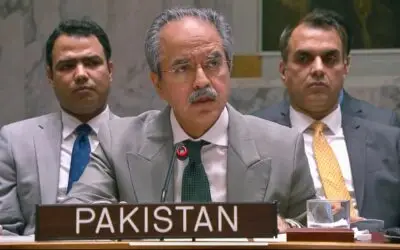
The formal correspondence was delivered by Pakistan’s Permanent Representative to the UN, Ambassador Asim Iftikhar Ahmad. It centers on a series of illegal Indian infrastructure developments along the Chenab River system—a western waterway explicitly allocated to Pakistan under the World Bank-brokered accord.
Indus Waters Treaty Allocation & Conflict Zones
• Eastern Rivers (Ravi, Beas, Sutlej): Allocated to India.
• Western Rivers (Indus, Jhelum, Chenab): Allocated to Pakistan (Under Indian threat).
• The Link-3 Threat: Indian project to divert 1.9m acre-feet from Chenab to Beas.
• Legal Stand: Permanent Court of Arbitration ruled against Indian abeyance.
The immediate flashpoint involves India’s public tendering of the “Link-3 Project” in Himachal Pradesh, which seeks to construct a massive transit tunnel to divert 1.9 million acre-feet of water annually from the Chenab into the Beas basin. The Foreign Office has flagged this inter-basin transfer, alongside a planned “silt flushing” operation at the Salal Dam, as illicit attempts to acquire water-control capabilities that violate the Vienna Convention on the Law of Treaties and broader international water laws.
Defying the Permanent Court of Arbitration
Tensions over the water sharing framework have steadily worsened since a brief military confrontation in May 2025, which New Delhi used as a pretext to unilaterally place its treaty obligations in abeyance. Despite India’s position, the Permanent Court of Arbitration (PCA) issued a Supplemental Award affirming that no state can unilaterally suspend its treaty responsibilities.
The latest diplomatic escalation follows public remarks by Indian Water Minister CR Patil, who claimed the state is actively working to ensure “not a single drop of water” enters Pakistan. By engaging the UNSC, Islamabad is seeking to preemptively counter India’s engineering strategies in occupied Kashmir before construction on the controversial link tunnel formally begins on August 1.