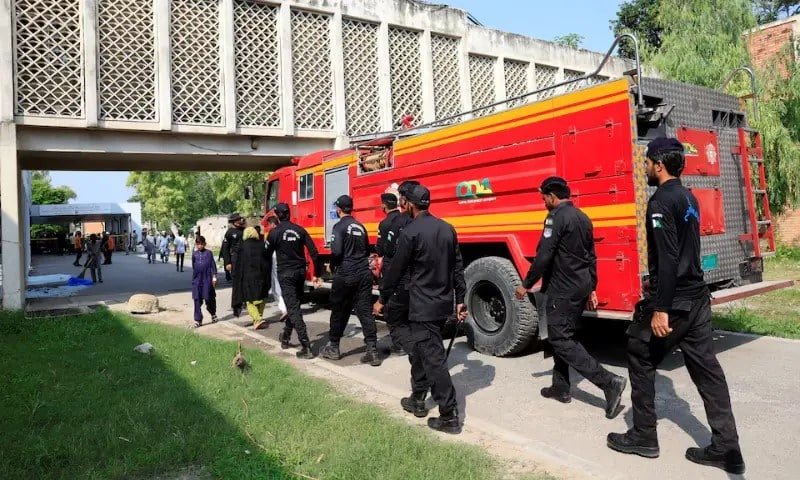




Punjab hospitals and health authorities have been directed to take immediate fire safety measures after a deadly fire killed 14 infants at Islamabad’s Pakistan Institute of Medical Sciences on Wednesday. Chief Minister Maryam Nawaz directed a fresh audit of fire safety arrangements at healthcare facilities in the province. The fire broke out in the Mother and Child Hospital ward of PIMS on the third floor. The cause is believed to have been a spark in an air conditioner, but it has not yet been confirmed.
Key Points
- CM Maryam Nawaz orders hospital fire safety audit across the province within 24 hours
- Punjab Healthcare Commission issues emergency orders for fire safety compliance
- Hospitals to implement emergency “code red” system, conduct regular drills
- Rescue 1122 to review hydrant availability within a week
- Smoke detectors, sprinkler systems in ICUs, nurseries asked for feasibility report
Witnesses’ Stories Prompt Questions Authorities Disagree
Witnesses at the scene described a chaotic response. They said they waited hours for emergency services to arrive, had to break through windows to try to access the neonatal intensive care unit, and found some doors locked. Authorities have pushed back against these accounts, saying the response unfolded differently. The cause of the fire has not yet been pinpointed.
Punjab Healthcare Commission issues broad new requirements
The Punjab Healthcare Commission on Thursday issued urgent directives to improve fire safety in public and private hospitals in the province. The commission directed the health departments, the Punjab Emergency Services Department and hospital administrations to take immediate steps to ensure full readiness for fire and non-fire emergencies.
Hospitals were told to have trained staff, working emergency equipment, adequate resources and conduct regular emergency drills so they could act quickly and effectively when something went wrong. “All hospitals, public or private, shall comply with the existing Minimum Service Delivery Standards in its entirety, including those related to Facility Management System and Hospital Infection Control protocols,” the commission emphasized.
Next came new requirements. Hospitals need to develop an emergency coding system, which must include a “code red” for fire emergencies. They need working firefighting equipment at the ready, trained staff, regular emergency drills, and clearly written standard operating procedures. Hospitals should also have proper building safety and fitness certificates and emergency exit maps displayed in a prominent place.
The commission directed the Punjab Emergency Services Department to inspect hospitals under section 3(3) of the Punjab Community Safety Act, 2021 and the building safety regulations. Under this framework, District Emergency Officers can inspect hospital buildings, verify that fire safety arrangements are actually in place and issue safety certificates valid for one year once legal requirements are fulfilled. The commission directed that fire safety audits of all public and private hospitals be carried out immediately. The inspection report will include specific recommendations and will be provided directly to the commission for any hospital that is found to be non-compliant. Punjab Emergency Services Department was also asked to provide records of inspections conducted during the past three years and a list of hospitals that did not meet the legal requirements.
Tight Deadlines for CM Maryam’s Directives
Punjab Information Minister Azma Bokhari confirmed on X Wednesday evening that CM Maryam has ordered a fresh fire safety audit of hospitals across Punjab and has asked for the report within 24 hours. Bokhari handed over the whole file with Maryam’s instructions.
The document directs Deputy Commissioners to immediately check the availability and working condition of fire extinguishers and firefighting equipment at all public health facilities in their districts. Inspection teams should also evaluate the suitability and accessibility of emergency exits in coordination with Rescue 1122 teams, keeping real emergency conditions in view. Secretaries of the Specialized Healthcare and Medical Education Department and the Health and Population Department were directed to instruct field staff, medical superintendents and health CEOs to assist district administrations to get this work done. The Implementation and Coordination Wing of the Services and General Administration Department shall prepare a consolidated report and submit it to the Chief Minister by August 27, 2026.
Maryam also directed Rescue 1122 to immediately review the existing hydrant points and identify where new hydrants are needed in the vicinity of health facilities, keeping in view realistic access conditions in an emergency. The health departments will carry out repairs and new installations with support from Housing, Urban Development, and the Public Health Engineering Department, Rescue 1122, and local government bodies. “The work has to be done within a week, and divisional commissioners will be personally monitoring the progress to meet the deadline. A compliance report on this piece is due Sept. 4.
Maryam has also directed the health secretaries to undertake a comprehensive review of all air conditioners, electrical wiring and other electro-medical equipment in all hospitals under their administration, through Medical Superintendents and CEOs of District Health Authorities. Repairs are required, and a compliance report is due by August 29. A final consolidated report on all health departments is due August 30.
Long-term changes are also on the table
However, Maryam has directed deputy commissioners to institutionalize monthly emergency mock drills as a continuous process in health facilities to continuously assess all the emergency standards mentioned in her directives. She has also directed health secretaries and the CEO of the Infrastructure Development Authority to prepare a feasibility report for installing technology-driven fire alarm systems, smoke detectors, and water sprinkler systems in intensive care units, nurseries, and emergency departments of tehsil headquarters hospitals, district headquarters hospitals, and tertiary care hospitals across Punjab. That report is due in a week, and the document states that further action should be taken as a top priority once it is filed.