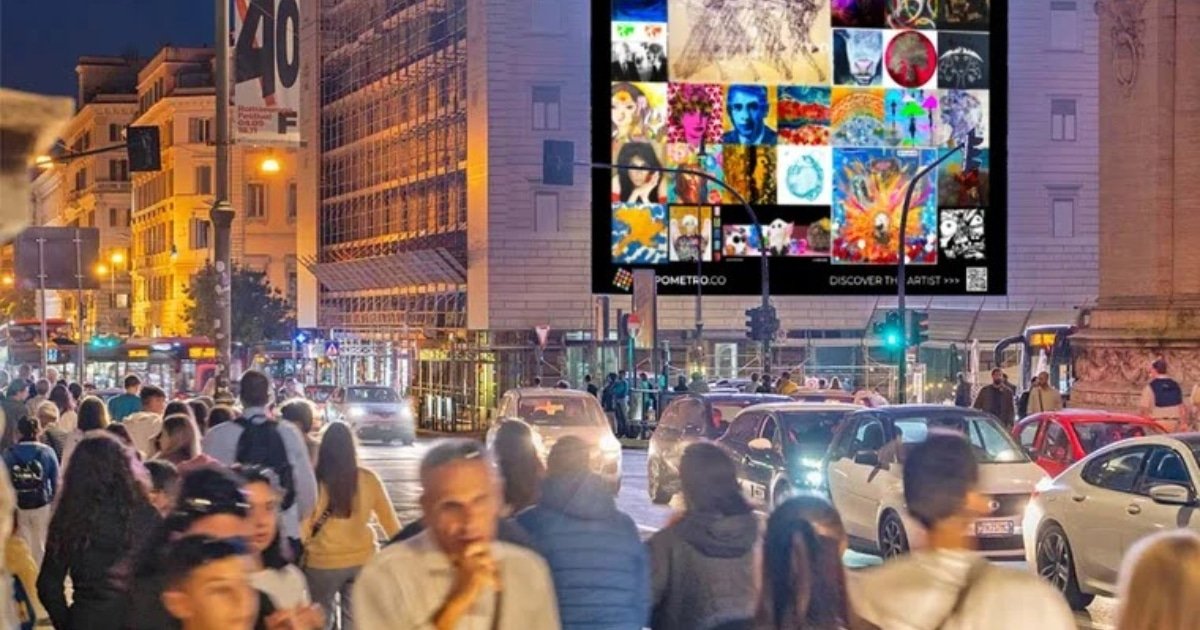




In the fading light of a Roman evening, millions of locals and tourists crossing the Ponte Vittorio Emanuele II found themselves walking through a gallery without walls. Towering above the cobblestones, the iconic LED screens of Expo Metro Rome 2026 flickered to life, replacing high-fashion advertisements with the bold, ink-black strokes of Pakistani-American contemporary artist Warda Rana.
Her featured digital work, Curated Identity; The It Thing, did more than just decorate the skyline; it effectively highjacked the public’s attention, forcing a moment of introspection in one of the world’s most crowded pedestrian axes.
View this post on Instagram
The Canvas: A City Transformed
The Expo Metro Rome 2026 was a monumental “open-air” experiment. By converting two giant LED billboards near the Vatican and Castel Sant’Angelo into art displays, the exhibition achieved what traditional galleries often cannot: universal accessibility.
For 16 hours a day, Rana’s work cycled into view every six minutes, reaching a staggering daily audience of nearly half a million people per screen. This “phygital” approach, blending physical architecture with digital expression, allowed Rana’s minimalist vision to “slip into the everyday movement” of Rome.
View this post on Instagram
The Work: “Curated Identity; The It Thing”
Rana, a Doha-based artist of American and Pakistani heritage, has long been obsessed with what she calls the “subtle negotiations of self.”
Curated Identity is an interrogation of the modern persona. In an age of social media and performative lifestyles, Rana’s piece explores how we “curate” our existence to fit societal “It” standards.
Staying true to her signature Minimalist Modern Style, the work relies on a stark, spontaneous black line. Inspired by surrealism and fashion illustration, the piece strips away the noise of digital life to find the “beauty in human struggle” between the simplicity of the soul and the complexity of the mind.
View this post on Instagram
Rana’s inclusion in a showcase of 559 artists from 72 countries is a significant milestone for the Pakistani art diaspora. Coming off the heels of the Lahore Digital Festival, her success in Rome signals a shift where Pakistani artists are no longer just “representing a region”; they are leading global conversations on technology and identity.
You May Like To Read: The Patriarch in the Tote Bag: Mehmood Aslam and the Satire of the “Performative Male”
Check out our latest video: