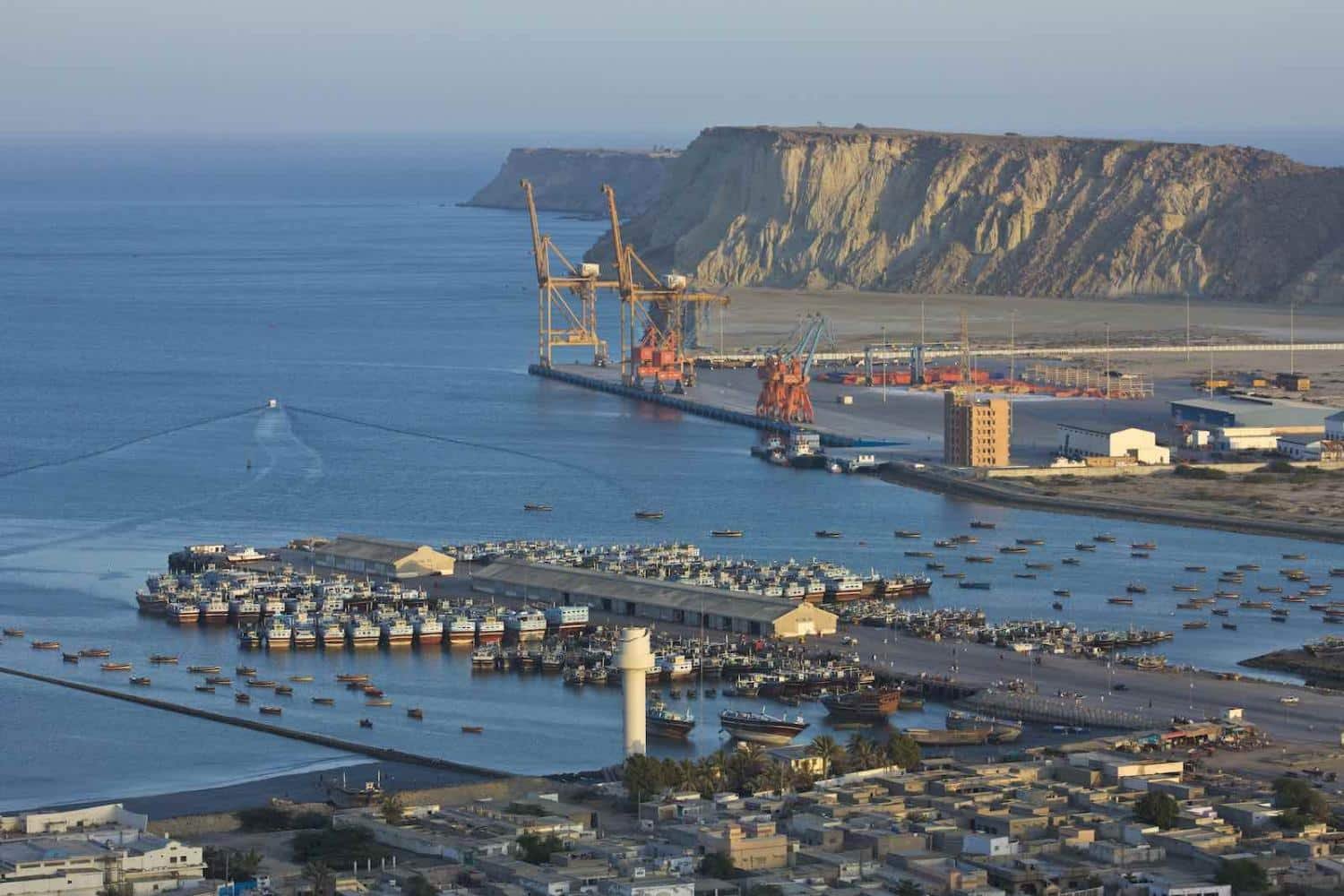





The Gwadar Port on the Pakistani Balochistan coast has become a vital part of Pakistan’s maritime strategy. Originally owned by Oman and transferred to Pakistan in 1958, Gwadar remained largely undeveloped until recent decades, when the China-Pakistan Economic Corridor (CPEC) projects started. The Pakistan Navy (PN) has consistently strengthened its position, focusing on its deep-water berth and closeness to busy shipping lanes. The first Makran Coast base was established in 1987, commissioned by the PN in Gwadar as PNS Akram. Pakistan completed the Jinnah Naval Base at Ormara in 2000, a deep-water facility located west of Karachi to reduce the risk of blockage, as experienced in 1971.
- PNS Akram in Gwadar, the first Makran base and current HQ of the Western Command.
- Jinnah Naval Base in Ormara is the second-largest naval base after Karachi.
- PNS Makran in Pasni, a coastal patrol airbase established in the 1980s to support surveillance around Gwadar.
This development reflects increasing interest in the navy. Gwadar gained prominence with the commissioning of PNS Akram in 1987, as the first naval base on the Makran coast. In 2000, Jinnah Base was opened, providing maintenance and berthing support away from India’s west coast. Together, these bases give the Pakistan Navy the logistics capability and patrol power needed for operations in the Arabian Sea below the Strait of Hormuz.
Naval infrastructure and posturing have expanded in Gwadar during the 2010s and 2020s as part of CPEC. Task Force-88 was established to address security in Gwadar in 2016 and includes a combination of warships, fast-attack vessels, maritime patrol planes, and Unmanned Vehicles to protect the port and CPEC shipping routes.
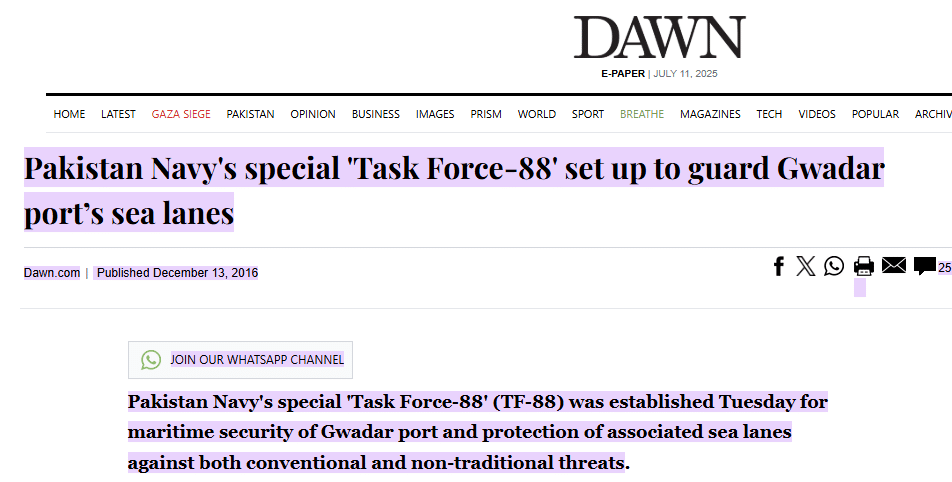
Source: DAWN
The navy is also deploying Marines and patrols in Gwadar. PN leadership emphasizes this focus. In early 2025, Admiral Naveed Ashraf pledged the success of CPEC by taking all necessary measures to secure Gwadar Port.
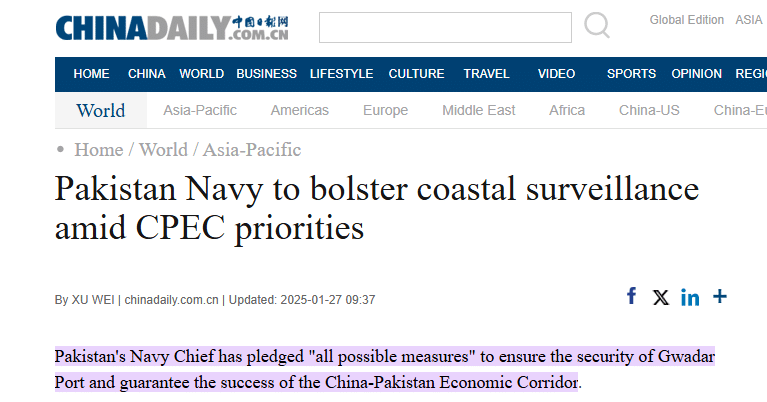
Source: China Daily
During the 2024 Pakistan Navy efficiency parade, the Chief of Naval Staff highlighted the importance of Gwadar’s safety, praising officers for safeguarding “strategic maritime zones, particularly Gwadar Port.” These official messages indicate that the PN is fully committed to defending the port.
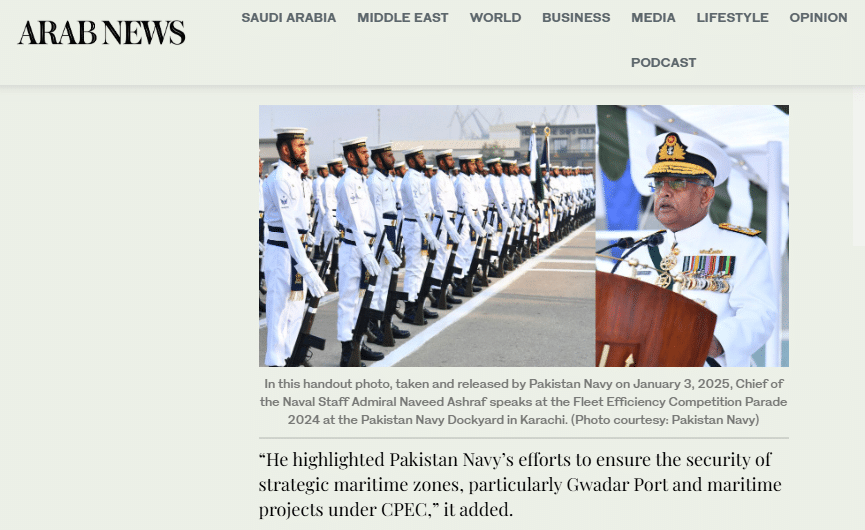
Source: Arab News
On the ground, Gwadar has also developed supporting infrastructure, reflected by the new Gwadar International Airport (opened in 2023) and expanded naval facilities. In 2025, a China-Pakistan joint communique “welcomed the official opening of the new Gwadar International Airport” and committed to further developing the port as a multimodal logistics hub. The mid-2024 CPEC joint statement also noted that Pakistan and China see Gwadar as a critical node in cross-regional connectivity, calling for an acceleration of port infrastructure development, including a proposed transshipment hub and shipyard.
The strategic importance of Gwadar is primarily due to its location. The port is located at the Arabian Sea just beyond the Strait of Hormuz, the strategic choke point in the connection between the Persian Gulf and the open ocean. According to one of the analyses, the port of Gwadar supports the CPEC, since it is located in the Strait of Hormuz, which is one of the most important straits worldwide. The PN can use Gwadar to observe international shipping routes that contain about two-thirds of the world’s supply of oil reserves. The Gwadar port is the closest deep-water outlet of Pakistan to Iran and the hydrocarbon-rich states of Central Asia through the overland routes. Securing Gwadar, therefore, enhances the maritime security in the region by preventing illegal trafficking and offering a naval presence close to the Gulf of Oman.
The involvement of China further enhances Gwadar’s maritime role. Pakistan and China have publicly talked about Gwadar as a joint trade and energy port under CPEC. In 2024-2025, joint statements repeatedly refer to Gwadar as a key hub of connectivity and trade. At the same time, official Pakistani sources stress that Gwadar remains under Pakistani command.
The PN vows only defensive cooperation, not a foreign base. In a 2025 interview, Admiral Ashraf highlighted the long-standing “bilateral relationship” between Pakistan and the PLA navies, describing joint exercises (e.g., AMAN multilateral drills) as aimed at maintaining regional maritime order. He explicitly linked this collaboration to combating piracy and terrorism at sea, not any foreign power projection.
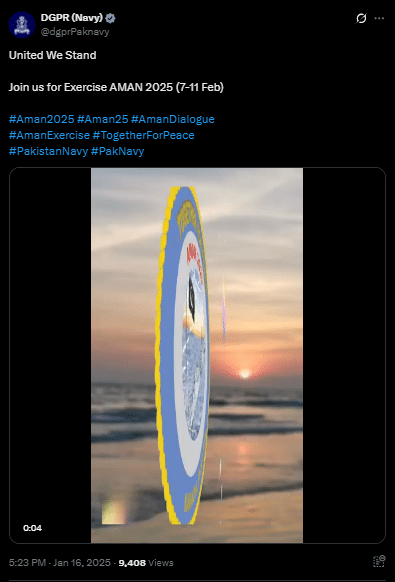
Source: @dgprPaknavy/ X
In summary, Gwadar’s development under CPEC has strengthened China-Pakistan strategic relations, but Pakistan Navy is ultimately responsible for the port’s security. As both governments emphasize, Gwadar’s growth benefits mutual economic interests, while PN forces keep it a secure seaport on Pakistan’s western front.