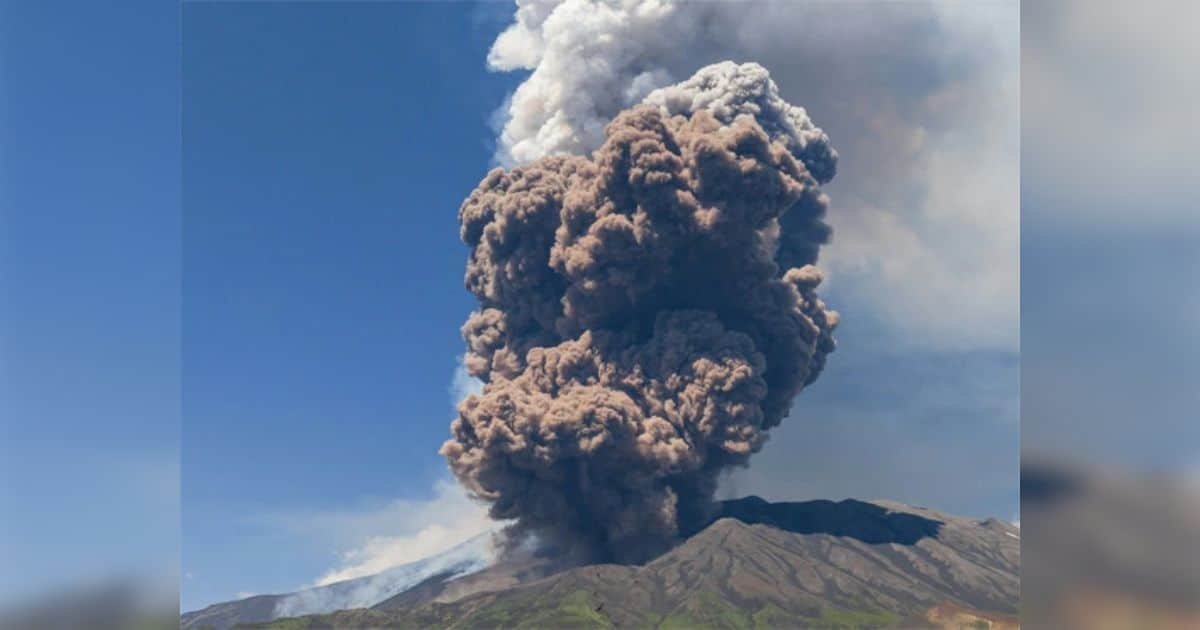





Ash clouds from an erupting Ethiopian Volcano have been detected near Pakistan’s coastal city of Gwadar, prompting the national meteorological authorities to issue aviation alerts for high-altitude flights. According to the Pakistan Meteorological Department (PMD), satellite imagery early Monday recorded volcanic ash approximately 60 nautical miles south of Gwadar, marking the first time plumes from this eruption have drifted so close to Pakistani airspace.
PMD spokesperson Anjum Nazir-e-Rizgham confirmed that two consecutive volcanic ash advisories were issued for aircraft flying at altitudes of around 45,000 feet. “The alerts have been issued for international flights that typically traverse Pakistani airspace at or above 45,000 feet,” the spokesperson said, noting that crews of high-altitude aircraft have been instructed to exercise heightened caution. Volcanic ash can severely damage aircraft engines, reduce visibility, and affect navigation systems, making such advisories crucial for aviation safety.
You May Also Like: Dhaka Renews Extradition Request for Hasina as Regional Political Ripples Reach Pakistan
Ash from the Ethiopian Volcano has spread widely across the region, reaching Yemen, Oman, India, and northern Pakistan. The eruption originates from the Haile Gobi volcano, situated roughly 800 kilometres northeast of Ethiopia’s capital, Addis Ababa.
⚠️ Ethiopia: The Hayli Gobi volcano erupted today for the first time in ten thousand years and sent ash up to a height of 15 km.🔥🔥 pic.twitter.com/aiPVhhO4rr
— Dr. Fundji Benedict (@Fundji3) November 24, 2025
Background of the Haile Gobi Volcano
The Haile Gobi volcano, standing about 500 metres high, is part of the geologically active East African Rift Valley — one of the most dynamic tectonic regions in the world. The Rift Valley marks the boundary where the African and Arabian tectonic plates are slowly drifting apart. This divergence thins the Earth’s crust, creating fissures and conduits through which magma can rise to the surface, often resulting in frequent volcanic and seismic activity.
ETHIOPIA: Hayli Gubbi is the southern most volcano of the Erta Ale Range erupts today violently after 10,000years…..it is the northern end of the Great Rift Valley.
Is the pressure by the super plume underneath the cause of flooding by water bodies on the floor of the Rift… pic.twitter.com/Ycpkr3hY4S
— Jophick (@jophick) November 24, 2025
Volcanoes in the Rift Valley, including Haile Gobi, are typically shield volcanoes formed by low-viscosity lava flows. While many of them erupt periodically with moderate intensity, their ash plumes can spread over vast distances due to powerful upper-level winds. Historically, eruptions in this region have affected not only local populations but also air travel routes over East Africa, the Gulf region, and the Arabian Sea. Although Haile Gobi is not among Ethiopia’s most well-known volcanoes, its current eruption has drawn international attention due to the wide dispersal of ash across several countries.
Monitoring and Preparedness
The PMD stated it is closely monitoring the ash movement and issuing regular updates to aviation authorities. “We are tracking the plume trajectory through satellite and atmospheric models. Aircraft flying at high altitudes must remain vigilant,” the spokesperson said.
Aviation authorities have reassured that no disruptions to flight operations have been reported so far, but monitoring will continue as long as the volcano remains active. The situation highlights the interconnected nature of regional atmospheric conditions and the importance of coordinated early-warning systems for aviation safety.