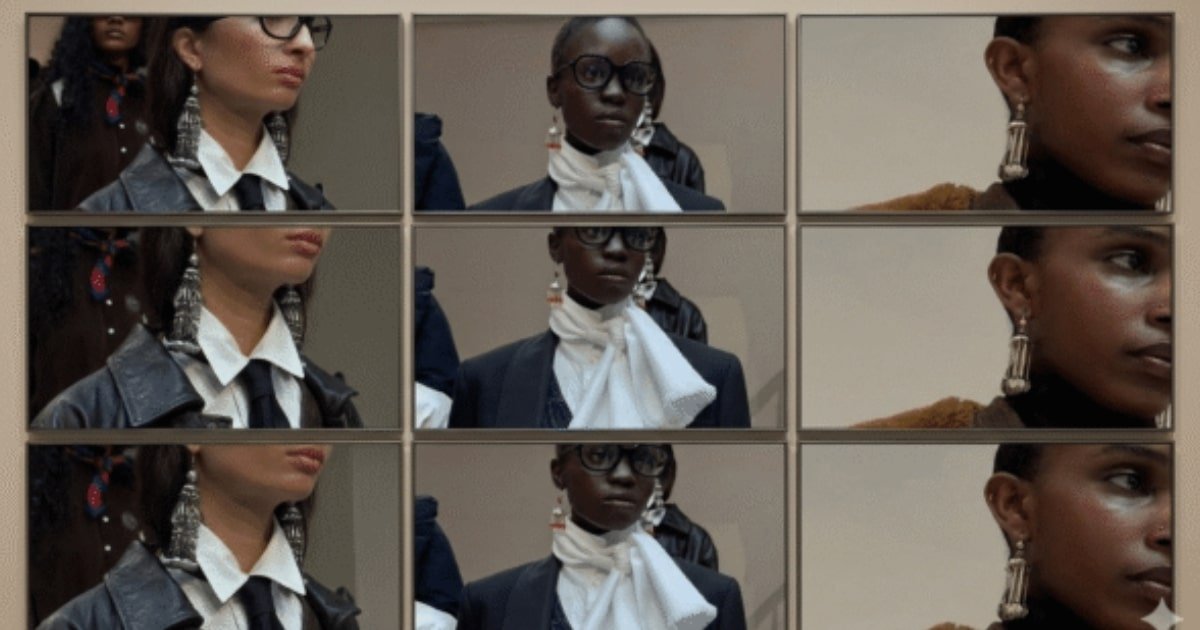





In the early days of March 2026, as the fashion world decompressing from New York Fashion Week, a familiar ache began to throb within the South Asian creative community. Ralph Lauren’s Fall 2026 Ready-to-Wear collection had just debuted, a masterclass in “renegade spirit” and “romantic adventure.” Models moved through a sunset-hued palette of velvets and silks, accessorized with what the show notes described as “vintage-inspired drops.”
To the untrained eye, they were just beautiful earrings. To the subcontinent, they were unmistakably jhumkas. But as the models took their final turns, the word “jhumka” was nowhere to be found. Instead, centuries of craftsmanship were flattened into a generic Western aesthetic, marking yet another chapter in the long, exhausting history of cultural erasure for profit.
View this post on Instagram
The Jhumka: More Than an “Unexpected Detail”
The bell-shaped chandelier earring known as the jhumka is a foundational element of South Asian identity. Whether it’s the heavy gold versions worn at weddings or the oxidized silver pairs favored by students in Lahore and Delhi, the jhumka carries a specific weight, literally and metaphorically.
When a Western heritage label incorporates these silhouettes but strips them of their name, they aren’t just “borrowing” a shape; they are sanitizing it. Indigenous artisans have perfected the intricate filigree and “ghungroo” (tiny bell) attachments for generations. By rebranding them as boho-chic or minimalist vintage, the industry reinforces a colonial hierarchy: the design is only “elegant” once it has been validated by a Western runway.
a recurring theme in modern fashion that is sad yet ironical to me, knowing almost none of these pieces are being actually sourced from south-asian artisans, let alone any credit being given to that community whatsoever. https://t.co/QM2Z8gBDLK
— 𓃠 (@izzah_vl) March 6, 2026
The “It-Girl” Pashmina: Luxury Without the Legacy
The latest spark in this debate was ignited by Kendall Jenner, who was recently photographed draped in a deep maroon Pashmina shawl as part of a quiet luxury ensemble. While Western fashion critics quickly labeled the look stealth wealth and minimalist chic, the South Asian community viewed it through a different lens.
For artisans in Kashmir and across Pakistan, the Pashmina is far more than a seasonal “it-girl” accessory; it is “Soft Gold.” The term itself comes from the Persian pashm, and the fabric is the result of a grueling, hand-combed process involving the undercoat of Changthangi goats. When the Global West repackages this heritage craft as a generic “luxury wrap,” it effectively erases the indigenous weavers who have spent centuries perfecting the art of the handloom. By stripping the shawl of its geographic and cultural identity, the industry turns an ancient legacy into a fleeting, decontextualized trend.
Why is Kendall Jenner wearing a pashmina shawl with an alo set? pic.twitter.com/MzI7zBcmkN
— ☆ Angelita ☆ (@pyschodior) December 1, 2025
The “Scandinavian Scarf” and the Art of Erasure
Perhaps the most egregious example of recent years is the rebranding of the dupatta. In 2024 and 2025, social media was flooded with influencers and fast-fashion brands marketing the “Scandinavian Scarf”, a long, lightweight, embroidered cloth styled exactly like a dupatta.
For many Pakistani and Indian women, the irony is bitter. The dupatta is a garment that has, for decades, been a target of “othering” in the West, labeled as a symbol of regressive modesty or “too ethnic” for professional spaces. To see it suddenly rebranded as a “minimalist European discovery” sold for hundreds of dollars, is a masterclass in fashion colonialism. One might argue that it’s not a discovery if we’ve been wearing it for three thousand years; it’s a heist.
I get so pissed watching white people appropriate dupatta I can’t do this kill them
— Nom – missing 🪴 🌱 ⚖️ hours (@Ello_Im_Shy) February 19, 2026
From Shalwars to “Balloon Pants”
The theft isn’t limited to accessories. The Shalwar, the voluminous, tapered trouser that is the literal national dress of Pakistan, has been repeatedly repackaged by luxury houses as “Balloon Pants,” “tapered harem trousers,” or “draped poplin bottoms.”
Brands like Alaïa and Zara have recently pushed these silhouettes as the key to a great fall outfit, utilizing the specific gathers and pleats that South Asian tailors have used for centuries to ensure comfort in heat. When the cultural context is removed, the functionality and history are lost. The shalwar is a garment of movement and heritage; the “balloon pant” is just a seasonal trend destined for a landfill by 2027.
The Indigenous Backlash: “Our Culture is Not a Costume”
The reaction from indigenous artisans and the diaspora in 2026 is no longer one of quiet frustration. It is a loud, coordinated demand for intellectual property recognition. South Asians are pointing out the hypocrisy of a system that once mocked their “smelly food” and “loud jewelry” only to monetize those exact elements a decade later.
Joint family= Multigenerational Living
Haldi doodh= Turmeric Latte
Dupatta= Scandinavian Scarf
Kolhapuri Chappal= Heritage SandalsAt this point I really need a dictionary of appropriation lol!! 🤷🏻♀️ https://t.co/QTk7ljy3Vy
— Amrashree Mishra | अमराश्री मिश्र (@AmrashreeMishra) February 10, 2026
The problem isn’t the exchange of culture; fashion has always been a conversation. The problem is the silence. When Ralph Lauren or any other designer uses the jhumka, the dupatta, or the shalwar, they have a responsibility to name the source. Without credit, acknowledgment, and a seat at the table for the artisans who actually hold this knowledge, “inspiration” is just a polite word for extraction.
As we move further into 2026, the message to the Global West is clear: if you want our look, you have to respect our history. Stop “discovering” us, and start crediting us.
You May Like To Read: Saheefa Jabbar Khattak Sparks Ethnic Firestorm Over Hiring Comments
Check out our latest video: