






Operation Banyan Al Marsoos, named after a Quranic verse meaning “iron wall’ in Arabic, was a retaliation by the Pakistani military in response to India’s Operation Sindoor. It marked a radical change in Pakistan’s military doctrine and became a textbook example of hybrid warfare through multi-domain dominance. One of the primary reasons for the operation’s success was its combination of locally developed military systems, cyber capabilities, and the effective employment of AI on the battlefield, in conjunction with conventional warfare and kinetic operations. The electronic, cyber, and unmanned platforms worked in unison through a cohesive strategy, which proved to be a decisive factor in the operation’s success.
Electronic Warfare and Cyber Offensive
The operation saw the launch of a coordinated attack that included the employment of fighter jets, drones, and surface-to-surface missiles that targeted key Indian military and logistical installations, including airbases at Pathankot, Udhampur, Srinagar, Bathinda, missile storage at Beas and Nargot, as well as the S-400 air defense system at Adampur. Command bases and supply depots at Uri, Rajouri, and KG Top were also hit.
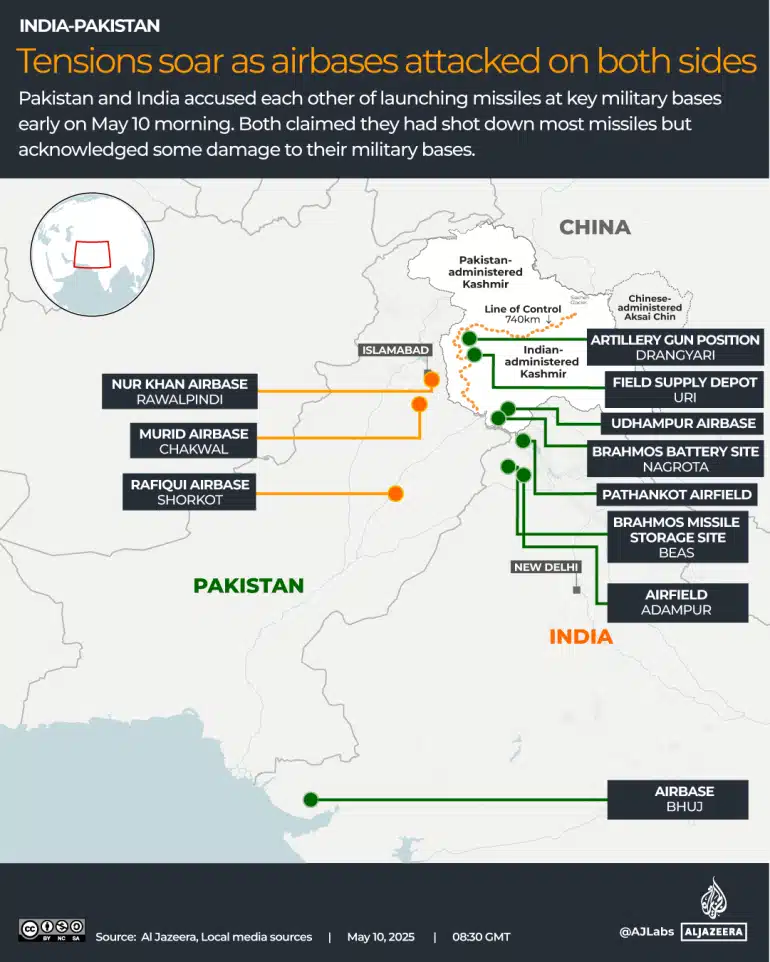
Source: Al Jazeera
In addition to this offensive, Pakistan also launched an extensive cyber warfare operation targeting the Indian government, military, and civilian infrastructure. Approximately 70% of India’s power grid was compromised, resulting in major blackouts in cities across the country. Government and private websites, including those of BJP, MTNL, and BEML, were defaced or taken offline. Pakistan also disabled over 2500 security cameras in India while leaking crucial defense-related data from UIDAI, HAL, and BSF to the public. The Maharashtra Electricity Board was also targeted, resulting in record corruption and service disruptions that affected millions. The operation saw the successful use of malware, phishing, and ransomware in warfare. This cyberattack had the desired effect of crippling systems and causing widespread panic.
#Breaking
Pakistani Cyber Attack on IndiaMultiple Indian websites, including Assam Rifles, the Department of Atomic Energy portal, and Indian Defence Production, were compromised in a major Pakistani cyberattack. pic.twitter.com/XIv3LZ1E8X
— Eagle Eye (@zarrar_11PK) May 10, 2025
Drone Warfare and AI
In recent years, drone warfare has developed to a great extent and is being actively employed in conflicts around the world, notably in the Russian-Ukrainian war. The Sub-continent has, for the most part, seen conventional and guerrilla warfare. This latest Pak-India conflict marks a turning point in warfare in this region with the active use of AI and drones in battle.
The skillful use of drones by Pakistan has also been noted by Indian military officials, who observed that Pakistan’s launching of over 500 low-cost drones into Indian airspace as part of Operation Banyan Ul Marsoos was a calculated move to stress-test Indian defenses and gather data. The use of Chinese commercial-grade or locally modified drones, including the Turkish-made Asisguard Songar UAVs, in swarms and with mother drones guiding clusters in coordinated waves, aimed to expose Indian air defense architecture, such as radar positions, engagement zones, and response tactics. The tactical advantage of this exercise was that it triggered expensive air defense systems worth billions while costing only 5-10,000 rupees. This marked a shift in Pakistan’s military doctrine from conventional stand-offs on the border to high-tech, low-cost, asymmetric warfare through deep penetration into enemy land.
Breaking
300-400 Pakistani drones targeted Indian locations from Leh to Sir Creek, says Union govt
India on Friday said that Pakistan attempted drone incursions in 36 locations. “A swarm of 300-400 drones targeted Indian locations from Leh to Sir Creek,” the government… pic.twitter.com/SkSP35wTqa
— Maktoob Hindi (@maktoobhindi) May 9, 2025
Paralyzing the Enemy
For the first 48 hours of the launch of this retaliation, most Indian government and military officials were paralyzed and did not have any clue about what was happening. The counterattack was a modern-day Blitzkrieg, combining the use of AI drones, cyberattacks, and conventional land and air maneuvering. Most of the communication channels were either hindered or compromised by radar blackouts, cyber attacks, and overshadowing UAV threats from multiple domains. The enemy was caught unaware and found out the hard way the consequences of underestimating Pakistan’s tactical abilities.
India miscalculated by seeing itself in a giant mirror and followed the example of Israel’s untouchability by the West and its policy of massacre against a Muslim state. India, with its cosy relations with the West and with the support of Israel and US, chose to attack Pakistan… https://t.co/nkJLSigxs7 pic.twitter.com/2qi7pZQk5s
— TR_tech (@T_Nblty) June 7, 2025
Changing Strategic Landscape
After Baloch Liberation Army’s (BLA) attack on Jaffer Express, DG ISPR had stated in his press conference:
“Rules of engagement have changed!” ⚔️🇵🇰
The Jaffar Express terrorist attack has crossed the line.
DG ISPR Lt Gen Ahmed Sharif Chaudhary sends a clear message: The enemy will pay!
BLA must brace for what’s coming ☠️🔥#Pakistan #WarOnTerror #BLA #ISPR pic.twitter.com/MUeL5fUmof— Islamabad Insider (@IslooInsider) March 13, 2025
This statement was not only meant for the enemy within, but also for the enemy outside, facilitating the one within. Rules of engagement had to be changed when dealing with a country like India that does not hesitate to kill its own to use as a justification to launch attacks on its neighbors. Conventional warfare was unlikely to be effective against such an enemy. With a sophisticated air defense system also used by the Russians, as well as Israeli HAROP missiles and French Rafales, India entered the battlefield heavily equipped. What they did not expect was a country, roughly one-tenth the size of their own, retaliating with locally manufactured, cheaper drones and jets. Their overestimation of numerical supremacy, combined with their blind faith in advanced military technologies, was what led to their downfall on the battlefield. Pakistan’s retaliation was akin to an underdog standing up to the bully and shattering their delusions of dominance and strength.