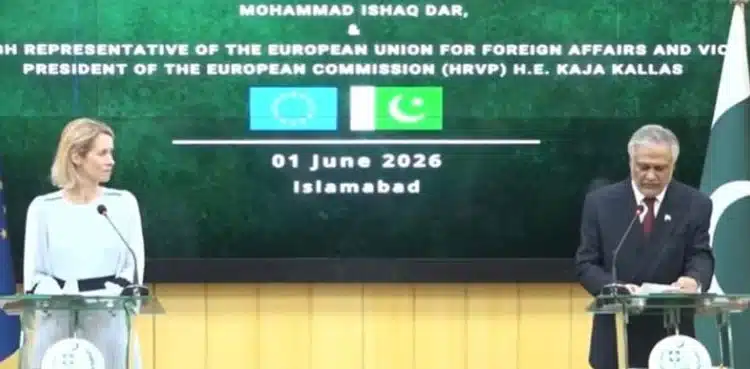


ISLAMABAD — The European Union’s (EU) high representative for foreign affairs and security policy, Kaja Kallas, termed Pakistan a “major regional power” and an “important partner” during the 8th EU-Pakistan Strategic Dialogue on Monday. Co-chaired by Kallas and Deputy Prime Minister Ishaq Dar, the high-level talks focused on expanding trade, regional security, and Pakistan’s critical role as a mediator in the Middle East.
Key Highlights
- Kaja Kallas and Ishaq Dar co-chaired the 8th EU-Pakistan Strategic Dialogue in Islamabad.
- The EU praised Pakistan’s role as the “main mediator” in preventing a full-blown war between the US and Iran.
- Europe remains Pakistan’s largest export destination, surpassing the combined exports to the US and China.
- Pakistan continues to lead globally in Erasmus Mundus Scholarships for the fifth consecutive year.
- Both sides agreed to transform their relationship into a more comprehensive and forward-looking partnership.
Europe Recognizes Pakistan’s Role in US-Iran Mediation
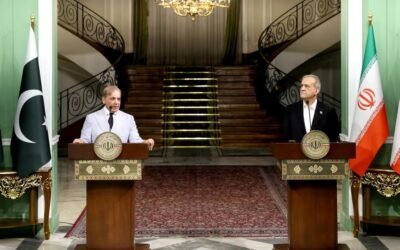
During a joint press conference, Kallas explicitly recognized Pakistan as the “main mediator” between the United States and Iran. She noted that Pakistan’s diplomatic efforts have repeatedly helped prevent a return to full-scale war and have created a “tenuous diplomatic opening” to extend ceasefire agreements and reopen the strategic Strait of Hormuz. While praising these efforts, Kallas emphasized that any temporary understanding must eventually lead to deeper discussions regarding nuclear stockpiles and regional stability.
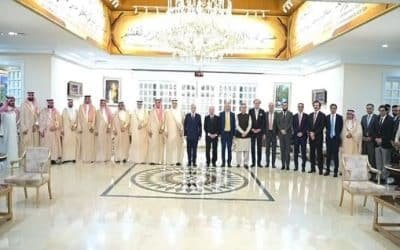
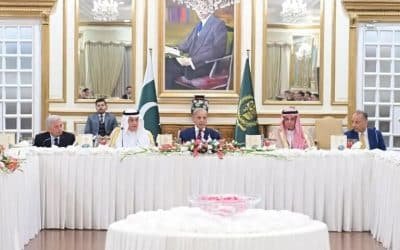
Deputy Prime Minister/Foreign Minister Senator Mohammad Ishaq Dar @MIshaqDar50 and EU HR/VP Ms. Kaja Kallas @kajakallas co-chaired the 8th Pakistan-EU Strategic Dialogue in Islamabad today.
The two sides held comprehensive discussions on Pakistan-EU relations including trade and… pic.twitter.com/iaBaG3QJbb
— Ministry of Foreign Affairs – Pakistan (@ForeignOfficePk) June 1, 2026
Deputy Prime Minister Ishaq Dar added that Pakistan and the EU remained in constant contact throughout last year’s India-Pakistan conflict and the ongoing US-Iran war. He expressed appreciation for the EU’s recognition of Pakistan’s peace efforts and vowed to continue working toward a lasting solution.
Trade, GSP+ Status, and Human Rights
The dialogue highlighted the massive economic weight of the EU-Pakistan relationship, with the EU serving as Pakistan’s largest export market with a trade volume of €12 billion. Kallas pointed out that Pakistan is the world’s leading beneficiary of the EU’s Generalized Scheme of Preferences Plus (GSP+), which allows duty-free access to the European market. However, she stressed that this preferential access is tied to tangible progress in implementing 27 international conventions:
Labor and Human Rights: The EU expects progress on human rights and labor standards.
Good Governance: Continued implementation of international governance standards is required.
Environmental Protection: Progress in environmental implementation remains a key condition.
Regional Security and Strategic Vision
The two leaders discussed a wide range of regional issues, including the security situation in Afghanistan and South Asia. Kallas called for restraint and de-escalation in the conflict between Pakistan and Afghanistan, while acknowledging Pakistan’s right to defend its people under international law.
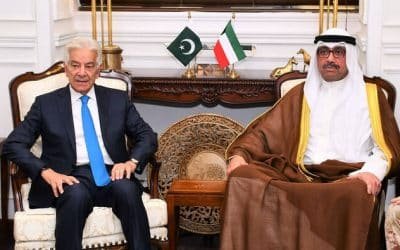
Deputy Prime Minister/Foreign Minister Senator Mohammad Ishaq Dar @MIshaqDar50 met with the EU HR/VP Ms. Kaja Kallas @kajakallas, today in Islamabad.
During the meeting, both sides acknowledged the positive trajectory of Pakistan-EU ties and agreed to further strengthen the… pic.twitter.com/xJAVuE3MG0
— Ministry of Foreign Affairs – Pakistan (@ForeignOfficePk) June 1, 2026
Ishaq Dar briefed the EU high representative on several core Pakistani concerns:
Jammu and Kashmir: Dar apprised Kallas of concerns regarding Indian aggression and advocated for a resolution based on UN Security Council resolutions.
Indus Water Treaty: He shared Pakistan’s vindicated position following a supplemental award by the Permanent Court of Arbitration regarding the Ratle and Kishanganga hydroelectric projects.
Counterterrorism: Both sides discussed terrorist threats emanating from Afghan soil, which remain a top concern for Islamabad.
The visit concluded with both sides reaffirming their commitment to a new “Strategic Vision” document aimed at elevating the partnership into a more comprehensive framework covering digital infrastructure, clean energy, and climate resilience.
: