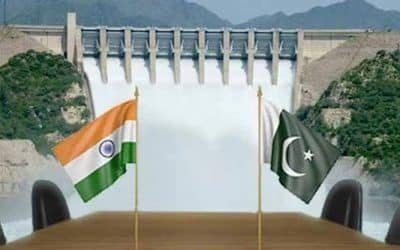





ISLAMABAD — Information Minister Attaullah Tarar asserted on Monday that the Indus Waters Treaty (IWT) remains fully operational and legally binding, emphasizing that the accord cannot be unilaterally revoked, abolished, or amended by India.
Addressing a joint press conference in Islamabad alongside Climate Change Minister Musadik Malik, Tarar stated that Pakistan’s legal stance has secured widespread international endorsement. The briefing comes amid escalating hydro-diplomatic friction following New Delhi’s efforts to place the 1960 accord in abeyance and construct a multi-billion rupee water diversion tunnel.
“The Indus Waters Treaty cannot be suspended unilaterally,” says Information Minister Ataullah Tarar, reiterating Pakistan’s stance on the longstanding water-sharing agreement between Pakistan and India.#SamaaTV pic.twitter.com/xaeHszIoRA
— SAMAA TV (@SAMAATV) June 29, 2026
“Prime Minister Shehbaz Sharif and Chief of Defence Forces Field Marshal Asim Munir have stated multiple times that water is our lifeline, as well as our red line. Our people have an absolute right to this water through a legally enforceable treaty.”
— Information Minister Attaullah Tarar
Strict Limits on Hydro-Hegemony
The ministers highlighted that the Permanent Court of Arbitration (PCA) recently issued a supplemental award that backed Pakistan’s legal interpretations. The international court placed substantive limits on India’s water-control capabilities on the western rivers (Indus, Jhelum, and Chenab), specifically ruling on technical design and maximum pondage disputes linked to the controversial Kishenganga and Ratle Hydroelectric projects.
The federal government also forcefully denounced India’s newly tendered “Link-3 Project”—a Chenab-Beas link tunnel aiming to divert 1.9 million acre-feet of water annually out of the Chenab basin—calling it a grave violation of the Vienna Convention on the Law of Treaties.
Economic Implications & National Security
Minister Musadik Malik warned that arbitrary restrictions on downstream water flow pose a direct existential threat to Pakistan’s stability, noting that any physical attempt to block or alter the shared waterways would be met with severe consequences.
| Sector | Impact Metric |
| Agricultural Livelihood | 40–50% of the national population depends directly on agriculture |
| Economic Dependency | 20–25% of Pakistan’s total economy is driven by the agricultural sector |
| Strategic Core | Upstream water control directly impacts national food and employment security |
To consolidate its legal narrative and spread awareness, the government is hosting a high-level international seminar in Islamabad on Tuesday, bringing together global water and legal experts to reinforce the permanence of lower riparian rights.