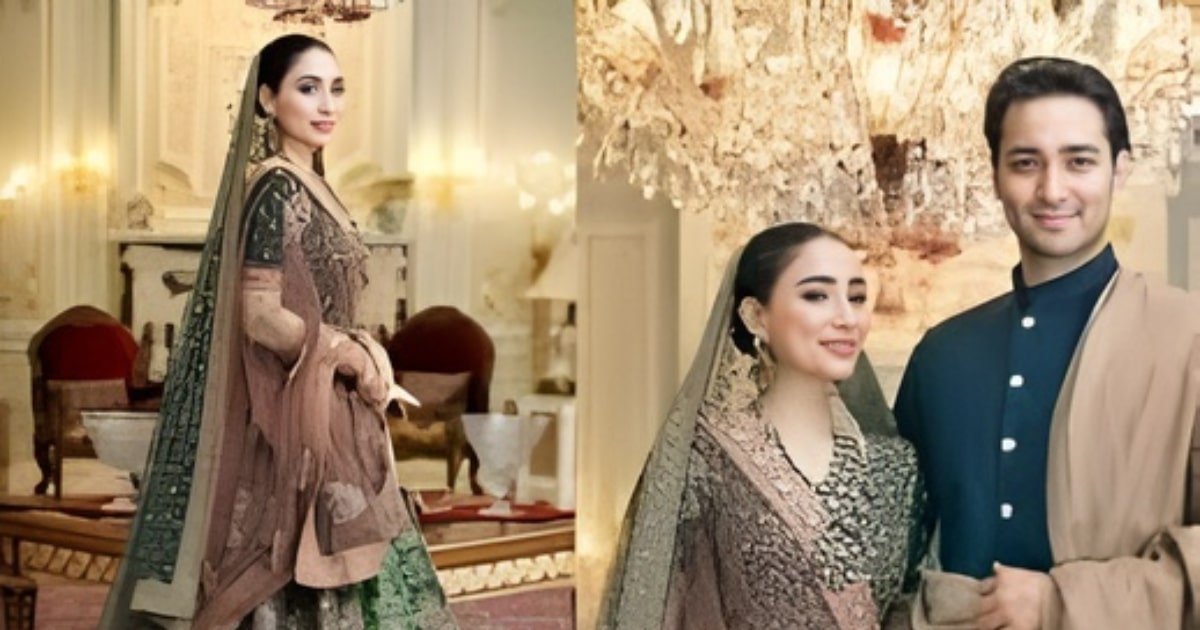



In the gilded hallways of Jati Umra, where the air smells of imported lilies and the weight of legacy, a wedding took place this January that was meant to be a private union. Instead, it became a public trial. When Junaid Safdar, the grandson of Nawaz Sharif, married Shanzeh Ali Rohail, the spectacle was designed to be a masterclass in regal elegance. But as the first high-resolution images hit the digital world, the conversation shifted from ‘Mubarak’ to ‘Mumbai.’
The bride’s choice to wear Indian couturiers for her primary events, a Sabyasachi lehenga for her Mehndi and a Tarun Tahiliani saree for her Baraat, has sparked a 1,000-watt debate on the sovereignty of style. In an era where ‘Brand Pakistan’ is fighting for global relevance, the country’s most powerful political family chose to outsource their aesthetic identity.
The Borderless Bride
For her Mehndi, Shanzeh Ali Rohail was the picture of “Heritage Luxury.” Her emerald green Sabyasachi lehenga, woven with muted purples and maroons, was a triumph of the designer’s signature antique-gold embroidery. Against the mint-green and rose décor of the Sharif residence, she looked like a portrait from a Mughal miniature. Two days later, for the Baraat, she stepped out in a scarlet Tarun Tahiliani saree, draped with a classic veil and paired with an emerald-and-diamond choker that felt more cinematic than ceremonial.
Technically, the looks were flawless. Culturally, they were a catalyst for outrage. Critics were quick to point out the irony: while the political elite frequently champion “buying local” and supporting the domestic textile industry, their own family milestones are dressed in the fabrics of our neighbors. The backlash wasn’t just about fashion; it was about the perceived snub to a domestic bridal industry that is currently at its creative peak.
View this post on Instagram
The ‘Mid’ Critique and the Copycat Scandal
Perhaps the most biting commentary came from the Gen-Z fashion police and local stylists. Within hours of the Baraat, influencers were calling the look “mid,” a slang term for average or underwhelming. The critique wasn’t just subjective; it was forensic. It didn’t take long for eagle-eyed netizens to realize that Shanzeh’s red Tahiliani saree was almost identical to one worn by Bollywood actress Ananya Panday in early 2025.
For a wedding of this magnitude, the expectation was originality. By choosing a “ready-to-wear” celebrity silhouette over a custom, artisan-led creation from a Pakistani master like Bunto Kazmi or Faraz Manan, the bride inadvertently signaled that she preferred the reflected glow of Bollywood over the distinct, heavy-handwork heritage of Lahore or Karachi.
View this post on Instagram
The Displacement of the Artisan
Beyond the digital noise lies a more somber economic argument. Pakistan’s fashion industry is one of the few sectors that has consistently successfully branded the country abroad. From the delicate Zardozi of Faisalabad to the intricate Gota work of Multan, the craftsmanship available within our borders is world-class.
When a family of such immense influence bypasses local talent, it devalues the “Made in Pakistan” label. The wedding was a missed opportunity for a “cultural export.” Had Shanzeh worn a local masterpiece, the global spotlight on the wedding would have served as a million-dollar advertisement for Pakistani artisans. Instead, the narrative became about the “obsession” with the Indian aesthetic, a trend that suggests the Pakistani elite still views the grass as greener (and the red as richer) on the other side of the border.
بھارت سے جنگ ہو تو ہم سوشل میڈیا پر لڑیں۔ بھارت ہمارے بارے میں بکواس کرے تو ہم الفاظ کی جنگ کریں۔ بھارت ہم پر تہمت لگاۓ تو ہم چیخیں چلائیں
اور ہمارے حُکمرانوں کی اولاد کی شادی ہو تو وہ کروڑوں کے جوڑے بھارت سے خرید کر پہنیں۔
ہم واقعی چ ہی ہیں۔ https://t.co/BrGtwBaSKR
— Mir Mohammad Alikhan (@MirMAKOfficial) January 18, 2026
The Counter-Argument: Fashion as a Personal Freedom
Of course, there is a vocal contingent defending the bride. They argue that a wedding is a personal milestone, not a political manifesto. In 2026, where global luxury is just a click away, should a bride be forced to carry the weight of national diplomacy on her shoulders? Supporters pointed out that Indian celebrities frequently wear Pakistani labels like Faraz Manan, so why shouldn’t the reverse be true?
“It’s 2026, can we all grow up?” asked one might ask. “Let a bride wear what she feels beautiful in.” This perspective views fashion as a bridge, a way to celebrate shared South Asian craftsmanship that transcends the bitter politics of the day. Some see Shanzeh’s choice not as a betrayal, but as a sophisticated, borderless appreciation of art.
You May Like To Read: The Heart of Language: “Qalb” AI Model Puts Urdu First
A House Divided
The “Sovereignty of Style” debate isn’t going away. As the Valima pictures emerged, this time featuring a lilac Faraz Manan ensemble, it felt like a tactical retreat into local territory. But the damage, or the statement, had already been made.
View this post on Instagram
The Junaid Safdar wedding of 2026 has exposed a deep-seated identity crisis within the Pakistani upper class. We are a nation that prides itself on its distinct culture, yet our most visible icons often seem to be looking elsewhere for validation. As long as the elite continue to choose the “prestige” of foreign labels over the “heritage” of their own, the local artisan will remain in the shadows of the very people they are meant to dress.
In the end, Shanzeh Ali Rohail looked beautiful. But in the court of public opinion, the “Star and Crescent” was momentarily outshone by the “Lotus,” leaving us to wonder: if our leaders don’t wear our pride, who will?
Check out our latest video: