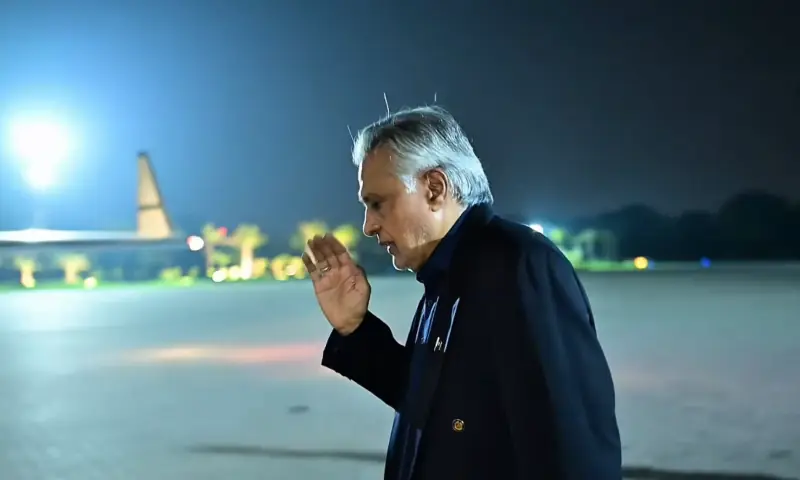


Deputy Prime Minister and Foreign Minister Ishaq Dar met his Jordanian counterpart Ayman Safadi in Amman on Wednesday, with the “deteriorating situation in the occupied West Bank” coming under discussion, according to a statement from Pakistan’s Foreign Office (FO). The meeting took place on the sidelines of a ministerial gathering aimed at formulating a unified position on the situation in occupied Jerusalem, bringing together foreign ministers from Arab League member states and other Islamic countries.
Key Highlights
- DPM Ishaq Dar meets Jordan’s Ayman Safadi in Amman over West Bank situation
- Both sides discuss recent developments in the US-Iran conflict
- Dar also holds separate meeting with Somalia’s foreign minister
- Pakistan reaffirms support for an independent Palestinian state on pre-1967 borders
- Ministerial meeting follows recent incursions reported at Al-Aqsa Mosque
West Bank, Jerusalem’s Holy Sites Top the Agenda
According to the FO, Dar and Safadi, who also serves as Jordan’s deputy prime minister, exchanged views on regional developments, with particular attention to the situation in the occupied West Bank. Dar appreciated Jordan’s role in safeguarding Jerusalem’s Islamic and Christian holy sites and its continued support for the Palestinian people, the statement said.
The two ministers also welcomed what the FO described as “growing momentum” in Pakistan-Jordan relations, reaffirming a shared commitment to deepening cooperation across political, defense, economic, educational and cultural areas, along with people-to-people exchanges.
Dar and Safadi additionally touched on wider regional developments, including the recent conflict between the United States and Iran. Both sides stressed the importance of dialogue and diplomacy in de-escalating tensions and reaffirmed close coordination at the bilateral and multilateral levels, including at the United Nations and the Organisation of Islamic Cooperation, to promote regional peace and stability.
Separate Talks With Somalia Focus on Bilateral Ties
Dar also held a separate bilateral meeting with Abdisalam Abdi Ali, Somalia’s Minister for Foreign Affairs and International Cooperation. The two discussed regional developments alongside what the FO called the longstanding fraternal ties between Pakistan and Somalia, reviewing ways to strengthen cooperation in political, economic, defense, education and capacity-building sectors. Both ministers reaffirmed their commitment to maintaining close coordination at multilateral forums, the statement added.
Deputy Prime Minister/Foreign Minister Senator Mohammad Ishaq Dar @MIshaqDar50 met with H.E. Abdisalam Abdi Ali, Minister for Foreign Affairs and International Cooperation of Somalia, on the sidelines of the Ministerial Meeting on Jerusalem in Amman today.
The two leaders… pic.twitter.com/KOvZdS7Nng
— Ministry of Foreign Affairs – Pakistan (@ForeignOfficePk) August 5, 2026
Pakistan Reiterates Support for Palestinian Statehood
Dar’s presence in Amman comes as part of Pakistan’s broader engagement on the Jerusalem question. The FO said he would use the ministerial meeting to “reaffirm Pakistan’s unwavering support for the Palestinian people and their just cause,” describing his participation as a reflection of Pakistan’s principled commitment to an “independent, sovereign and contiguous” State of Palestine based on pre-1967 borders, with Al-Quds Al-Sharif as its capital.
The meeting comes against the backdrop of repeated condemnation from Pakistan and other Muslim countries over what they describe as continued incursions by extremist Israeli settlers into Al-Aqsa Mosque, Islam’s third-holiest site in east Jerusalem. Israel captured and later annexed east Jerusalem in 1967. Under long-standing arrangements, Jewish visitors are permitted to enter the Al-Aqsa compound but not to pray there, an arrangement Israel says it remains committed to preserving even as Palestinians voice concern that it is gradually being eroded.
In June, foreign ministers from Pakistan and eight other Muslim countries jointly rejected any attempt to alter the historical and legal status quo in Jerusalem and its holy sites, a position Dar’s visit to Amman appears designed to reinforce.