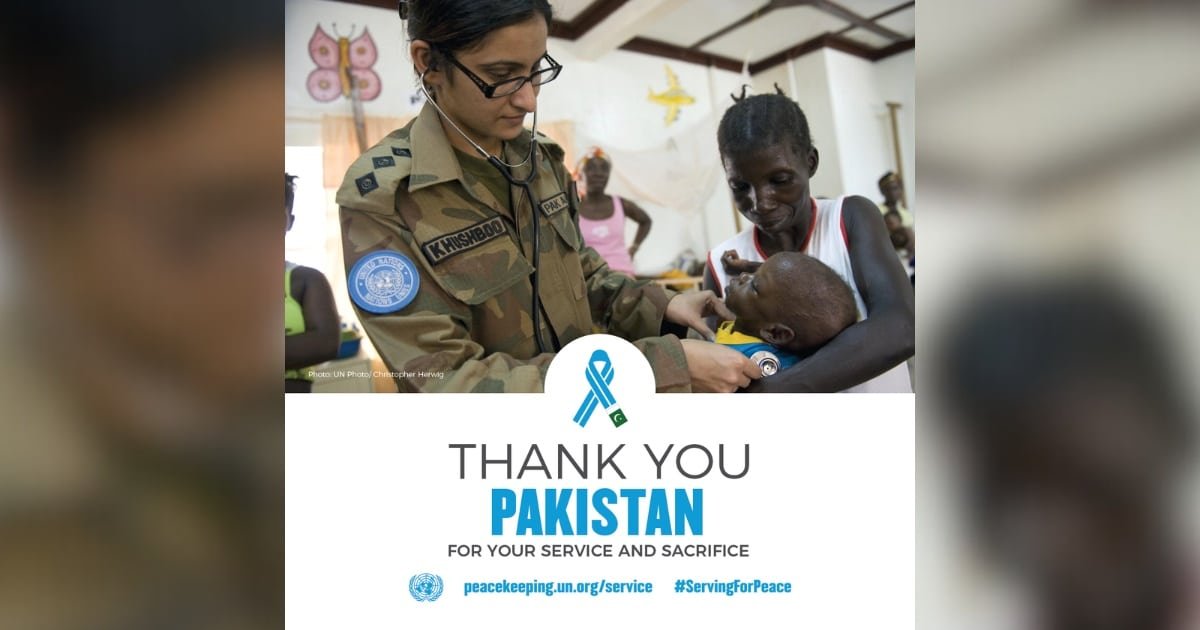


Pakistan has long been a leading contributor to United Nations peace operations. Its armed forces have a long history of peacekeeping. For decades, the country has remained one of the largest providers of troops and police. Since 1960, Pakistan has deployed over 200,000 personnel on 46 UN missions in 29 countries. In total, more than 235,000 Pakistani soldiers and police have served in 48 missions over eight decades. These deployments cover several continents. They include Africa (Liberia, Congo, Sierra Leone, Ivory Coast, CAR), Europe (Bosnia), and Asia (Cambodia, East Timor, Cyprus). Pakistan has won global praise for its efficiency, professionalism, and commitment.

Source: Today Stance
You May Like To Read: Trump–Putin Anchorage Summit Ends Without Ukraine Deal
Pakistan’s Global Peacekeeping Contributions
Pakistan’s role in Africa has been remarkable. Its battalions and engineers were key in ONUC (Congo, 1960s) and UNAMSIL (Sierra Leone, 1990s). Later, they served in UNMIL (Liberia) and MONUSCO (DRC). In Liberia, Pakistani peacekeepers patrolled Tubmanburg and repaired vital infrastructure. In CAR, they led operations under MINUSCA and ran medical units and Female Engagement Teams in Congo and the Central African Republic, to train females. In Sierra Leone and the Ivory Coast, engineers and infantry helped stabilize regions hit by conflict over resources. Analysts note that such missions build goodwill and open doors for stronger diplomatic and trade ties with African states.

Source: The News
Pakistan played a key role in the Balkans and Eastern Europe. In the 1990s, 3,000 Pakistani troops joined UNPROFOR in Bosnia. Their job was to protect civilians in Sarajevo and other towns. They patrolled conflict zones. They guarded safe areas. After the Dayton Accords, they served on UNMIBH in Bosnia. In Kosovo, under UNMIK, Pakistani troops worked for peace.
Pakistan has supported UN missions in South and Southeast Asia. Pakistani troops joined UNTAG in Namibia from 1989-1990. They helped with elections and demobilization. They also served in UNAMET in East Timor from 1999 to 2002. Pakistani observers and engineers worked in Sri Lanka, Nepal, and other hotspots. These missions were smaller in scale. Yet they showed Pakistan’s goal of promoting regional stability. Pakistani police trained local forces. They advised on crowd control in post-conflict areas. Their role reinforced the UN’s focus on civilian protection.
Motivations and Implications
Pakistan has strategic, diplomatic, and humanitarian reasons to engage in peacekeeping. Deployment of troops provides Pakistan with diplomatic leverage. They also establish relations with host states. The Army views the UN missions as a training ground for complicated operations. This experience trains it for counterinsurgency and homeland defense. Peacekeeping expertise has even been proposed by officials to carry with it broader diplomatic support.
The humanitarian aspect is also emphasized by Pakistan. Its officers explain missions as safeguarding civilians and the reconstruction of war-torn societies. Analysts indicate that Pakistani troops have been crucial in conflict resolution, relief, and protection of civilians. Examples are emphasized by Islamabad. In Liberia, engineers rebuilt roads. In Congo, women were trained by female teams. Such narratives present Pakistan as a good player and a proponent of female empowerment. Participation is also justified by leaders as evidence of adherence to the UN Charter. Ambassador Munir Akram referred to peacekeeping as a cost-effective mode of international security. The amount of contribution by Pakistan is massive, having more than 200,000 deployed members. This record reflects the country as a responsible partner in world peace and not a self-interested state.

Source: Arab News
Impact on Pakistan’s Global Reputation
Pakistan’s peacekeeping record has improved its global reputation. Its large contributions have won praise from the UN and the media. The UN calls Pakistan one of the largest and longest-serving contributors. Within the UN, it is often among the top five troop providers. For decades, Pakistani battalions have been seen as reliable and professional. Their presence also built goodwill. In Liberia, troops were honored in medal parades. In many missions, locals thanked them for restoring schools, clinics, and security. This strong reputation brings real benefits. Analysts say peacekeeping has opened doors for Pakistan. It builds influence in countries where Pakistan has little leverage. At a Karachi conference, speakers praised Pakistan’s “good name” in global forums. The international press has noted its sacrifices in sensitive zones. These reports show Islamabad as willing to risk lives for peace.
Overall, peacekeeping has boosted Pakistan’s image as a peace-loving nation. Islamabad uses this record in UN votes and negotiations. The legacy also has strategic value. Pakistan cites it to press for a stronger role in UN reforms and Security Council debates. In 2025, its ambassador said such service should mean more influence in peace decisions. At home, politicians call peacekeeping a source of pride. Even critics admit it gives the Army vital experience and global recognition that few other policies could achieve.
You May Like To Read: Countering Indian Influence in the Gulf: Soft Diplomacy or Strategic Presence?
Conclusion
Pakistan’s UN peacekeeping legacy is central to its global profile. It reflects decades of steady involvement. Few countries of similar size have matched this record. These missions advanced Pakistan’s interests. They built diplomatic ties, especially in Africa. They gave the Army valuable experience. They also boosted Pakistan’s image as a provider of global peace. Motivations included strategic benefits. Yet officials present the role in humanitarian terms. The impact has been positive for Pakistan’s reputation. Across continents, it is seen as more than a nuclear state or counter-terrorism ally. It is also a country that sends troops to serve under the UN flag. This record is marked by medals, praise from diplomats, and gratitude from locals. It remains a strong symbol of Pakistan’s place in the world.