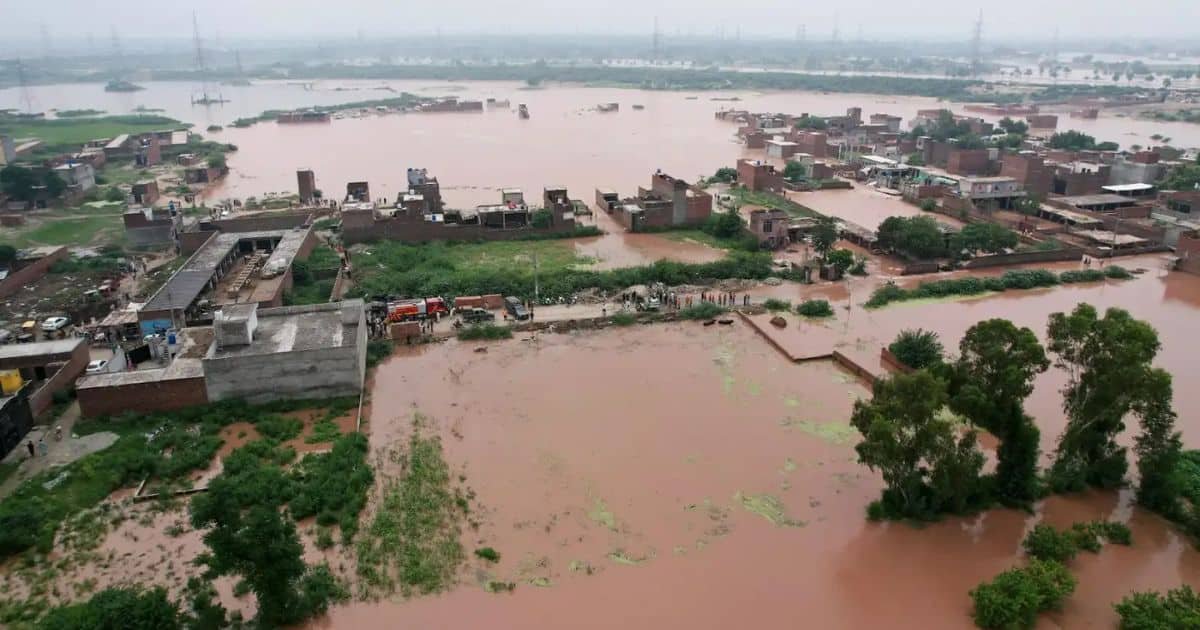





ISLAMABAD – The devastating floods across Punjab have affected more than 4.2 million people in 18 districts, leaving thousands homeless, health facilities crippled, and communities struggling with food insecurity. The Prime Minister has announced an increase in financial compensation for the families of victims, doubling the assistance from Rs1 million to Rs2 million per deceased, as the human and economic toll continues to rise.
‘The needs are huge’: Pakistan reels from floods as millions left homeless
Massive floods across Punjab, Khyber Pakhtunkhwa and Gilgit-Baltistan continue to leave millions homeless, destroying vital crops and pushing fragile communities to the brink. https://t.co/2BslDCpLtX pic.twitter.com/CUSJYAMlrv
— UN-Water (@UN_Water) September 23, 2025
According to a Rapid Needs Assessment (RNA) conducted by the United Nations Office for the Coordination of Humanitarian Affairs (UNOCHA), Muzaffargarh remains the worst-hit district, accounting for more than a quarter of the affected population. Other severely impacted regions include Jhang with 646,000 affected individuals, Bahawalpur with 514,000, Khanewal with 397,000, and Multan with 347,000. The survey covered 1,928 villages between September 8 and 18, revealing a dire humanitarian crisis.
You might be interested in: Over 3,000 Punjab Schools Damaged by Floods, Education Disrupted
Punjab Floods: Millions Displaced and Homes Destroyed
The floods have left a trail of destruction across Punjab. Out of 161,000 houses surveyed, 46,000 were found fully damaged and 115,700 partially damaged, forcing nearly 2.8 million people to abandon their homes. More than 93 percent of assessed areas reported some degree of housing damage, highlighting the widespread nature of the disaster. Displaced families are in urgent need of tents, blankets, tarpaulins, and winterisation kits to survive the coming months.
Health infrastructure has also suffered a major blow. Of the 742 health facilities assessed across the districts, 395 were damaged — including 80 that were completely destroyed. Bahawalnagar reported the most severe losses with 64 damaged facilities, followed by Jhang with 55 and Muzaffargarh with 46. The destruction threatens access to essential healthcare at a time when outbreaks of malaria, diarrhoea, and dengue are rising sharply due to contaminated water and poor sanitation.
Educational institutions have not been spared either. Floods damaged 667 schools, more than half of which were girls’ schools. In addition, 217 schools are currently being used as evacuation centres, disrupting the education of over 101,000 students. Sialkot recorded the highest damage, with 210 schools affected.
Water supply schemes have collapsed in several areas, with nearly 97,000 reported damaged. Of these, more than 48,500 were fully destroyed — the majority in Muzaffargarh, Jhang, and Bahawalpur. This has compounded the crisis, leaving rural communities without access to clean drinking water.
Livelihoods, Food Insecurity, and Relief Measures
Agriculture and livestock — the backbone of Punjab’s rural economy — have been severely disrupted. Crops have been washed away, livestock killed, and agricultural cycles interrupted. More than 85 percent of farming households in flood-hit districts are now facing critical income losses. Communities report food stocks lasting less than a week, with Multan and Bahawalnagar among the most insecure regions.
Meanwhile, the Senate Standing Committee on Cabinet Secretariat was informed that nearly 1,000 people have died in the floods, with many more injured. Around three million people have been rescued or evacuated since late June, while assessments of houses and livestock losses continue.
The Prime Minister’s decision to double ex gratia compensation to Rs2 million per deceased family will cost the government an estimated Rs2.033 billion. However, relief officials warn that the financial package alone may not be enough, as millions still lack shelter, healthcare, and food security.
As Punjab struggles with the aftermath, experts stress that urgent international support and stronger disaster resilience measures will be critical in preventing future humanitarian crises of this scale.
You May Like To Read: National Newspaper Readership Day: Call to Resist Fake News and Revive Reading Culture