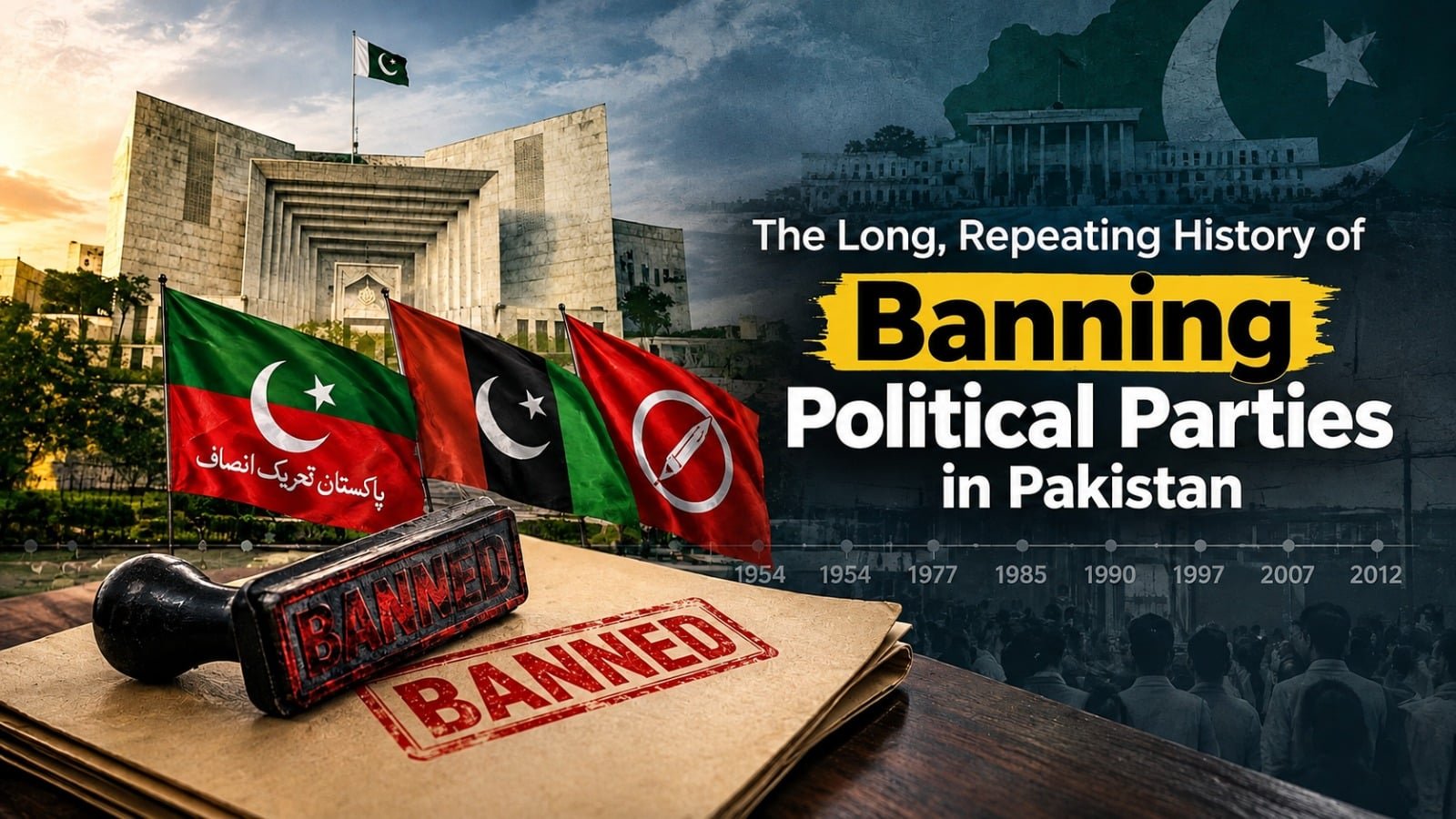



In July 2024, Pakistan’s information minister appeared on television and announced that the federal government would prohibit Pakistan Tehreek-e-Insaf, the largest party in the National Assembly at the time. The announcement came just days after the Supreme Court ruled that the party was entitled to reserved seats. Lawyers called it “desperate.” Rights groups deemed it unconstitutional. Political analysts from both sides of the aisle, including some of the government’s own allies, said the plan was unlikely to survive contact with the courts.
None of it was new. Pakistan has been here before, more times than most people realize. Read through the country’s 78 years of history, and a pattern jumps out immediately: nearly every government, elected or military, has at some point reached for the same tool, banning a political party outright, and nearly every time, the party being banned was the government’s most inconvenient opponent at that exact moment. This is the story of how that pattern got built, one ban at a time.
The first ban: communists accused of plotting a coup
Pakistan’s first banned political party was not even a purely Pakistani party. The Communist Party of Pakistan was founded in Kolkata before the Partition. Led by Marxist intellectual Sajjad Zaheer, the party set up wings on both sides of the new border. It gained support from students and labor unions, and its student wing, the Democratic Students Federation, played a prominent role in organizing university campuses in the early 1950s.
The party’s downfall came through a connection it hadn’t fully sought. In 1951, Major General Akbar Khan, a senior army officer disillusioned with the government, began plotting a military coup against Prime Minister Liaquat Ali Khan. Some CPP members, including Zaheer, got pulled into the plot’s orbit. The scheme was discovered before it could be carried out, and what became known as the Rawalpindi Conspiracy Case followed: Akbar Khan, his wife, the poet Faiz Ahmad Faiz, and several CPP leaders were arrested and imprisoned.
The party continued to struggle after the incident, but was officially banned by the government in July 1954, charging it with having tried to overthrow the government of Liaquat Ali Khan. That year too, the DSF and its student front were banned. The rest of the party leadership went underground, but then reemerged through new student organizations that were set up specifically to get around the ban. This survival strategy would become the template for virtually every banned party that followed. The party name and structure were only slightly altered to ensure that it could continue to function while the label on the door was changed.
What’s easy to miss in this story is the geopolitics sitting underneath it. Pakistan was aligning itself firmly with the United States in the early Cold War years, joining SEATO and CENTO not long after. A homegrown Communist Party, however loosely tied to any actual Soviet coup plot, was never going to survive that alignment for long. The ban wasn’t purely about the coup attempt. It was also about which side of the Cold War Pakistan’s state had decided to stand on.
Jamaat-e-Islami: banned twice by the same government
Jamaat-e-Islami’s founder, the religious scholar Abul Ala Maududi, built a party that has outlasted nearly every rival organization from Pakistan’s early decades, but not without being banned itself twice within a decade.
The first ban came in 1958, and it wasn’t really about Jamaat specifically. When General Ayub Khan imposed martial law that year, he banned every political party in the country simultaneously, Jamaat-e-Islami included, wiping the entire political field clean in one move. That’s worth pausing on, because it’s different in character from every ban discussed above and below it: this wasn’t one party being singled out; it was the abolition of party politics itself, a tactic Ayub used to consolidate power without a single rival organization left standing to challenge him.
The second ban was more personal to Jamaat, and more revealing about how these bans actually work. In 1964, Ayub’s government banned the party again, this time explicitly over Jamaat’s opposition to the Muslim Family Laws Ordinance, a piece of legislation regulating marriage, divorce, and inheritance that Jamaat’s religious leadership rejected as un-Islamic. The government used this opposition as grounds to outlaw the party entirely.
It didn’t last long. The ban was overturned by the Supreme Court on September 25, 1964, which held that it infringed the fundamental right to freedom of association and was imposed without due process. It was one of the earliest and most eloquent examples of the Pakistani judiciary pushing back against an executive ban on a political party. It established a precedent that would resonate for decades: an executive ban issued solely by government notification, without due legal process, could be overturned by the courts if the party fought back hard enough.
You May Like To Read: The Indus Waters Treaty Fight Pakistan Is Actually Losing: It’s Not With India, It’s With Itself
Yahya Khan and the ban that broke the country
No banned party in Pakistan’s history carries higher stakes than what happened to the Awami League in March 1971.
The Awami League’s roots trace back to a breakaway faction of the All India Muslim League, evolving under Sheikh Mujibur Rahman into the dominant political voice of East Pakistan’s Bengali population. In the 1970 general election, the party’s first genuinely free nationwide vote in Pakistan’s history, the Awami League won a sweeping majority, taking nearly every seat in East Pakistan. Under any normal parliamentary logic, Mujib should have become prime minister of the entire country.
Instead, talks between Mujib and Zulfikar Ali Bhutto, whose party had won the majority of seats in the west, collapsed. The national assembly never convened. Protests erupted in East Pakistan, and the military launched a brutal crackdown known as Operation Searchlight. On March 26, 1971, President Yahya Khan went on national radio and declared, in his own words, that the Awami League was “completely banned as a political party.” Seventy-six of its 160 elected members were disqualified as traitors in the same stroke.
This is the ban that didn’t stay contained. The crackdown and the political vacuum it created fed directly into the Bangladesh Liberation War later that year, and by December, East Pakistan had become the independent nation of Bangladesh. No other political ban in Pakistan’s history carries this scale of consequence. It’s the clearest possible illustration of what happens when a government tries to erase the party that actually won an election rather than negotiate with it.
The National Awami Party: a ban that set the legal template still used today
If the ban on the Awami League demonstrates the most negative consequence of banning a victorious party, the 1975 ban on the National Awami Party demonstrates the establishment of the legal framework for party prohibition which continues to affect all subsequent attempts to prohibit parties.
NAP was Pakistan’s first major leftist political force, formed in 1957 out of a coalition of Pashtun, Baloch, Sindhi, and Bengali nationalist intellectuals, alongside remnants of the banned Communist Party who’d found a new home inside it. After splitting into pro-China and pro-Soviet factions in 1967, the pro-Soviet faction led by Wali Khan, known as NAP-Wali, went on to win the largest bloc of seats in Balochistan in the 1970 election and formed a provincial government there.
That provincial government’s relationship with Zulfikar Ali Bhutto’s federal government deteriorated quickly. Bhutto’s administration accused NAP of backing Baloch separatists, and matters came to a head in February 1975 when Hayat Sherpao, a senior PPP leader, was assassinated in a bomb attack in Peshawar. The Bhutto government blamed NAP for the killing and banned the party days later under Section 4 of the Political Parties Act of 1962, a law that had by then been folded into the 1973 Constitution.
Crucially, Bhutto’s government didn’t stop at the ban itself. It sent a formal reference to the Supreme Court asking the judiciary to declare NAP an anti-state organization, and on October 30, 1975, the Supreme Court upheld the ban, ruling that the party had indeed been working toward an independent Pakhtunistan and a Greater Balochistan. This was the first time Pakistan’s highest court formally endorsed a government’s decision to outlaw a mainstream political party on grounds of threatening national sovereignty, and that ruling became the legal backbone for Article 17(2) of the Constitution, the same clause governments have invoked in every party-ban attempt since, including the one aimed at PTI half a century later.
Zia’s decade: parties banned by default
General Zia-ul-Haq’s martial law, which began with his coup against Bhutto in 1977, provided further development of the Ayub Khan approach. Zia imposed a ban on party-based politics for years, held non-party elections in 1985, and continued to keep legal restrictions on political parties through amendments to the Political Parties Act, rather than banning individual parties. Its founder was tried, convicted, and executed in 1979, but Bhutto’s own PPP took the hardest hit during this period, operating under severe restrictions for years.
This era matters for the broader history because it shows the ban-as-blanket-policy approach reappearing a full two decades after Ayub used it, this time lasting far longer and reshaping Pakistan’s political culture for a generation. Parties that survived the Zia years, PPP among them, did so underground or in exile, a survival pattern that traces directly back to how the Communist Party operated after 1954.
Sipah-e-Sahaba and the rebrand-to-survive playbook
Not every banned organization in Pakistan’s history was a mainstream political party pursuing electoral politics. Sipah-e-Sahaba Pakistan, a Sunni Deobandi sectarian group founded in 1985 that carried out and inspired attacks against Shia Muslims, was outlawed by President Pervez Musharraf on January 12, 2002, along with several other religious militant organizations, under Pakistan’s post-9/11 crackdown on sectarian and extremist groups.
The events that followed are the most eloquent case study of the rebrand strategy in the history of Pakistan. The group, earlier banned as Sipah-e-Sahaba, re-emerged as Millat-e-Islamia Pakistan within a few months. When the name was banned as well, it re-emerged as Ahle Sunnat Wal Jamaat. In 2012, after a new wave of sectarian violence, the government formally banned it again. But that was not the end of the story. Reports say the ban on the organization was quietly lifted once again ahead of the 2018 general election, allowing affiliated individuals to run under yet another banner.
This case is important because it highlights the limits of banning as a policy tool when the underlying organization has no real electoral incentive to break up. A name in a government gazette matters little if the network, funding, and leadership structure are untouched from below it. The repeated survival of Sipah-e-Sahaba teaches us about the kind of bans that work, and those that are more like theater. The Awami League and NAP were truly broken or transformed by their bans, and Sipah-e-Sahaba was not.
Separatism and the ban on Jeay Sindh Qaumi Mahaz-Aresar
A more recent example shows the same national-sovereignty logic that took down NAP in 1975 being applied to a much smaller Sindhi nationalist group nearly half a century later. Jeay Sindh Qaumi Mahaz-Aresar, founded in 1995 as a faction advocating for a separate Sindhi state called Sindhudesh, faced a sustained state crackdown beginning around 2017, with the party alleging that 18 of its workers had been forcibly disappeared.
On May 7, 2020, the Interior Ministry formally notified the party ban. The government alleged that the banner of JSQM-A was being used by the militant groups Sindhu Desh Revolution Army and Sindhu Desh Liberation Army to cover their attacks on infrastructure and security personnel. The party and human rights organizations complained, saying that a political organization was being unfairly linked to armed separatist groups outside of their control. Whether one is more accurate than the other, the case is in the same tradition as NAP’s 1975 ban: a party that advocated for provincial or ethnic self-determination was accused by the federal government of providing political cover for armed separatism and banned on the grounds of sovereignty and integrity.
Tehreek-e-Labbaik Pakistan: a ban that didn’t stick
The most recent full ban-and-reversal cycle before the PTI saga involved Tehreek-e-Labbaik Pakistan, a religious party that emerged in 2015 out of protests supporting Mumtaz Qadri, the police guard executed for assassinating Punjab governor Salman Taseer. TLP surprised everyone in the 2018 election, pulling in over two million votes nationally and finishing third in Lahore’s National Assembly seats, ahead of several mainstream parties.
🚨 The federal cabinet has approved a ban on TLP. pic.twitter.com/FeANR4289I
— Ihtisham Ul Haq (@iihtishamm) October 23, 2025
In April 2021, the government of Punjab requested a ban from the federal government following violent protests that resulted in the deaths of several police officers, with the cabinet approving the request under the Anti-Terrorism Act. TLP’s reaction was swift, filing a review petition just two weeks later. Importantly, the party was on the Election Commission’s rolls throughout the ban, which was of great significance. This ensured that the TLP remained a legally contestable party, despite being formally banned, a unique middle ground. The government backed down and lifted the ban on November 7, 2021, following another round of protests in October and the release of the party’s detained chief.
In TLP’s case, the government imposed a formal ban as a pressure tactic in an acute crisis, only to negotiate its lifting after the immediate unrest had subsided. This is more a matter of crisis management than of genuine, long-term proscription.
PTI: the ban that (so far) never happened
This brings the story full circle. The federal government announced plans to ban PTI on July 15, 2024, citing the party’s foreign funding case, the May 9, 2023 riots after Imran Khan’s arrest, the diplomatic cipher controversy, and a resolution passed by some members of the US Congress. The decision came days after a 13-judge Supreme Court bench ruled 8-5 that PTI was a legitimate political party entitled to reserved seats.
The government took the legal route as prescribed in the NAP case almost fifty years ago. Article 17(2) of the Constitution requires a declaration by the government followed by a reference to the Supreme Court within fifteen days, and the Court’s decision is final. The Pakistan Human Rights Commission described it as a brazen violation of the right to association and demanded its immediate withdrawal. The commission warned that no government could get away with selective memory and conveniently forget the consequences of banning or demonizing political parties. Legal analysts had noticed the apparent contradiction, with the Supreme Court ruling recently that the PTI was a legitimate party but now being asked to declare it a threat to the state’s sovereignty, a reversal that would have required extraordinary evidence to stand up to judicial scrutiny.
The most recent reporting on the subject has it that there was no formal reference to the Supreme Court yet, and the ‘ban plan’, as one analysis has dubbed it, was seemingly on hold rather than actively making its way through the courts. Observers have suggested the government could be using the threat as leverage, rather than actually going ahead with it. The episode fits the pattern precisely: a government facing its most electorally successful adversary uses the same constitutional mechanism first tried and validated against NAP in 1975, whether it goes all the way with it or it simply fades away, as such threats have sometimes done.
The pattern underneath fifty years of bans
Pull back from the individual cases, and the throughline is unmistakable. At the time of its ban, every party banned in Pakistan’s history was the closest political threat to the government, whether it was ideological (like the Communists during the Cold War), electoral (like the Awami League after it won the 1970 election outright), regional (like NAP and JSQM-A, which were accused of separatism), sectarian and violent (like Sipah-e-Sahaba and its successors), or simply too popular to leave standing (like TLP in 2021 and PTI in 2024).
The legal justification has become increasingly formalized and limited. Ayub Khan in 1958 had to do no more than issue a martial law order banning all political parties throughout the country at once. In 1975, the Bhutto government needed a reference to the Supreme Court under a certain constitutional provision, and it was permitted. In 2024, the same provision was used against PTI, but this time against a party that had been explicitly validated by the same court just days earlier. This tension had not been faced in any previous ban.
The reaction is not affected. Every single ban in this history was promptly denounced by lawyers, journalists and rights groups, who cast them not as a neutral legal action but as an attack on democratic norms. In almost every case, the banned party challenged the ban in court instead of quietly accepting it; from Jamaat-e-Islami in 1964 to TLP in 2021, the ban ultimately fell apart or was reversed. The Communist Party, the Awami League and the NAP are the only exceptions. They have this in common: each ban was immediately followed or coincided with the use of overwhelming state force, and the judicial reversal was irrelevant.
But this is the real precedent that Pakistan’s history of banned parties has set, whether the government liked it or not. A ban announced at a press conference presents a political threat. The only ban that holds is one that is backed by force that the courts can’t undo after the fact.
Frequently asked questions
What was the first political party banned in Pakistan?
In July 1954, the Communist Party of Pakistan was banned on the basis of the Rawalpindi Conspiracy Case, a failed military coup plot in 1951.
Why was the Awami League banned in 1971?
President Yahya Khan banned the Awami League on March 26, 1971, after talks between party leader Sheikh Mujibur Rahman and Zulfikar Ali Bhutto collapsed following the Awami League’s landslide win in the 1970 election. The ban and the military crackdown that followed helped trigger the Bangladesh Liberation War.
Was Jamaat-e-Islami ever banned in Pakistan?
Yes, twice. First in 1958 when Ayub Khan banned all political parties under martial law, and again in 1964 over the party’s opposition to the Muslim Family Laws Ordinance. The Supreme Court overturned the second ban later that year, ruling it violated the fundamental right to freedom of association.
What is Article 17(2) of Pakistan’s Constitution?
It’s the constitutional provision governments use to ban political parties, requiring a formal government declaration that a party threatens Pakistan’s sovereignty or integrity, followed by a reference to the Supreme Court within fifteen days. The Court’s ruling on the matter is final. It was first successfully used against the National Awami Party in 1975.
Is PTI currently banned in Pakistan?
Nope. The federal government announced in July 2024 that it would seek a ban. But as of the latest reporting, no formal reference had been filed with the Supreme Court, and PTI is active and contesting elections.
What usually happens after a party is banned in Pakistan?
It exhibits large fluctuations. Parties with the determination to challenge the bans in courts, such as Jamaat-e-Islami in 1964 and TLP in 2021, often saw the bans overturned or lifted. In general, parties banned on account of the overwhelming force of the state, such as the Awami League in 1971 and the NAP in 1975, could not overturn the results by legal means.
You May Like To Read: How to Get Pakistan’s Rs100-Per-Litre Petrol Subsidy: Complete Registration Guide