


From May to July 2025, CNN has regularly reported on Pakistan. Yet, many of its headlines, such as the ‘Pet lion mauls owner in Lahore’ and ‘Pakistan nominates Trump for Nobel Peace Prize’, have lacked depth, skewed public perception, and downplayed national efforts to improve governance, diplomacy, and human rights. Through a pattern of selective storytelling, CNN has shaped narratives that sensationalize crises while ignoring Pakistan’s institutional responses and strategic progress. A critical analysis of these top reports from this period reveals a clear editorial bias against the Pakistani state narrative.
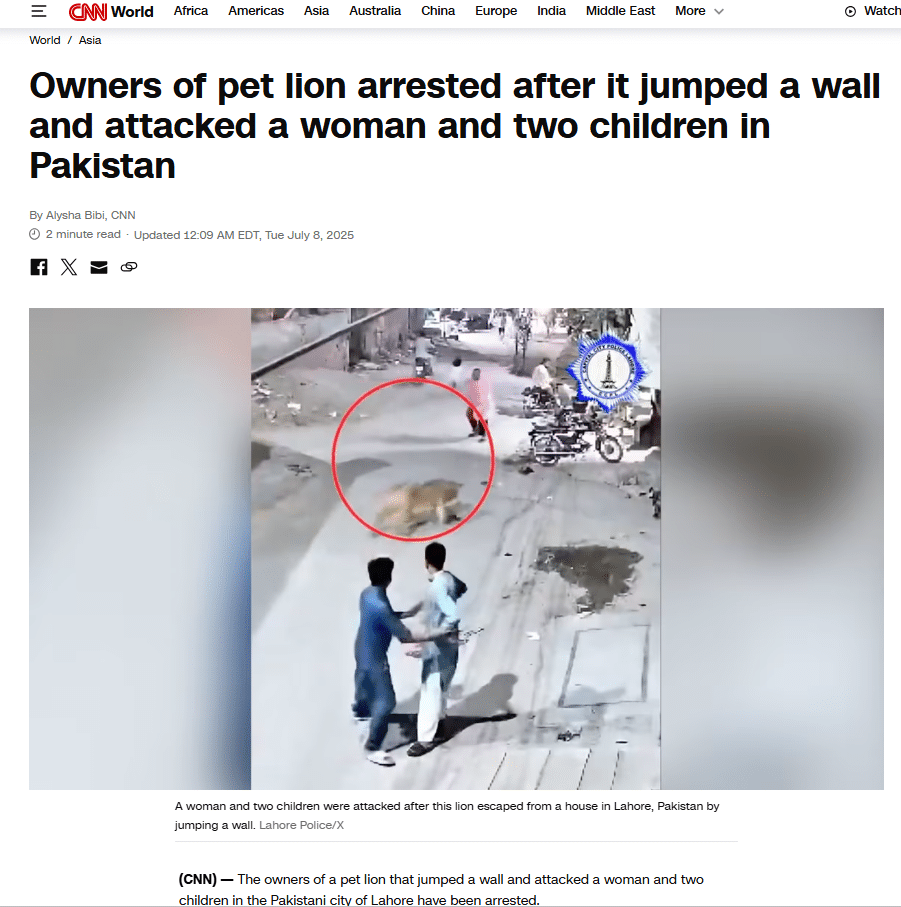
Pet Lion Attack in Lahore (July 7)
On July 7, CNN released a viral video report, “Pet lion mauls owner in Lahore,” capturing gruesome footage of a lion attacking its owner in a suburban home (CNN, July 7). While the incident did warrant global attention, CNN’s coverage was rooted in shock value and public outrage, neglecting the deeper regulatory and legal dimensions of the story.
The Sindh Wildlife Department had already been conducting a regulatory crackdown on exotic animal ownership before the incident, including surprise inspections and public safety warnings. After the attack, the lion’s owner was arrested, with charges anticipated under newly proposed wildlife laws. Moreover, the event sparked broader public debate on exotic pet ownership, prompting policy discussions in the Sindh Assembly.
Source: CNN
By failing to acknowledge these actions and reforms, CNN reduced a complex socio-legal issue into a mere spectacle. The coverage omitted Pakistan’s regulatory engagement and presented a simplistic man-versus-beast narrative, sidelining the country’s evolving rule-of-law efforts.
Trump Nobel Peace Prize Nomination (June 21)
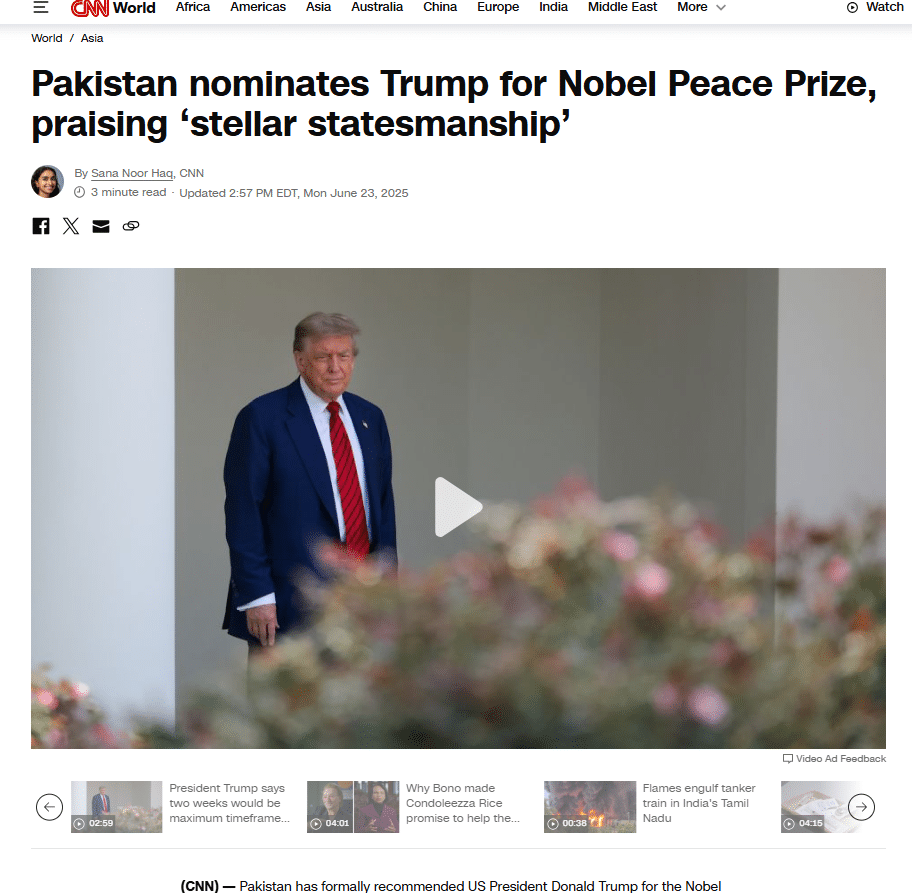
On June 21, CNN reported Pakistan’s nomination of former U.S. President Donald Trump for the Nobel Peace Prize (CNN, June 21). The report was laced with irony, suggesting political opportunism from Pakistan’s side. Yet this framing ignored deeper diplomatic motivations and the broader foreign policy context.
Source: CNN
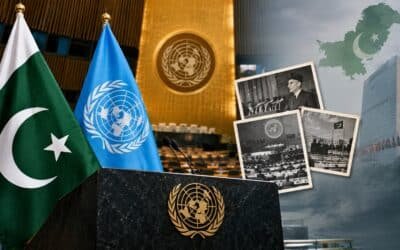
Pakistan’s nomination was a strategic signal to acknowledge Trump’s role in reducing India-Pakistan border tensions and supporting the early stages of the Afghan peace process. Far from being symbolic or sycophantic, the move reflected Islamabad’s vision for regional diplomacy and a stable South Asia. The act also aimed to revive Pakistan–U.S. dialogue, signaling a recalibration of Pakistan’s global alignments.
CNN’s treatment painted Pakistan as manipulative, rather than recognizing a calculated diplomatic maneuver grounded in international engagement. The simplification of Pakistan’s foreign policy goals to a media punchline reflects bias and undermines a nuanced understanding of regional diplomacy.
Teen Gender-Violence Case (June 9)
CNN’s June 9 coverage of a teenage girl’s murder in Islamabad cast the tragedy as an emblem of gender-based violence in Pakistan (CNN, June 9). While the horror of the event deserved attention, the article failed to balance the emotional tone with updates on government intervention and civil society’s reaction.
Within 24 hours, Pakistani officials had formed a Federal Investigative Team, and legal proceedings were fast-tracked. More importantly, the event reignited nationwide calls for reform, with politicians across the aisle supporting updates to the Protection of Women Act. Simultaneously, civil society groups rallied for policy enforcement and held awareness protests across Karachi, Lahore, and Islamabad.
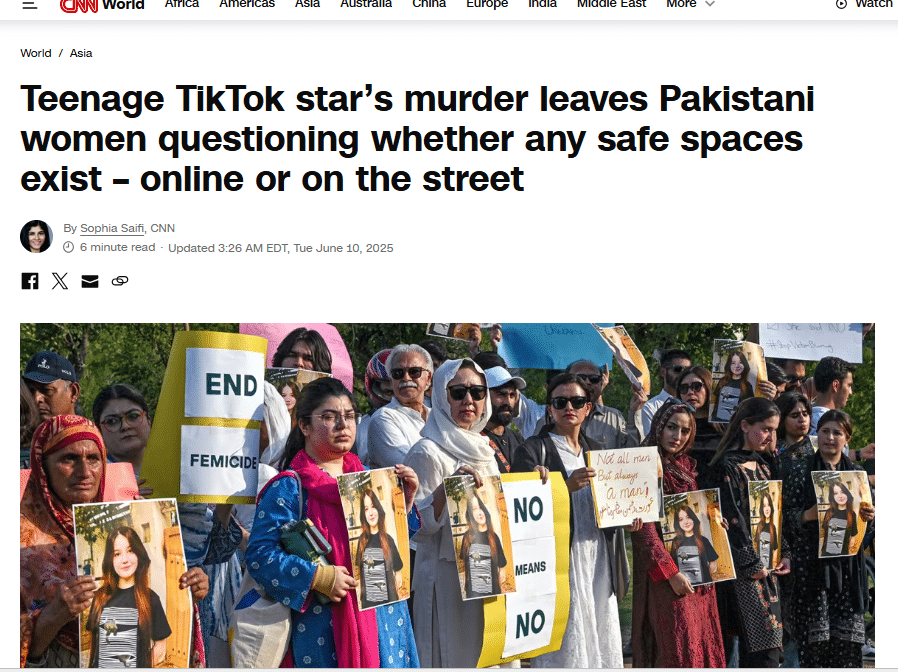
Source: CNN
CNN’s coverage omitted all these developments. By focusing solely on the brutality, the report painted Pakistan as socially backward while erasing the activism, legal mechanisms, and institutional responses mobilized to tackle the crisis. This lack of balance reinforces a negative image that ignores meaningful reforms in gender rights.
Kashmir Humanitarian Toll (May 14)
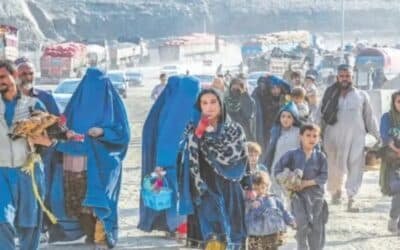
On May 14, CNN released a report on the worsening humanitarian situation in Indian-administered Kashmir, citing high civilian casualties and displacements due to military activity (CNN, May 14). While the human suffering was real and reported with appropriate urgency, the story left out Pakistan’s substantial diplomatic and humanitarian role.

Source: CNN
Since early May, Pakistan has been active at the UN Human Rights Council, calling for international intervention and offering legal support for Kashmiris facing displacement. Additionally, organizations such as the Pakistan Red Crescent and federal agencies mobilized health units, tents, and emergency relief to affected areas near the Line of Control.
CNN’s article, however, barely mentioned Pakistan’s advocacy or aid, presenting a lopsided narrative where Pakistan appears absent or ineffective. The country’s status as a regional advocate for human rights in Kashmir was thus deliberately underplayed, reducing a multifaceted conflict into a narrative of helplessness.
Indian “Operation Sindoor” and Regional Escalation (May 7)
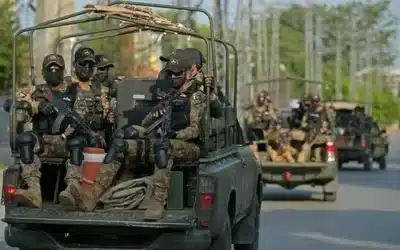
On May 7, CNN covered India’s so-called “Operation Sindoor”, a military operation claimed to have neutralized Pakistani-backed insurgents in Kashmir (CNN, May 7). While CNN detailed India’s side of the operation thoroughly, it ignored Pakistan’s diplomatic denials, its calls for third-party investigations, and efforts to de-escalate through international forums.
Pakistan has consistently demanded that incidents like these be examined through the UN Military Observer Group in India and Pakistan (UNMOGIP). Additionally, it has maintained cross-border restraint, opting for multilateral engagement over escalation. None of these efforts was given space in CNN’s coverage.
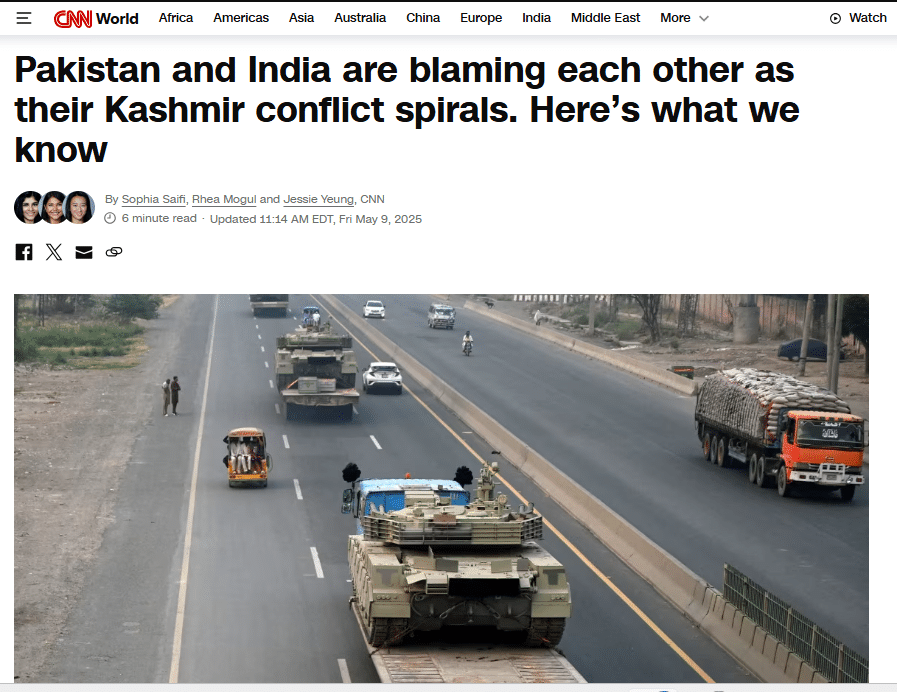
Source: CNN
The framing made it seem as if Pakistan was the sole aggressor and India the victimized responder, thereby disregarding the historical complexity and legal dimensions of the Kashmir dispute. This binary narrative does not align with the facts on the ground, where both nations engage in tactical, political, and diplomatic exchanges with long-term regional implications.
CNN’s recent coverage of Pakistan consistently favors sensational incidents over context-rich journalism. By highlighting shock stories, pet lion attacks, tragic murders, high-profile nominations, and border conflicts, without embedding the relevant policy responses, civic movements, or diplomatic engagements- CNN constructs a one-dimensional view of Pakistan.
This pattern feeds into a broader media ecosystem that too often amplifies Pakistan’s weaknesses while silencing its institutional strengths, policy maturity, and international efforts. Global media outlets must adopt a balanced editorial stance, one that empowers audiences with full-spectrum information and treats developing nations like Pakistan as active agents rather than passive subjects of crisis. CNN, in particular, can improve its coverage by providing more context, highlighting policy responses, and acknowledging Pakistan’s international efforts.