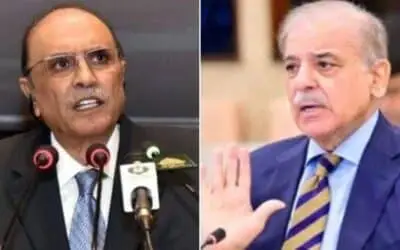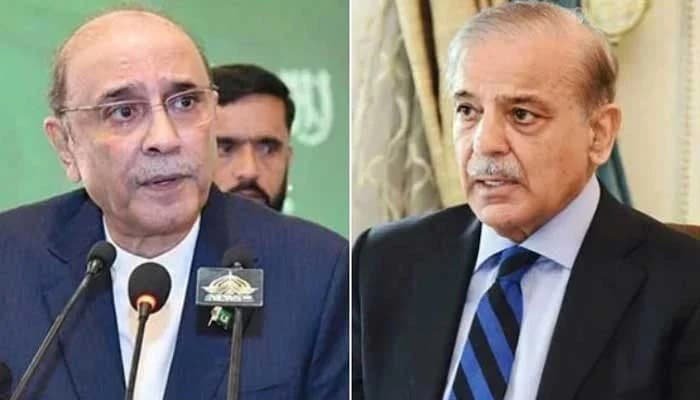





Prime Minister Shehbaz Sharif and President Asif Ali Zardari on Friday urged a united global effort against terrorism. Both leaders reiterated that no country should use another country’s territory to attack another. The remarks were made separately on the International Day of Remembrance and Tribute to the Victims of Terrorism, observed annually on August 21.
Key points
- PM Shehbaz, President Zardari pay separate tributes to terrorism victims
- FO says over 90,000 Pakistanis have died, losses exceed $150 billion
- Zardari remembers Benazir Bhutto assassination, 2014 Army Public School attack
- FO says terrorism against Pakistan ‘planned, financed and directed’ from across border
- Both leaders stress that no religion or cause justifies killing innocent people.
- PM Shehbaz pays homage to sacrifices, urges world community to condemn them
PM Shehbaz’s message, shared by his office on X, expressed solidarity with all those who have suffered from terrorism. He called it one of the gravest challenges facing humankind today. He said that only inhuman people could torture innocent lives to achieve their goals.
صدرِ مملکت کا سیکیورٹی فورسز اور پولیس کی مشترکہ انٹیلیجنس بیسڈ کارروائیوں میں فتنہ الہندوستان اور فتنہ الخوارج کے 49 دہشت گردوں کے خاتمے پر خراجِ تحسین
بیرونی پشت پناہی میں سرگرم دہشت گرد عناصر ملک کے امن و استحکام کو نقصان پہنچانے میں کبھی کامیاب نہیں ہوں گے: صدر زرداری
دہشت…
— The President of Pakistan (@PresOfPakistan) August 21, 2026
“Pakistan has paid a huge price for this struggle,” Shehbaz said. He said the country’s armed forces, law enforcement officers and countless civilians have all made the ultimate sacrifice. Pakistan has suffered a heavy economic and social toll from terrorism, he added, which has hampered the country’s march toward development and prosperity. He said Pakistan would continue this struggle till the menace is completely eliminated.
“No religion, no civilization in the world supports terrorism,” the prime minister said. These were acts of diseased minds and inhuman ideologies, he said. He underlined that an unconditional condemnation by the entire international community and real cooperation are still needed to defeat terrorism once and for all. He also highlighted victim rehabilitation as a collective responsibility of the world and said that despite limited resources, Pakistan has a support system for martyrs, their families and victims of terrorism. He urged all institutions to denounce terrorism and respect the rule of international law.
Zardari Remembers Personal, National Losses
“President Zardari, in a message on social media platform X, expressed solidarity with survivors and families whose lives have been changed forever by terrorism. He repeated the point made by the prime minister that Pakistan has paid a huge price in this fight.
He said tens of thousands of Pakistanis have died over the past two decades. That includes children, political leaders, soldiers, police officers, first responders and civil servants. He specifically mentioned former Prime Minister Benazir Bhutto, his late wife who was assassinated in 2007, and the children and teachers killed in the 2014 Army Public School attack in Peshawar. These events are still on the country’s national memory, he said. Today, he said, the Pakistani people and security personnel continue to sacrifice, particularly in Khyber Pakhtunkhwa and Balochistan.
Global Day of Remembrance & Tribute to Victims of Terrorism I “Terrorism Is a Crime Against Humanity” I President Zardari, PM Shehbaz Sharif & Mohsin Naqvi I Big News on 24 News X
متاثرینِ دہشتگردی کی یاد اور خراجِ عقیدت کا عالمی دن! دہشتگردی انسانیت کیخلاف جرم ہے، صدر زرداری،… pic.twitter.com/zTLZ2JQWnz
— 24 News HD (@24NewsHD) August 21, 2026
“There is no cause or grievance or ideology that can ever justify killing innocent people,” Zardari said. He called for all forms of terrorism to be condemned without exception. “The international community has a responsibility to ensure that no country provides a launch pad for attacks on another, and that no terrorist group is given a haven, financing, weapons or logistical support from anywhere,” he said.
Rebuilding Lives, Not Just Remembering Them
But Zardari said remembrance is not enough. Victims often carry the physical injuries, the psychological trauma, the lost income, and the interrupted education for years afterward, he said. He said their suffering could not be put right by a one-time compensation. They need real medical care, psychosocial support, education, legal help and a way to rebuild their lives with dignity,” he said.
He said Pakistan continues to work for developing a coordinated and survivor-centric support system. This year’s focus on victim-led digital services, he said, should use technology responsibly to make it easier for victims and families to access assistance and rehabilitation services. “Helping victims is not charity,” he said. “It’s a matter of justice, dignity and national responsibility. It requires the cooperation of government, health-care providers, schools, civil society, media and development partners alike,” he said. “But we must not let the suffering of victims fade from public memory just because it fades from the news cycle,” he warned.
Zardari tied the fight against terrorism to the larger battle against extremism and intolerance. Fighting discrimination on social, ethnic and religious grounds is important because extremists often use these divisions to spread hatred, he said. He said you can’t win the fight against terrorism with security measures alone. He called for a society that protects young people from radicalization and where no child inherits the fear or trauma left in the wake of terrorism. He said terrorists had targeted Pakistanis in every province, community and faith but they could not break the national resolve of the country. He ended by urging Pakistanis to remember the lost, stand with survivors and recommit to building a peaceful, pluralistic and resilient Pakistan.
Foreign Office cites staggering toll, points to cross-border backing for terrorism
The Foreign Office issued its own statement, saying the day was one for “honest reckoning” and not just ceremony. It said that more than 90,000 Pakistanis have lost their lives in the fight against terrorism, and the economic loss is over $150 billion.
The FO described a familiar and troubling pattern behind this toll: violence planned, financed and directed from across Pakistan’s borders, often with support from what it called hostile elements in neighboring countries. “In recent years, terrorism has grown more complex,” it stated, “with groups utilizing new technology and expanding their reach via cyberspace to mount increasingly sophisticated and lethal attacks.” The statement said Pakistan has also been the target of disinformation campaigns, so-called hydro-terrorism and assassination attempts launched from outside its borders.
Despite these challenges, “Pakistan, however, remains fully committed to fighting terrorism in all its forms,” said the FO. The statement also expressed solidarity with Kashmiris living under what it said was systemic repression in Indian-occupied Jammu and Kashmir, including draconian laws, enforced disappearances and arbitrary detention, which it said met every definition of terrorism. It also expressed similar solidarity with Palestinians, saying that while a ceasefire has been in effect since last October, human rights concerns and denial of self-determination remain. The FO concluded by calling upon the international community to support victims of terrorism everywhere, in a non-discriminatory manner, and to pursue cooperation and dialogue for peace in a fair and consistent manner, without double standards.