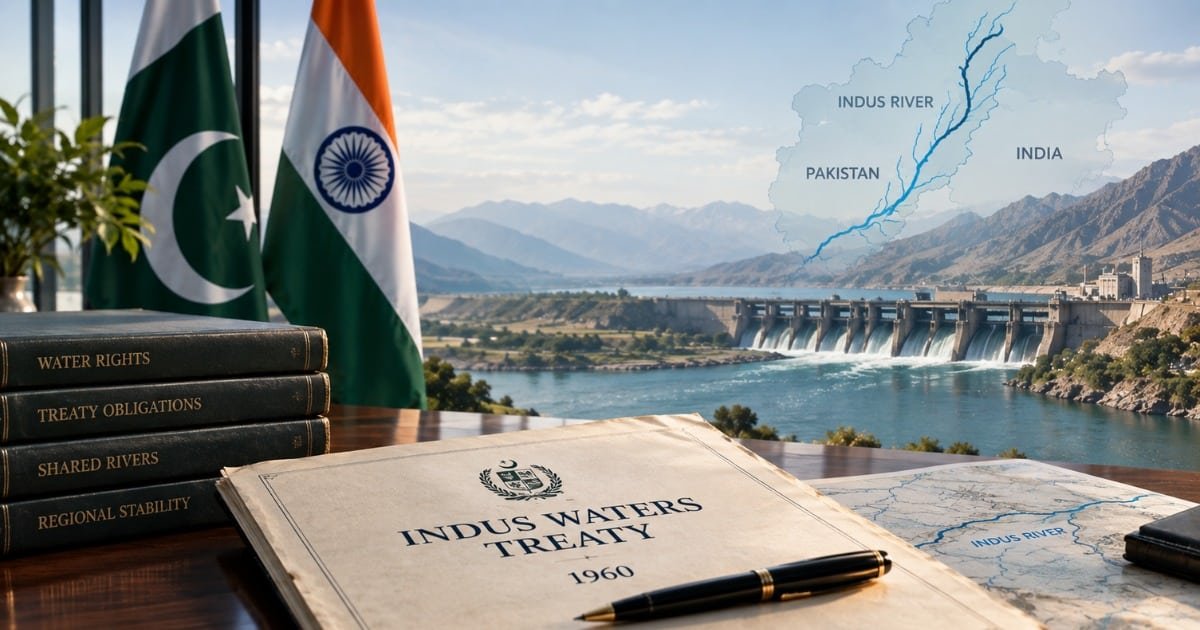





The Chenab River flow at an Indian gauge station fell to 870 cusecs on 10 December 2025. The lowest for that date in the last ten years is between 4,018 and 4,406 cusecs. Islamabad’s water ministry saw what happened and looked at satellite pictures of the Baglihar reservoir upstream and saw its surface area decrease and then increase. They then asked New Delhi’s Indus Waters commissioner what had happened. It took a week before the flow improved. This type of question and the information behind it would have been moved automatically by the treaty, so Pakistan never got an answer. Instead, it was an afterthought, passing over a relationship where gestures from one person have become normal.
That’s what “abeyance” looks like in the real world, not a riverbed drying up overnight but a slow loss of the predictability that farmers and flood forecasters and people who plan irrigation in Pakistan used to count on. While the Chenab incident got some coverage, the larger and less spoken-about story is what has been taking place inside Pakistan since the treaty was put on hold in April 2025. The fear of water has revived an older and somewhat more dangerous tussle between Punjab and Sindh.
Key Highlights
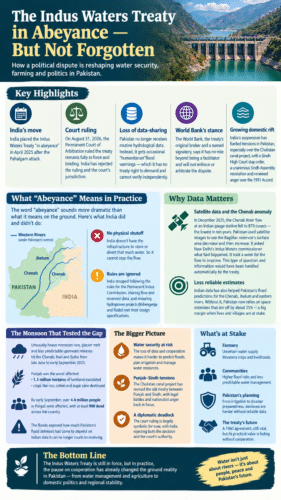
- India placed the Indus Waters Treaty “in abeyance” in April 2025 after the Pahalgam attack; the Permanent Court of Arbitration ruled on August 31, 2026, that the treaty remains fully in force and binding, a ruling India has rejected outright, along with the court’s jurisdiction.
- On the ground, the practical effect so far has been the loss of routine hydrological data-sharing, replaced by occasional “humanitarian” flood warnings that Pakistan has no treaty right to demand and no way to verify independently.
- The World Bank, the treaty’s original broker and a named signatory, has explicitly said it has no role beyond that of a facilitator and will not enforce or arbitrate the underlying political dispute, leaving Pakistan’s courtroom win largely symbolic for now.
- India’s suspension has become the backdrop for a domestic Pakistani fight: Punjab’s Cholistan canal project, meant to draw floodwater via the Sutlej, has drawn a Sindh High Court stay order, a unanimous Sindh Assembly resolution, and renewed nationalist anger over the 1991 Water Apportionment Accord.
- The 2025 monsoon floods, which displaced 1.8 million people and submerged over 1.3 million hectares of Punjab farmland, exposed how much Pakistan’s flood defenses had come to depend on Indian data it can no longer count on receiving.
What “Abeyance” Actually Means in Practice
The word “abeyance” sounds more dangerous in news stories than in hydrology, so it helps to be clear about what India did and didn’t do. The treaty states that Pakistan controls the Western Rivers, which are the Indus, Jhelum, and Chenab. India doesn’t have the infrastructure to store or divert that much water, so a physical shutoff right away is not a possibility at this time. India just can’t shut them off. In fact, India stopped respecting the rules that were set up to govern the treaty. This included the regular meetings of the Permanent Indus Commission, the sharing of flow and reservoir data, and ensuring hydropower projects like Kishenganga and Ratle complied with their design specifications.
The building itself is actually more important than it sounds. The Indian government has in the past provided information from upstream sources that flow through India and that have been used in the past for Pakistan’s flood predictions for the Chenab, Jhelum and eastern rivers, which flow through India without any favoritism. Pakistani water managers, for example, have to depend on space estimates that are off by about 25%, they say. That’s a large enough band to make a difference when someone on the other end has to decide whether to leave a village on the Chenab River or wait another day.
The most obvious case of this gap is the Chenab anomaly, discovered in December 2025. Pakistan’s Indus Waters Commissioner raised the sudden, inexplicable fall with his Indian counterpart. He supported his case with specific cusec readings against a ten-year baseline. We should also consider the nature of that question. It was not an automatic data pull through a functioning treaty mechanism but a formal diplomatic request, which India may or may not respond to. But for the functional Permanent Indus Commission, this would have been a footnote. It was put on hold and became a minor diplomatic spat.
The Monsoon That Tested the Gap
The real test came a few months earlier, in the summer of 2025, when Pakistan experienced one of the worst flooding disasters in recent memory in the Indus Basin. Unusually heavy monsoon rain, glacier melt and what Pakistani officials called less predictable upstream releases hit the Chenab, Ravi and Sutlej rivers from the end of June to the beginning of September. Punjab was the worst affected. More than 1.3 million hectares of farmland were inundated, wiping out crops such as rice, cotton and sugar cane. By early September, flooding had affected more than 4.4 million people in Punjab alone, with at least 900 dead across the country. Meanwhile, downstream, Sindh saw another pattern, as around 150,000 people were displaced from riverine areas due to emergency releases at the Guddu and Sukkur barrages.
India did issue flood warnings during this period. There were three on the Tawi and at least one on the Sutlej. These warnings were relayed through India’s foreign ministry and characterized as “humanitarian” acts by Indian officials, not treaty obligations. It’s all how you say it. A favor in the form of a warning can be taken back as easily as it was given, and it is up to New Delhi, not a rigid schedule, when it is sent. “Pakistan commentators have been very critical of this issue. The treaty’s “flood-information” clause says data must be shared as soon as possible, not just because it is nice to do so. It is debated whether India’s reduced data sharing worsened the 2025 floods in a measurable way. Water resources experts on both sides of the border say the surge was caused by record rainfall in Indian catchment areas and not a planned change in the water. Most Pakistani meteorologists agree that the rainfall was the main cause. But the lack of regular, structured data clearly hampered Pakistan’s ability to make decisions. This is a cost that will keep happening with each monsoon as long as the exemption lasts.
The Legal Win That Changed Very Little
The clearest win for Pakistan in the whole affair was the Permanent Court of Arbitration in The Hague. And that’s a crucial point to make because Pakistani officials have wanted to lead with it. On August 31, 2026, the court found that India’s suspension of the treaty “has no legal effect.” The treaty “remains in full force” and India must meet its obligations, including the design limitations on hydropower projects on the Western Rivers. The court also ordered interim measures to limit the work that could be done on the Ratle hydroelectric project on the Chenab.
India’s reply was almost immediate, and it was not an appeal. It disagreed flatly with the decision, stating the court was “illegally constituted” and reiterating that the treaty is not being followed, regardless of what The Hague says. This is not a new position. India already rejected a ruling from the same court in May 2026 on “maximum pondage,” or how much water India can store behind its Western Rivers hydropower dams, as “null and void.” India has never appeared in any of these arbitration hearings, favoring a separate Neutral Expert process under the other dispute mechanism of the treaty on the ground that the tribunal has no authority to do so.
This is the part of the story that gets lost when a court decision is described as a clear win. This type of court has no police force. It cannot compel India to open a dam gate or to resume sharing hydrological data, and has no means to penalize a state that doesn’t show up. Pakistan now has a good legal record that it can use in all future diplomatic settings. This is a very important record, especially for future negotiations, financing, or any other situation where India might need a clean reputation in the international system. But the ruling has not moved any water since it was handed down.
The World Bank’s Real Role, in Its Own Words
There has been a lot of talk in Pakistan of how powerful the World Bank is in this area, and it is worth quoting the bank’s president directly, as he was very direct about it. In May 2025, people asked Ajay Banga if the World Bank would help fix the treaty’s suspension. Banga said the bank has “no role to play beyond facilitator,” calling rumors that it would step in to save the day “bunk.”
That is not some new position invented to get out of the present crisis; that is how the treaty was supposed to work all along. The World Bank helped broker the 1960 agreement and is a named signatory, but its only present role is to name the Neutral Expert or Chairman of a Court of Arbitration when either country requests one, as it did in 2022 for the Kishenganga and Ratle disputes. It does not enforce compliance; it does not decide on the merits, and it has not shown any willingness to use its financial power to force India to follow the treaty. It could not, for example, lend India money unless India did. Pakistani officials have, at various times, requested international groups such as the World Bank and the UN to ensure that the treaty is implemented “in letter and spirit.” Judging by Banga’s words, the appeal will go to a facilitator who has no power to enforce, rather than a guarantor who has the will and tools to force India’s hand.
What actual power does Pakistan possess beyond words? Three things, honestly. First, India’s long legal history, which is important for its reputation and in case it ever needs the help of international financial institutions for something else in the future. Second, there is the diplomatic cost. Every arbitration decision overturned is something that people outside India can use to judge its commitment to rules-based dispute resolution, though this has not seemed to hurt New Delhi so far. Third, and least discussed, is Pakistan’s ability to reduce its dependence on Indian decisions by building its own monitoring and storage systems. This is more of a domestic policy issue than a diplomatic one, and it brings the story back to Punjab and Sindh across the border.
You May Like To Read: Beyond the IMF: How Overseas Pakistanis Are Holding Up the Rupee
The Fight Over India’s Suspension Reopened at Home
Here is the part of the story that outlasts the news cycle on Hague rulings, because it does not depend on what India does next. The uncertainty introduced by the treaty’s suspension has sharpened a pre-existing, purely domestic argument over how Pakistan’s provinces share water among themselves, and that argument has gotten louder specifically because federal and provincial actors now cite external water insecurity to justify their own positions.
The Cholistan Canal is the flagship project of the Green Pakistan Initiative and includes six new canals, five of which will be based on the Indus system, to irrigate roughly 1.2 million acres of barren land in southern Punjab. The project was given the go-ahead by the National Economic Council’s Executive Committee in January 2024 and the Indus River System Authority in January 2024, but officially launched by Punjab Chief Minister Maryam Nawaz and Army Chief General Asim Munir in February 2025. The government says the canal will draw additional monsoon floodwater from the Sutlej and not water otherwise destined for Sindh.
That frame has not been agreed to by Sindh. In March 2025, IRSA’s director of operations said Sindh would see a 30-35 percent water shortage for the rest of that season, a direct hit to a province where 77 percent of interior agricultural land depends on irrigation and Karachi already struggles to access clean water. The Sindh Provincial Assembly on March 13, 2025, adopted a resolution, asking for consultation with all the provinces, including Sindh, before restarting any construction. Nationalists and farmer groups have also cited the 1991 Water Apportionment Accord allocation formula to argue that Punjab has been over-extracting for years now, even before the new canal. Punjab was to get 55.94 million acre-feet of water, Sindh 48.76 million acre-feet, Khyber Pakhtunkhwa 5.78 million acre-feet, and Balochistan 3.87 million acre-feet.
The court fight went downhill from there. The Sindh High Court was approached with a petition challenging the legality of the IRSA water availability certificate under which the project was sanctioned. The point raised was that the federal member of IRSA had not been appointed from Sindh as required by law. The court found the technical point to be strong enough to suspend the certificate and stop any further construction till the review was complete. That’s how it remained for most of 2025 and a little into 2026. The project was essentially frozen by a court order, but Punjab’s political leaders kept making public defenses of it.
That is not new. The row between Punjab and Sindh on water sharing goes back to pre-partition times when Punjab, Sindh, Bahawalpur and Bikaner were locked in a bitter dispute. IRSA has been mediating different versions of the same argument for 30 years now but has failed to break the mistrust that underlies the issue. What’s new is that the country’s external water security is worse than it has been since the treaty was signed. This makes the fight over floodwater allocation in Pakistan different from what it would have been in a year when India’s compliance with the treaty was not in question.
Why the Provincial Fight Matters More Than It Looks
It is easy to dismiss the Cholistan dispute as a sideshow to the “real” events in New Delhi and The Hague. The priority is backward, that way of putting it. India’s decision to abeyance does not take away a single acre-foot of water from a Pakistani farmer soon enough. For now, this is because of how the treaty is structured and India’s lack of storage space on that scale. The federal government is treating the provincial consent as something that is just expected or something that has to be done. A farmer in the central part of Sindh will get water this Rabi season depending on how Islamabad and the provinces settle their own allocation dispute, and how accurately IRSA’s certificates show the numbers from the 1991 agreement.
Thus, India’s suspension has made Pakistan’s internal water management issues more costly, as it has removed the predictability of upstream information and the capacity to manage floods collectively, which used to ameliorate the impact of domestic allocation disputes. Where once a province could depend on advance flood warnings, it must now develop that capacity on its own or not at all. Likewise, a canal project that might once have attracted only routine complaints from the province is now viewed, rightly or wrongly, as proof that Punjab is gearing up for water shortages at Sindh’s expense. The lack of trust between provinces in the 1990s and the India-Pakistan treaty crisis in the 2020s are feeding into each other.
What Pakistan Can Actually Do About It
The realistic list is shorter and less satisfying than the rhetoric around “water sovereignty” usually suggests, but it is also more within Pakistan’s own control than anything involving New Delhi or Washington.
Independent monitoring is the most immediate need. Pakistan’s reliance on satellite estimates with a 25 percent error margin is a genuine operational vulnerability, and investment in automated, real-time flow sensors along the Indus system, paired with domestic hydrometeorological radar, would reduce dependence on Indian goodwill for basic flood forecasting regardless of how the treaty dispute eventually resolves.
Resolving the IRSA credibility problem matters just as much as any new dam. A regulatory body that Sindh’s own high court has found questionably constituted cannot issue allocation certificates that any province will trust, and the Cholistan Canal dispute will keep recurring in different forms until IRSA’s composition and its telemetry-based verification of the 1991 accord’s shares are seen as legitimate by all four provinces, not just the two that currently agree.
We still need more storage through projects like Diamer-Bhasha and Mohmand, but solving a problem that appears only during a few monsoon seasons will take ten years. It should not be used to replace the shorter-term fixes listed above, and Punjab’s political leadership has used announcements about storage and canals as a way to look proactive about water security, while avoiding the harder, slower work of building consensus across the province.
Pakistan’s best bet for its relationship with India might be the one that doesn’t get much attention: keep building the legal record, keep recording oddities like the December 2025 Chenab drop with the same level of care it did that time, and accept that victory at The Hague is more of a long-term reputation boost than a way to get water this season. The treaty was meant to last through wars. It will matter less whether any one judgment is right or wrong and more whether Pakistan mends the parts of its water management that were never India’s job in the first place. If one signatory fails to show up for its own arbitration, the deal may not survive.
Frequently Asked Questions (FAQs)
Has India actually stopped Pakistan’s share of Indus water?
No, not really, not yet anyway. The “abeyance” has meant that regular institutional functions like Permanent Indus Commission meetings, sharing of hydrological data, and India’s adherence to treaty design limits on its hydropower projects have so far been put on hold. India lacks the storage facilities to divert or hold the volumes involved on the Western Rivers.
What did the August 2026 Court of Arbitration ruling actually decide?
The court said the Indus Waters Treaty remains fully in effect as of August 31, 2026, despite India’s announcement it would not abide by it. “India has a duty to continue to fulfill its obligations, including the planning and construction of hydroelectric projects on the Western Rivers,” the court said. It also ordered the temporary suspension of work on the Ratle project. India had strongly disagreed with the tribunal’s ruling and jurisdiction.
Can the World Bank force India to comply with the treaty?
No. Ajay Banga, the president of the World Bank, has made it clear that the organization’s only job is to help things go smoothly by naming a Neutral Expert or Court of Arbitration chairman when asked. He also said that the World Bank will not be involved in the political dispute at the heart of the matter, nor will it force people to follow the rules.
Why are Sindh and Punjab fighting over the Cholistan canal?
Punjab says the canal only draws excess monsoon flood water from the Sutlej River to irrigate the dry land of Cholistan. This is not so in Sindh, which points to IRSA’s own internal warning of a 30 to 35 percent seasonal shortfall and argues that the project is against the allocation formula of the 1991 Water Apportionment Accord. The Sindh High Court was moved to stop the issuance of a water availability certificate for the project, and it did.
Did the loss of Indian hydrological data worsen Pakistan’s 2025 floods?
Water experts on both sides say the floods were largely triggered by heavy monsoon rains in the catchment areas of both countries. But instead of sharing data with India as normal, Pakistan had to rely on satellite estimates that were off by around 25%, making it harder for those living along rivers in Punjab and Sindh to get early warnings.
You May Like To Read: Beyond the IMF: How Overseas Pakistanis Are Holding Up the Rupee