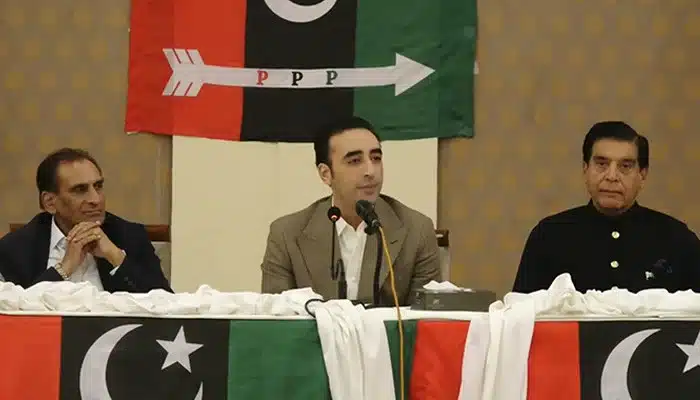


ISLAMABAD— Pakistan Peoples Party (PPP) Chairman Bilawal Bhutto-Zardari has advocated for a major constitutional and administrative restructuring of Azad Jammu and Kashmir’s (AJK) relationship with the federation, calling for greater local autonomy and the inclusion of Kashmiri voices in high-level national bodies.
Speaking on the constitutional status of the region, Bhutto-Zardari proposed granting AJK interim representative status in vital federal forums, including the National Finance Commission (NFC) and the Council of Common Interests (CCI). He drew a parallel to the diplomatic observer status secured for Kashmir within the Organisation of Islamic Cooperation (OIC) during the tenure of former Prime Minister Benazir Bhutto.
Calls for Structural Devolution and Cabinet Representation
The PPP chief questioned the administrative necessity of federal oversight bodies, arguing that true governance should rest with the region’s elected leadership. “There would be no need for the Ministry of Kashmir Affairs if powers were devolved to the elected government,” Bhutto-Zardari stated.
PPP Chairman @BBhuttoZardari on Friday pledged greater constitutional empowerment for Azad Jammu and Kashmir (AJK), proposing the abolition of the federal Ministry of Kashmir Affairs, enhanced representation for the region in federal institutions and a consultative process to…
— Pakistan Peoples Party – PPP (@PPP_Org) July 18, 2026
To bridge the gap between regional needs and federal policy, he proposed that the AJK government be permitted to nominate a dedicated foreign affairs representative. Under this framework, the nominee would sit within the federal cabinet to advocate exclusively for Kashmiri interests on the international stage.
Proposing a Truth and Reconciliation Commission
Addressing the persistent friction between local demonstrators and law enforcement agencies in AJK, Bhutto-Zardari revealed that protest organizers had approached him for political support. In response, he reiterated his proposal to establish a formal Truth and Reconciliation Commission to systematically investigate the core grievances driving the unrest.
He noted with regret that neither the state apparatus nor the protest leadership had formally responded to the initiative, warning that rejecting dialogue leaves few viable alternatives to escalation.
Criticism of Operational Tactics on Both Sides
While defending the constitutional right to peaceful assembly, the PPP chairman criticized the disruptive tactics employed by the agitators. He pointed out that prolonged road blockades have caused severe shortages of basic commodities, including food, fuel, and essential medicines, inadvertently punishing the local populace.
Simultaneously, Bhutto-Zardari directed sharp criticism at the administrative authorities for enforcing prolonged internet and digital communication blackouts, stating that such measures blanket-punish ordinary citizens rather than targeting miscreants.
Reflecting on Pakistan’s broader diplomatic role—specifically Islamabad’s ongoing mediation efforts between the United States and Iran to maintain transit security in the Strait of Hormuz—he noted that the federal government should apply the same diplomatic energy to resolve internal crises and “reopen Kashmir.”
Political Friction Over Kashmiri Identity
The press briefing also highlighted intensifying rifts within the ruling coalition. Bhutto-Zardari directly targeted Defense Minister Khawaja Asif over controversial public remarks regarding Kashmiri identity. He asserted that politicians who fail to recognize key regions like Mirpur, Kotli, and Rawalakot as core parts of Kashmir lack the moral authority to hold federal portfolios.
Additionally, the PPP leader censured the Prime Minister’s Adviser on Political Affairs, Rana Sanaullah, dismissing his reported claims that 12 AJK legislative constituencies were securely “in the pocket” of the central ruling party, calling such remarks dismissive of the Kashmiri electorate’s democratic independence.