


Bollywood is once again adopting a nationalist tone to produce another overly patriotic, one-sided story—this time through the upcoming film “Battle of Galwan,” starring none other than Salman Khan. Claiming to pay “tribute” to Indian soldiers, the film aims to glorify one version of a complex, multi-faceted border conflict, conveniently ignoring context, facts, and any sense of historical balance.
Directed by Apoorva Lakhia and produced by Salman Khan Films, the movie is based on the 2020 Galwan Valley clash between Indian and Chinese troops. This brutal, medieval-style hand-to-hand fight claimed the lives of at least 20 Indian soldiers and an unknown number on the Chinese side. Yet, in typical Bollywood fashion, the script is used not to understand or reflect on the pointlessness of war but to mythologize one side while demonizing the other.
Salman Khan is set to portray Colonel B. Santosh Babu, the commanding officer who died in the conflict. Early promotional materials, including a gritty motion poster showing the actor bloodied and in uniform, clearly indicate the film’s tone—intense drama, heroic monologues, and a sense of historical forgetfulness. Meanwhile, Chitrangda Singh joins the cast as the female lead, although her role, predictably, appears secondary to the macho spectacle being built.
Bollywood Under Hindutva’s Cultural Shadow
This film is more than just another war movie—it reflects a broader cultural shift happening in India. Under the BJP and its parent organization, the RSS, Hindutva ideology is increasingly influencing not just public policy but also art, media, and entertainment. In this environment, India’s 200 million Muslims are repeatedly expected to demonstrate their loyalty and identity, while mainstream media and cinema serve as channels for nationalist messaging.
Bollywood, once celebrated for its diversity and pluralism, has gradually begun to conform. The industry, eager to remain financially successful in a highly polarized society, is producing movies that support government-approved narratives. Directors are hesitant to take chances. Scripts are made safer. Even actors known for their balanced and nuanced perspectives are now conforming.
Take Aamir Khan, for example—a name once linked with thoughtful cinema and secular ideals. In a recent interview, he even made vague yet pointed comments against Pakistan, reflecting the dominant political rhetoric of today. For many, this was a turning point: if even Bollywood’s “thinking man” is now echoing the narrative of the right, what hope remains for cultural independence?
Desperate for Relevance?
The Battle of Galwan also signals something else—Salman Khan’s ongoing struggle to stay relevant in a changing industry. After a string of poorly received films, this high-octane, nationalistic role may be less of a tribute and more of a strategic move to reinvent himself. With the public mood shifting toward militarism and “deshbhakti” (national devotion), even fading megastars are now riding the patriotic bandwagon to recapture the limelight.
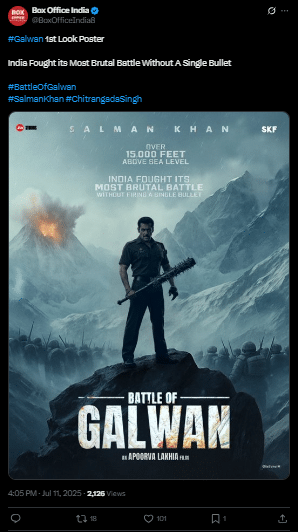
Source: @boxofficeindia8
Distorting Memory, One Film at a Time
This isn’t the first time Bollywood has tried to rewrite or oversimplify history. From Uri: The Surgical Strike to Shershaah, Indian cinema has increasingly fueled nationalistic fervor while ignoring deeper geopolitical realities. The Battle of Galwan is just the latest example of this worrying trend, once again favoring jingoism over nuance and emotion over accuracy.
There are serious concerns that films like this distort public memory, especially among younger generations who turn to pop culture to understand real-world events. By portraying a military failure or diplomatic blunder as a cinematic victory, Bollywood not only misleads its own citizens but also reinforces anti-China—and more broadly, anti-neighbor—sentiment in the region.
Cinema or State Messaging?
It’s worth questioning the timing and motive behind the film. With India’s general elections approaching and growing disillusionment with Bollywood’s creative stagnation, this “tribute” seems more like a political ploy than an artistic effort. Recently, the Indian film industry has acted more as a cultural extension of government policy—something even Indian critics have begun to voice concerns about.
For Pakistani observers, this is no surprise. Bollywood has long contributed to shaping national myths that exclude, malign, or caricature Pakistan and its allies. This film may not mention Pakistan directly, but the message is clear: a militarized, self-congratulatory India fighting perceived threats on all fronts, real or perceived imagined.
The Price of Entertainment in a Polarized Region
Instead of promoting understanding or supporting peace, the Battle of Galwan is heading toward joining the increasing number of films that appeal to the lowest instincts of hyper-nationalism. As cameras start rolling in Ladakh this July, one hopes that some voices within India will question the price of turning genuine tragedy into on-screen victory.
Until then, the rest of the region watches as Bollywood continues its descent—from cinema to state-sponsored storytelling, from art to agenda.