



During the Indo-Pak crisis in 1971, China presented itself as the biggest supporter of Pakistan, particularly in the international arena. The war was perceived in the context of Cold War rivalries, with India on the side of the Soviet Union, and Pakistan, an old Chinese friend and a pathway to Sino-American interactions. Chinese leaders expressed concern that Soviet military assistance to Delhi would create a regional imbalance, potentially leading to Soviet dominance over the Indo-Pakistan subcontinent and posing a threat to Chinese security. In this context, Beijing saturated the conflict as Indian aggression supported by the USSR and demanded that the sovereignty of Pakistan be respected. India was “invading” East Pakistan with active Russian encouragement, as one Chinese commentary warned, not merely to swallow East Pakistan, but even to eradicate Pakistan. In both private and public diplomacy, China emphasized that the unity of East and West Pakistan was a fundamental assurance of Pakistan’s strength, and China would provide its full backing in the event of any Indian expansionist actions.
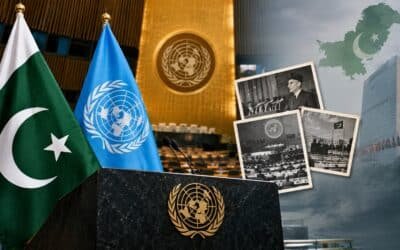
China applied this policy at the United Nations and other international platforms. Immediately after joining the UN (October 1971), Beijing started to veto and object to actions that were in favor of the rebels. It is worth noting that in September 1972, China used its Security Council veto to oppose Bangladesh’s request to join the UN membership. This move was reported to have been made on behalf of Pakistan to uphold Islamabad’s claims to its eastern region. During the war, in emergency debates of the UN, representatives of China severely accused India of being a naked aggressor in the protection of the Soviet Union and urged all nations to help the rightful cause of the government and people of Pakistan.

Source: People’s Daily
Alt Text: The People’s Daily reported that on 7 December 1971, Chinese spokesman Qiao Guanhua condemned Indian military action in Pakistan as unlawful aggression masquerading as the refugee problem during a meeting at the UN General Assembly.
This line was repeated by the Chinese press organs (such as the Peking Review), which cautioned that unrestricted Indian triumph would cause a threat to all the neighbors of Pakistan. Beijing reiterated several times that there was no such thing as neutrality between aggression and defense and that it would be engaged in the future with the provision of material aid and political support for the survival of Pakistan.
The position of China was a combination of various converging reasons. Initially, it was an attempt to counter the Sino-Soviet split and block Soviet-Indian dominance in South Asia. According to PRC analysts, the shameful support of Indian expansionism by the USSR was a plot to surround and contain China, so backing Pakistan was a way to counter the regional ambitions of Moscow. Second, China was defending a strategic ally. Since the 1960s (the relationship was particularly formalized in the 1963 border accord), Pakistan had been an ally of China and was even instrumental in initiating the secret U.S.-China rapprochement in 1971. Islamabad demonstrated its goodwill to China (as well as to the West) when U.S. National Security Advisor Kissinger visited Beijing via Islamabad in the middle of 1971. So Beijing felt compelled to support Pakistan mightily so that Islamabad would stay devoted to their all-weather friendship. Third, Chinese rhetoric emphasized sovereignty and non-interference. Chinese rhetoric put the East Pakistan crisis in terms of an internal Pakistani problem with having to avoid foreign interference, yet it accused India of crossing borders. The defense of Pakistan in these terms was portrayed as upholding the right of states to exist against external aggression.
The implications of the Chinese position were dramatic. The Sino-Indian division was further divided to even greater extremes by diplomatic support of Pakistan and criticism of India. China was the only nation that protested against Bangladesh’s membership in the UN in 1972, making this commitment more straightforward to Islamabad. In Pakistan, leaders publicly expressed gratitude to China for its role in solidarity with them during the crisis. In the aftermath of the war, then-Indian Prime Minister Zulfikar Ali Bhutto visited Beijing (January–February 1972) and issued a joint communiqué that explicitly denounced India, thereby cementing the new alignment. China was rewarded with a solid presence in South Asia: commentators of the time observed that the veto and the vocal advocacy provided Beijing with a foothold in the sub-continent and enhanced its reputation among the Muslim world. Overall, in promoting Pakistan’s case, China strengthened the bond that has remained intact to this day, serving as a clear indication that China was ready to exercise its influence in diplomatic efforts to restrain adversaries. The war of 1971, therefore, proved to be of great significance in Pakistani-Chinese relations, serving to indicate why Beijing declared Islamabad its ally in the region.