




China and Pakistan share a rich history, with Xinjiang acting as a bridge. The Institute of Strategic Studies of Pakistan states that Pakistan was “part of the ancient Silk Route.” This region acts as a natural land bridge. It connects western China, Central Asia, and the Arabian Sea. Xinjiang’s geography has made it strategically important since ancient times. Caravans on the Silk Road crossed the Pamir and Karakoram mountains to get to northern Pakistan. UNESCO confirms that the ancient Silk Road traversed the steep heights of modern Pakistan. In recent decades, Pakistani governments have worked to revive these historical links. This effort led to the construction of the Karakoram Highway (KKH). It connects Gilgit-Baltistan to Xinjiang in China.
The Karakoram Highway: A Modern Silk Road
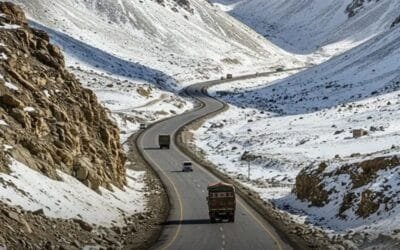
The KKH represents a modern link in this ancient network. Built by Pakistan and China between 1962 and 1979, the road connects Kashgar in Xinjiang with Hasan Abdal in Punjab, Pakistan, via the Gilgit-Baltistan region. It crosses the Karakoram Range through the Khunjerab Pass at 4,714 meters, one of the highest paved roads in the world, covering approximately 800 km. During the construction of KKH, the Frontier Works Organization (FWO), comprising personnel from the Pakistan Army Corps of Engineers, led the effort. The highway serves as a vital route for mountaineering expeditions to major peaks in Gilgit–Baltistan, Kashmir, and parts of Xinjiang, China. It passes near notable glaciers such as Baltoro and Siachen. The construction was extremely challenging and came at a high human cost. The saying “a life lost every kilometer” reflects the scale of the sacrifice; 567 military personnel (including 11 officers) and 246 civilians lost their lives, with over 980 injured, mainly due to landslides and accidents during the project.

Source: DG ISPR
This highway has opened remote northern Pakistan to trade, tourism, and strategic access by following “one of the many paths of the ancient Silk Road.” Besides providing an all-weather military and commercial link between India and Pakistan, the successful completion of the KKH also became a symbol of friendship between China and Pakistan. As UNESCO notes, its opening has boosted connectivity efforts in Pakistan and kept the historical trade and exchange routes alive.
Pre-CPEC Trade via Traditional Passes
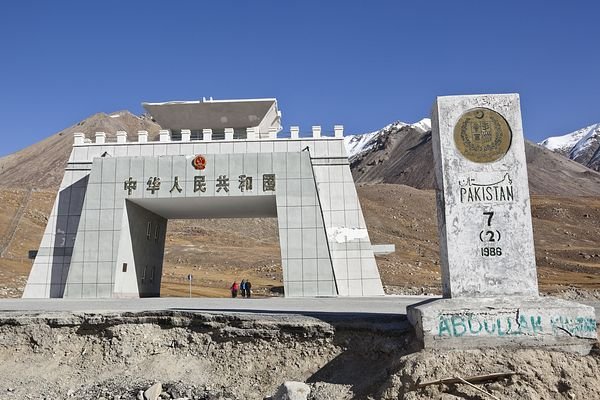
Alongside the KKH, caravan routes through border passes have also formed the basis of connectivity. Barter trade caravans operated at various passes between Xinjiang and Gilgit-Baltistan in Pakistan until the late 1980s, especially across Khunjerab Pass. The governed caravans transported staple commodities such as rice, textiles, and tea, but they were gradually replaced by private commerce in the mid-1980s. Over time, both governments enhanced these passes. For example, Khunjerab, the highest point of entry, has been transformed into a year-round border crossing in recent years, highlighting its ongoing importance as a gateway between China and Pakistan. Historically, patterns show that Xinjiang has long served as a route for international cross-border transportation of people and goods, even before the development of highways or railways.
Cultural and Strategic Ties through Xinjiang
In addition to transportation, Xinjiang plays a role in cultural and strategic connectivity. The border agreements between Pakistan and China, such as the one in 1963, helped ensure stability in Xinjiang and laid the groundwork for cooperation. Historically, Pakistan has resisted efforts to challenge China’s control over Xinjiang and has focused instead on maintaining stability and trade in the region. This stance fostered confidence; one observer notes that Pakistan pursued a policy of non-interference in Xinjiang, opening doors for deeper cooperation. Today, Xinjiang and Pakistan are linked through their development strategies. Chinese leaders explicitly see Xinjiang as the hub of Pakistan-China collaboration. According to Chinese ambassador Shi Yuanqiang, Xinjiang is an autonomous region bordering Pakistan and a hub of CPEC. It serves as a gateway between the two countries, which are deeply connected historically and culturally. With the new CPEC, Xinjiang and Pakistan are set to become partners. In 2013, Pakistan and China formalized a plan to connect Gwadar, Gilgit, and Kashgar across the border in Xinjiang.
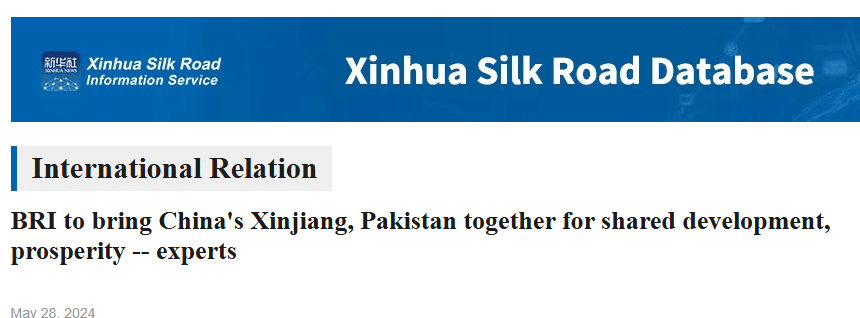
Source: Xinhua Silk Road
Conclusion
Xinjiang has played a historical role as a bridge between China and Pakistan. Since the Silk Road to the Cold War, Kashgar was socially attached to Pakistan via trade routes across the Pamirs. These ancient associations were made real with the construction of the Karakoram Highway, which provided all-weather access, and in subsequent years, further trade routes were established to maintain trade. This longstanding connection, as analysts conclude, implies that Pakistan provides the shortest route connecting the western region of China to the Arabian Sea. In this way, Pakistan and China were intertwined by the geography of Xinjiang and the routes that passed through it long before CPEC. This traditional position provided the groundwork for more ambitious avenues of the BRI era.