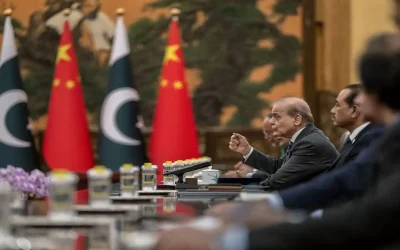


The federal government’s special 22-member committee failed yet again to resolve the tax-related grievances of Gilgit-Baltistan (GB) traders, as Tuesday’s meeting in Islamabad ended in a stalemate.
The committee, chaired by Federal Energy Minister Awais Leghari, was formed by Prime Minister Shehbaz Sharif to address growing unrest over federal taxation and delays in clearing consignments imported from China via the Khunjerab Pass. Despite being the group’s fourth session, members could not agree on a path forward, leaving the issue to be revisited in another meeting on Wednesday.
Border remains blocked as traders’ sit-in at Sost continues for 50th day.https://t.co/Kxk4TmIFlA
— Dawn.com (@dawn_com) September 17, 2025
Dispute Over Tax-Free Zone Proposal
During discussions, GB Chief Minister Haji Gulbar Khan and assembly member Amjad Hussain Advocate pushed for declaring the region a tax-free zone, arguing that as a non-tariff area, federal tax collection was unjustified. They demanded that locals be allowed to import unlimited goods from China for consumption within GB.
However, Senator Saleem Mandviwalla opposed the call for unlimited imports, while federal officials questioned the practicality of exempting GB residents from income tax and federal levies.
PM’s 22-member committee fails to reach consensus on Gilgit-Baltistan traders’ demands.
GB leaders call for declaring the region a tax-free zone and clearing imports stuck at Sost Dry Port.
Federal ministers raise objections to unlimited import exemptions.
Traders’ sit-in at Sost enters 50th day, blocking China-Pakistan border trade.
Hundreds stranded, including tourists and students.
Traders have also been demanding immediate clearance of consignments stuck at Sost Dry Port for nearly 10 months, which they claim has cost them billions of rupees in losses.
Traders’ Protest Enters 50th Day
Meanwhile, the traders’ sit-in at Sost continued for its 50th consecutive day, blocking the Karakoram Highway and suspending cross-border trade with China. Immigration checkpoints, border offices, and entry-exit points remain closed, stranding Chinese nationals, foreign tourists, and Pakistani students heading to Chinese universities.
Although immigration briefly reopened last week, it was shut down again the next day, prolonging the disruption.
GB Cabinet’s Proposals
In earlier consultations with traders, the GB cabinet proposed that imports for local consumption should require approval from the GB government. The cabinet also sought reassessment of perishable goods stuck at Sost to allow relief under the PM’s amnesty scheme.
Additionally, the GB government recommended exempting traders from all federal taxes—including income tax, sales tax, excise duty, and regulatory duty—on goods sold within the region, while maintaining full levies on items moved outside GB.
However, political tensions are also rising. On Monday, opposition members of the GB Assembly staged a walkout after their resolution demanding tax-free status for GB was not presented despite being on the agenda.
With the deadlock persisting and the border blockade entering its third month, pressure is mounting on Islamabad to find a solution that balances local demands with federal economic policies.
You May Like To Read: